Radish Seed
- Chinese
- 莱菔子
- Pinyin
- Lai Fu Zi
- Latin
- Semen Raphani
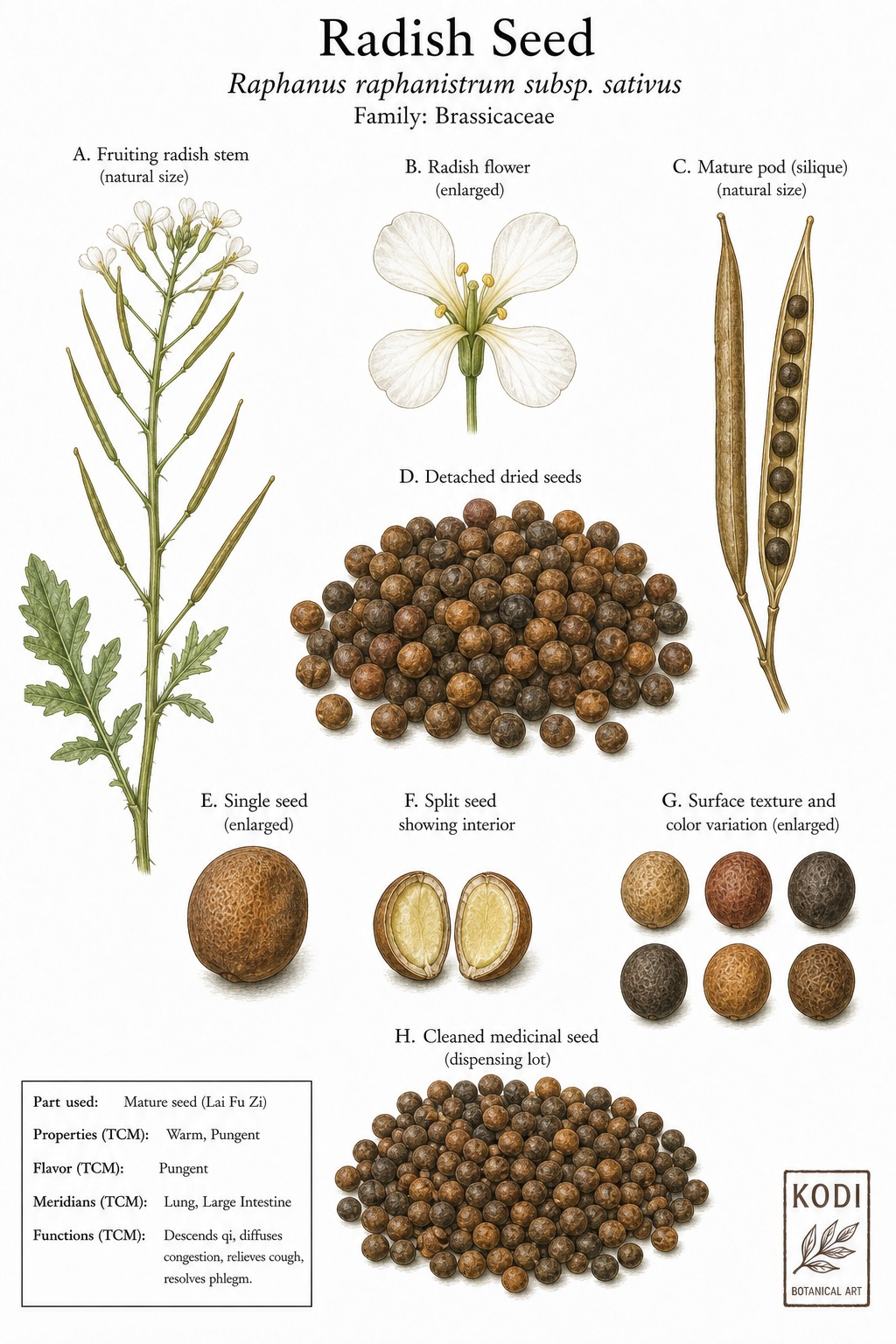
Known in TCM as Lai Fu Zi (莱菔子), this acrid and sweet, neutral herb enters the Lung, Spleen, and Stomach. Traditionally, it reduces food stagnation and relieves distension ... Lai Fu Zi is a classic seed herb for bloating, belching, foul food retention, and fullness after overeating or poor transformation, most often applied for abdominal distension, poor appetite, and productive cough. Modern research has identified Glucosinolates among its active constituents.
Part used: Seed
Also Known As
Latin: Semen Raphani | Pinyin: Lai Fu Zi | Chinese: 莱菔子
TCM Properties
- Taste
- acrid, sweet
- Temperature
- neutral
- Channels
- Lung, Spleen, Stomach
Traditional Use
Primary Actions
- Reduces food stagnation and relieves distension ... Lai Fu Zi is a classic seed herb for bloating, belching, foul food retention, and fullness after overeating or poor transformation.
- Directs rebellious qi downward and transforms phlegm ... it treats cough, wheezing, chest oppression, and phlegm obstruction when digestive stagnation and Lung qi rebellion coexist.
- Assists bowel movement in obstructive accumulation patterns ... when retained food and qi stagnation bind the middle, Lai Fu Zi can help move both stool and gas.
Secondary Actions
- Raw Lai Fu Zi is stronger for descending qi and transforming phlegm, while stir-fried seed is often preferred when the focus is food stagnation and middle-burner obstruction.
- Traditional teaching warns that Lai Fu Zi can reduce the tonifying effect of rich qi tonics, so it is used to break accumulation rather than to build a depleted constitution.
Classic Formulas
- Bao He Wan ... classic food-stagnation formula that illustrates Lai Fu Zi's ability to reduce retained food and move qi.
- San Zi Yang Qin Tang ... hallmark use of Lai Fu Zi with other seeds to descend qi, transform phlegm, and ease wheezing.
- Digestant combinations with Shan Zha or Shen Qu ... common strategy when severe post-prandial fullness and foul stagnation dominate the presentation.
Classical References
- Traditional materia medica describes Lai Fu Zi as acrid, sweet, and neutral, entering the Lung, Spleen, and Stomach to reduce food stagnation and direct qi downward.
- The herb is especially valued when digestive obstruction and phlegm-wheezing appear together, because it treats the retained food root and the respiratory branch at once.
Modern Research
Active Compounds
- Glucosinolates such as glucoraphasatin ... major sulfur-containing seed constituents
- Sulforaphene and related isothiocyanates ... bioactive breakdown products tied to antimicrobial and metabolic research
- Sinapine thiocyanate and fatty oils ... traditional seed constituents relevant to digestion and pharmacology
Studied Effects
- A 2013 review summarized the phytochemistry and pharmacological activities of Raphani Semen and noted reported activity in hypertension, obesity, diabetes, constipation, and cough research (PMID 23935670).
- A 2022 comprehensive review of the dried seeds of Raphanus sativus covered traditional use, processing-related transformation, and pharmacology, reinforcing why raw and processed Lai Fu Zi are kept distinct in practice (PMID 35580770).
- Modern research therefore supports digestive, metabolic, and respiratory relevance for the seed, although most studies remain preclinical or quality-control focused rather than definitive clinical trials.
PubMed References
Safety & Interactions
Contraindications
- Spleen and Stomach deficiency without food stagnation or phlegm accumulation
- Chronic weakness where downward-dispersing seed herbs aggravate depletion
Cautions
- Because Lai Fu Zi strongly reduces stagnation, it is used cautiously alongside rich qi-tonifying strategies that are meant to build rather than disperse.
- Very large doses may loosen the bowels or aggravate weak digestion in sensitive patients.
Conditions
- Abdominal Distension Traditional ★★★★☆ JSON
- Poor Appetite Traditional ★★★☆☆ JSON
- Productive Cough Traditional ★★★☆☆ JSON
- Wheezing Traditional ★★★☆☆ JSON
- Constipation Traditional ★★☆☆☆ JSON
Frequently Asked Questions
What is Radish Seed used for?
Radish Seed is traditionally used to Reduces food stagnation and relieves distension ... Lai Fu Zi is a classic seed herb for bloating, belching, foul food retention, and fullness after overeating or poor transformation., Directs rebellious qi downward and transforms phlegm ... it treats cough, wheezing, chest oppression, and phlegm obstruction when digestive stagnation and Lung qi rebellion coexist., Assists bowel movement in obstructive accumulation patterns ... when retained food and qi stagnation bind the middle, Lai Fu Zi can help move both stool and gas.. Research has investigated its effects on: A 2013 review summarized the phytochemistry and pharmacological activities of Raphani Semen and noted reported activity in hypertension, obesity, diabetes, constipation, and cough research (PMID 23935670).; A 2022 comprehensive review of the dried seeds of Raphanus sativus covered traditional use, processing-related transformation, and pharmacology, reinforcing why raw and processed Lai Fu Zi are kept distinct in practice (PMID 35580770)..
What are other names for Radish Seed?
Radish Seed is also known as Raphani, Raphani Semen, Radish Fruit Seed. In TCM: 莱菔子 (Lai Fu Zi); Semen Raphani.
Is Radish Seed safe during pregnancy?
The safety of Radish Seed during pregnancy has not been established. Consult a qualified healthcare provider before use.
What are the contraindications for Radish Seed?
Radish Seed should not be used in: Spleen and Stomach deficiency without food stagnation or phlegm accumulation; Chronic weakness where downward-dispersing seed herbs aggravate depletion. Consult a qualified healthcare provider before use.