Radde Anemone Rhizome
- Chinese
- 两头尖
- Pinyin
- Liang Tou Jian
- Latin
- Rhizoma Anemones Raddeanae
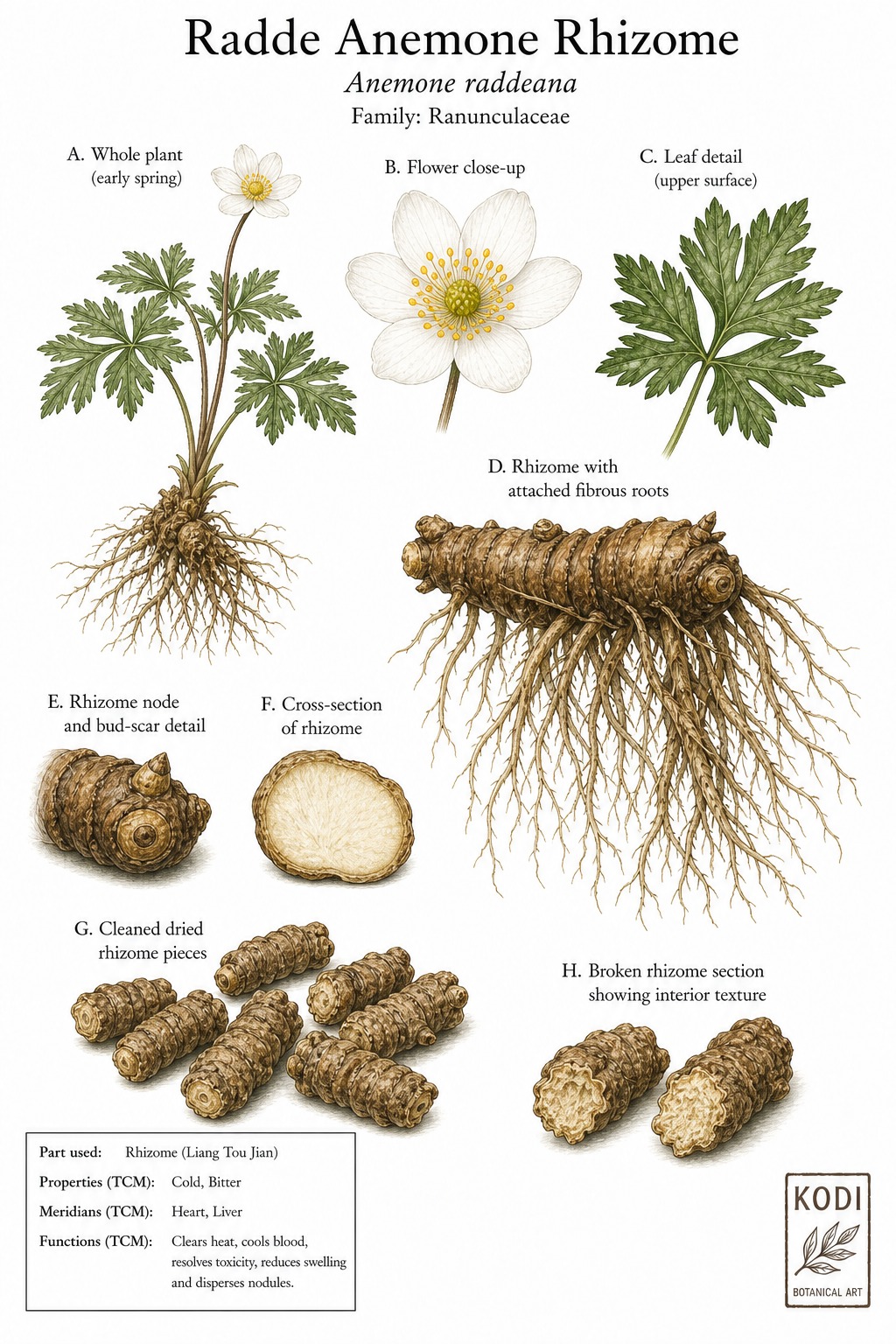
Known in TCM as Liang Tou Jian (两头尖), this pungent, hot herb enters the Spleen. Traditionally, it dispels wind-damp and unblocks the collaterals ... Liang Tou Jian is used for rheumatic pain, cold-damp obstruction, and stubborn aching of the limbs and joints, most often applied for rheumatism, joint pain, and abscess. Modern research has identified Raddeanin among its active constituents.
Part used: Rhizome
Also Known As
Latin: Rhizoma Anemones Raddeanae | Pinyin: Liang Tou Jian | Chinese: 两头尖
TCM Properties
- Taste
- pungent
- Temperature
- hot
- Channels
- Spleen
Traditional Use
Primary Actions
- Dispels wind-damp and unblocks the collaterals ... Liang Tou Jian is used for rheumatic pain, cold-damp obstruction, and stubborn aching of the limbs and joints.
- Relieves pain and reduces swelling ... older use includes neuralgia, fixed painful swellings, and traumatic or obstructive pain with a hard, resistant quality.
- Resolves toxic swellings ... folk application extends to boils, carbuncles, and inflamed lesions where a hot toxic rhizome was used to break stubborn accumulation.
Secondary Actions
- Later trade and folk sources may call the same Anemone raddeana material Zhu Jie Xiang Fu ... this page keeps the classical Liang Tou Jian naming lane and leaves the later sibling page room to be more trade-rhizome-forward.
- The herb is hot and toxic, and modern interest in its triterpenoid saponins does not remove the need for conservative dosing and strong safety framing.
Classic Formulas
- Wind-damp pain combinations pair Liang Tou Jian with Qin Jiao or Wei Ling Xian when cold obstruction and pain are the dominant pattern.
- Swelling and pain patterns combine it with Ru Xiang or Mo Yao when the goal is to reduce fixed painful accumulations.
- Toxic-swelling folk combinations pair it with Jin Yin Hua or Pu Gong Ying when hot swollen lesions are prominent.
Classical References
- Traditional herb sources describe Liang Tou Jian as pungent, hot, and toxic, used mainly for wind-damp pain and swelling.
- Modern summaries of Anemone raddeana preserve the old Northeast-China use for rheumatism, neuralgia, arthritis, and skin infection rather than treating it as a broad tonic herb.
Modern Research
Active Compounds
- Raddeanin A and related triterpenoid saponins ... the best-known modern constituents
- Oleanane-type pentacyclic triterpenoids ... a major structural family in Anemone raddeana rhizome
- Lupeol, betulin, and betulinic acid derivatives ... supportive anti-inflammatory and cytotoxic fractions
Studied Effects
- A 2018 review summarized the chemistry and pharmacological effects of Anemone raddeana rhizome and confirmed its long-standing use for neuralgia and rheumatism (PMID 28986812).
- A 2018 analytical study profiled cytotoxic triterpenoids in the rhizomes of Anemone raddeana, underscoring how strongly the modern literature focuses on saponin chemistry and antitumor potential (PMID 29976404).
- A 2020 cell-based study reported anti-breast-cancer activity alongside toxicity observations for total secondary saponins from Anemone raddeana rhizome, reinforcing both pharmacologic interest and the need for caution (PMID 32446927).
PubMed References
- Review of Anemone raddeana Rhizome and its pharmacological effects. (2018)
- Quantitative and qualitative analyses of cytotoxic triterpenoids in the rhizomes of Anemone raddeana using HPLC and HPLC-ESI-Q/TOF-MS. (2018)
- Anti-breast cancer and toxicity studies of total secondary saponin from Anemone raddeana Rhizome on MCF-7 cells via ROS generation and PI3K/AKT/mTOR inactivation. (2020)
Safety & Interactions
Contraindications
- Pregnancy
- Yin-deficient heat patterns
- Weak constitution with gastrointestinal irritation or poor tolerance for hot toxic herbs
Cautions
- Liang Tou Jian is traditionally classed as toxic and should not be treated as a casual daily anti-inflammatory or antitumor supplement.
- Modern cytotoxic and saponin-rich literature may explain pharmacologic activity, but it also strengthens the case for supervision rather than self-treatment.
Conditions
- Rheumatism Traditional ★★★☆☆ JSON
- Joint Pain Traditional ★★★☆☆ JSON
- Abscess Traditional ★★☆☆☆ JSON
- Traumatic Injury Traditional ★★☆☆☆ JSON
Frequently Asked Questions
What is Radde Anemone Rhizome used for?
Radde Anemone Rhizome is traditionally used to Dispels wind-damp and unblocks the collaterals ... Liang Tou Jian is used for rheumatic pain, cold-damp obstruction, and stubborn aching of the limbs and joints., Relieves pain and reduces swelling ... older use includes neuralgia, fixed painful swellings, and traumatic or obstructive pain with a hard, resistant quality., Resolves toxic swellings ... folk application extends to boils, carbuncles, and inflamed lesions where a hot toxic rhizome was used to break stubborn accumulation.. Research has investigated its effects on: A 2018 review summarized the chemistry and pharmacological effects of Anemone raddeana rhizome and confirmed its long-standing use for neuralgia and rheumatism (PMID 28986812).; A 2018 analytical study profiled cytotoxic triterpenoids in the rhizomes of Anemone raddeana, underscoring how strongly the modern literature focuses on saponin chemistry and antitumor potential (PMID 29976404)..
What are other names for Radde Anemone Rhizome?
Radde Anemone Rhizome is also known as Anemone Rhizome, Anemone raddeana, Liangtoujian. In TCM: 两头尖 (Liang Tou Jian); Rhizoma Anemones Raddeanae.
Is Radde Anemone Rhizome safe during pregnancy?
Radde Anemone Rhizome is not recommended during pregnancy.
What are the contraindications for Radde Anemone Rhizome?
Radde Anemone Rhizome should not be used in: Pregnancy; Yin-deficient heat patterns; Weak constitution with gastrointestinal irritation or poor tolerance for hot toxic herbs. Consult a qualified healthcare provider before use.