Purpleflower Holly Leaf
- Chinese
- 四季青
- Pinyin
- Si Ji Qing
- Latin
- Ilicis Chinensis Folium
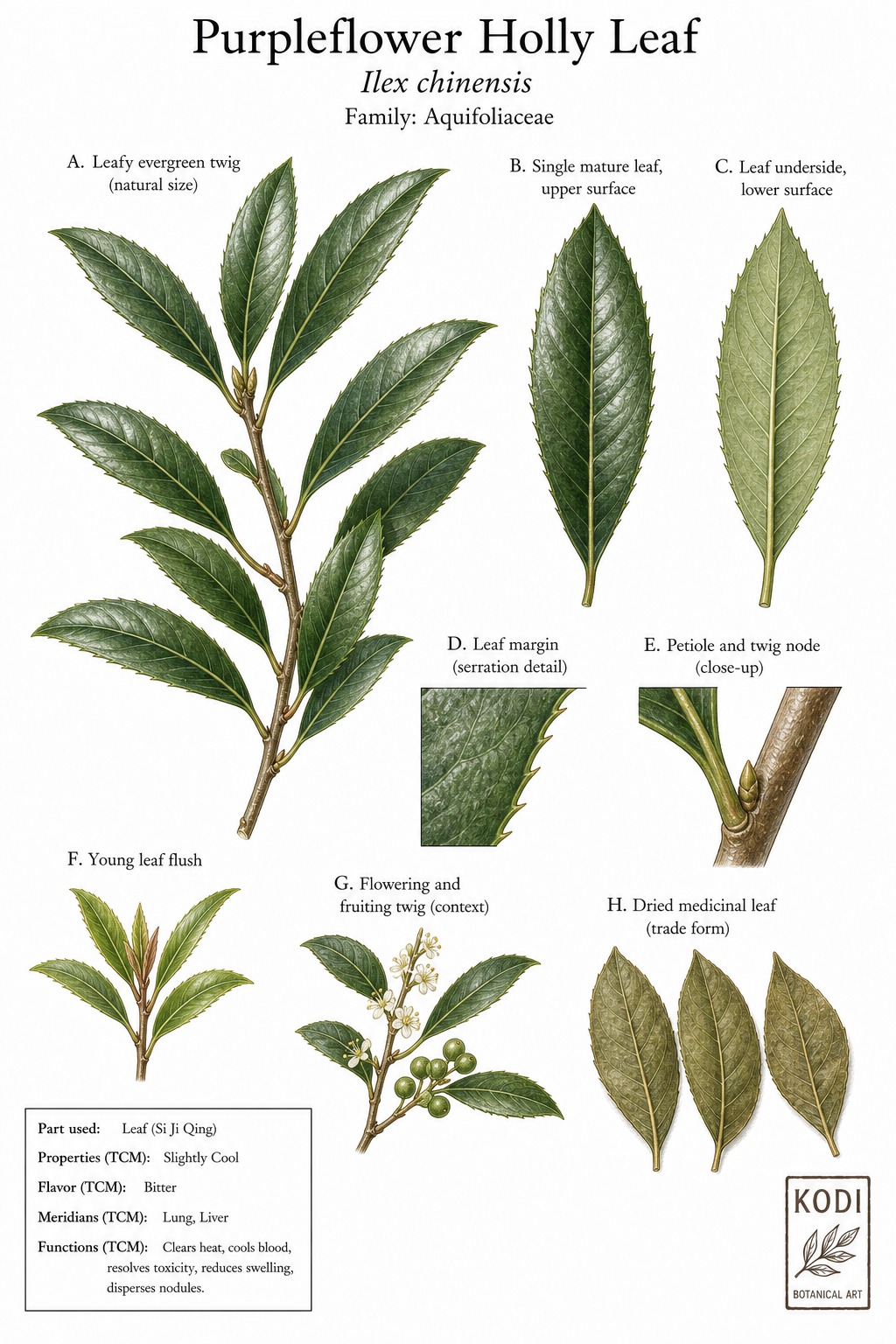
Known in TCM as Si Ji Qing (四季青), this bitter and astringent, cold herb enters the Bladder, Large Intestine, and Lung. Traditionally, it clears heat and resolves toxin ... Si Ji Qing is used for Lung heat cough, sore throat, dysentery, infected sores, and ulcerative lesions, most often applied for cough, sore throat, and urinary tract infection. Modern research has identified Pedunculoside among its active constituents.
Also Known As
Latin: Ilicis Chinensis Folium | Pinyin: Si Ji Qing | Chinese: 四季青
TCM Properties
- Taste
- bitter, astringent
- Temperature
- cold
- Channels
- Bladder, Large Intestine, Lung
Traditional Use
Primary Actions
- Clears heat and resolves toxin ... Si Ji Qing is used for Lung heat cough, sore throat, dysentery, infected sores, and ulcerative lesions.
- Cools blood and helps stop bleeding ... traditional external and internal use includes traumatic bleeding and heat-related oozing lesions.
- Astringes sores and promotes tissue repair ... classic external applications include burns, scalds, chronic ulcers, and damp lesions that need both cooling and closure.
Secondary Actions
- This Si Ji Qing page belongs to Ilex chinensis leaf and should not be blurred into Gou Gu Ye, the tonifying Ilex cornuta leaf record already live elsewhere in the site.
- In modern trade the herb may appear as leaf, root bark, or broader folk material, but this monograph keeps the dried leaf lane reflected by the prompt and corrected Latin name.
Classic Formulas
- Heat-toxin cough formulas pair Si Ji Qing with Jin Qiao Mai or Yu Xing Cao for bronchitic throat-lung irritation.
- Throat and dysentery patterns combine it with She Gan or Bai Tou Weng when toxic heat affects the throat or intestines.
- External burn and ulcer washes use it with Di Yu or Huang Bai for cooling, drying, and promoting closure.
Classical References
- Chinese materia medica references describe Si Ji Qing as bitter, astringent, and cold, used to clear heat, resolve toxin, cool blood, and astringe sores.
- Standard modern identification assigns the leaf of Ilex chinensis to this name, distinguishing it from other holly medicines such as Gou Gu Ye and Mao Dong Qing.
Modern Research
Active Compounds
- Pedunculoside and related triterpenoid saponins ... signature modern compounds in Ilex chinensis work
- Rotundic acid and other triterpenoids ... supportive anti-inflammatory constituents
- Protocatechuic acid, caffeic acid, and related phenolics ... additional leaf compounds tied to antioxidant interest
- Kaempferol-3-O-glucuronide ... a notable flavonoid glycoside studied in modern disease models
Studied Effects
- Early phytochemical work isolated pedunculoside, rotundic acid, caffeic acid, and other constituents from Ilex chinensis leaves, establishing a chemistry base for later pharmacology (PMID 8216789).
- A 2021 experiment reported that kaempferol-3-O-glucuronide from Ilex chinensis ameliorated non-alcoholic fatty liver disease in a preclinical model, supporting the plant's broader anti-inflammatory reputation (PMID 34069176).
- A 2023 study described a new seco-ursane triterpenoid from Ilex chinensis leaves with anti-neuroinflammatory activity, showing that the species remains pharmacologically active in current natural-products research (PMID 37776618).
PubMed References
Safety & Interactions
Contraindications
- Cold Spleen and Stomach patterns with chronic loose stool or poor appetite
- Use of unverified substitute holly species
Cautions
- Large doses may burden weak digestion because the herb is bitter, cold, and somewhat astringent.
- External burn, ulcer, and bleeding use still requires ordinary wound care and infection assessment rather than assuming an herb alone is sufficient.
Conditions
- Cough Traditional ★★★☆☆ JSON
- Sore Throat Traditional ★★★☆☆ JSON
- Urinary Tract Infection Traditional ★★☆☆☆ JSON
- Burns Traditional ★★★☆☆ JSON
- Eczema Traditional ★★☆☆☆ JSON
Frequently Asked Questions
What is Purpleflower Holly Leaf used for?
Purpleflower Holly Leaf is traditionally used to Clears heat and resolves toxin ... Si Ji Qing is used for Lung heat cough, sore throat, dysentery, infected sores, and ulcerative lesions., Cools blood and helps stop bleeding ... traditional external and internal use includes traumatic bleeding and heat-related oozing lesions., Astringes sores and promotes tissue repair ... classic external applications include burns, scalds, chronic ulcers, and damp lesions that need both cooling and closure.. Research has investigated its effects on: Early phytochemical work isolated pedunculoside, rotundic acid, caffeic acid, and other constituents from Ilex chinensis leaves, establishing a chemistry base for later pharmacology (PMID 8216789).; A 2021 experiment reported that kaempferol-3-O-glucuronide from Ilex chinensis ameliorated non-alcoholic fatty liver disease in a preclinical model, supporting the plant's broader anti-inflammatory reputation (PMID 34069176)..
What are other names for Purpleflower Holly Leaf?
Purpleflower Holly Leaf is also known as Ilex chinensis Leaf, Red Holly Leaf, Si Ji Qing Leaf. In TCM: 四季青 (Si Ji Qing); Ilicis Chinensis Folium.
Is Purpleflower Holly Leaf safe during pregnancy?
The safety of Purpleflower Holly Leaf during pregnancy has not been established. Consult a qualified healthcare provider before use.
What are the contraindications for Purpleflower Holly Leaf?
Purpleflower Holly Leaf should not be used in: Cold Spleen and Stomach patterns with chronic loose stool or poor appetite; Use of unverified substitute holly species. Consult a qualified healthcare provider before use.