Purple Perilla Fruit, Perilla Seed
- Chinese
- 苏子
- Pinyin
- Su Zi
- Latin
- Fructus Perillae
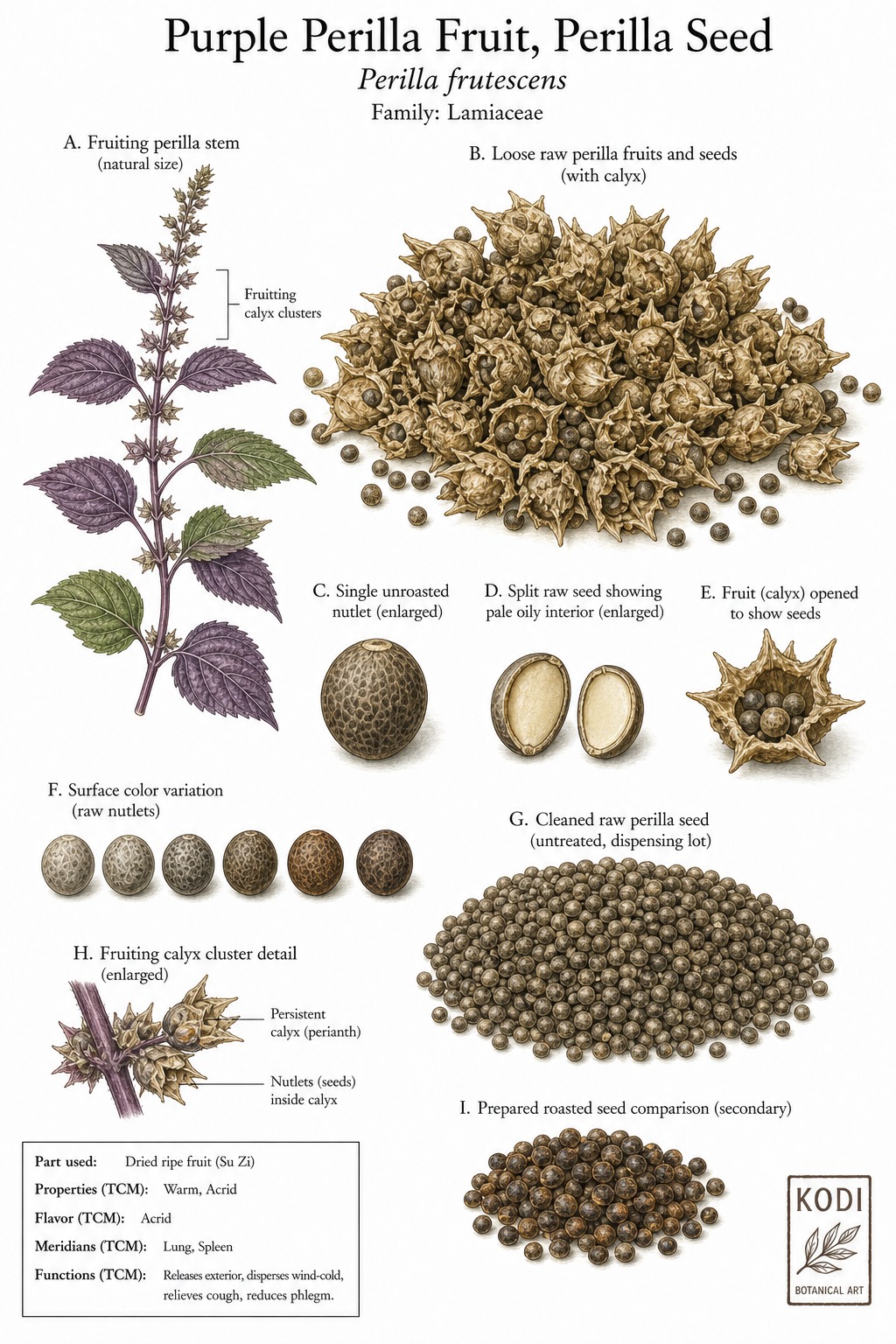
Known in TCM as Su Zi (苏子), this acrid, warm herb enters the Large Intestine and Lung. Traditionally, it directs rebellious Lung qi downward and stops cough and wheezing ... raw Su Zi is used when phlegm, cold, or weak descent causes noisy breathing, cough, and chest fullness, most often applied for cough, wheezing, and asthma. Modern research has identified Alpha-linolenic among its active constituents.
Part used: Fruit
Also Known As
Latin: Fructus Perillae | Pinyin: Su Zi | Chinese: 苏子
TCM Properties
- Taste
- acrid
- Temperature
- warm
- Channels
- Large Intestine, Lung
Traditional Use
Primary Actions
- Directs rebellious Lung qi downward and stops cough and wheezing ... raw Su Zi is used when phlegm, cold, or weak descent causes noisy breathing, cough, and chest fullness.
- Transforms phlegm and eases chest oppression ... it is especially suited to cough or asthma patterns where abundant seed oils help the qi descend and loosen congested phlegm.
- Moistens the intestines and unblocks the bowels ... Su Zi helps constipation when dryness or weak downward movement coexists with Lung qi rebellion.
Secondary Actions
- Raw Su Zi is slightly more moistening and less moderated than the roasted Chao Su Zi sibling ... this page should stay distinct from the prepared perilla-seed page.
- The medicinal material includes the small fruit and seed together, so loose calyx fragments in trade lots are not necessarily impurity when the source is properly identified.
Classic Formulas
- Su Zi Jiang Qi Tang ... hallmark formula for wheezing, copious phlegm, and rebellious Lung qi with underlying deficiency below.
- San Zi Yang Qin Tang ... teaching formula that uses seed medicinals, including Su Zi, to descend qi and resolve food-phlegm obstruction.
- Run Chang Tang style logic ... oily seeds are used when constipation accompanies deficient fluid movement or poor downward conduction.
Classical References
- Traditional materia medica describes Su Zi as warm and descending, especially for cough, wheeze, and constipation from impaired Lung and Large Intestine movement.
- Roasting changes handling and emphasis but not the core herb identity, so raw and prepared perilla-seed pages are related yet not interchangeable.
Modern Research
Active Compounds
- Alpha-linolenic acid and other unsaturated fatty acids ... dominant seed-oil constituents
- Rosmarinic acid and related phenolics ... broader Perilla bioactive compounds
- Flavonoids and seed proteins ... additional fractions discussed in pharmacologic reviews
Studied Effects
- A 2017 review summarized the phytochemistry and pharmacology of Perilla frutescens and affirmed that the leaves, stems, and seeds all have documented medicinal use in Chinese medicine (PMID 27890564).
- Perilla seed oil supplementation reduced leukotriene generation in patients with asthma associated with lipometabolic disturbance, supporting the seed's traditional relevance to wheezing and airway inflammation patterns (PMID 10878492).
- A 2024 review of perilla seed oil summarized antioxidant, anti-inflammatory, lipid-regulating, neuroprotective, and immunomodulatory findings, offering broader modern support for the medicinal value of the seed itself (PMID 39594031).
PubMed References
- Phytochemical and phytopharmacological review of Perilla frutescens L. (Labiatae), a traditional edible-medicinal herb in China. (2017)
- Effects of perilla seed oil supplementation on leukotriene generation by leucocytes in patients with asthma associated with lipometabolism. (2000)
- Perilla Seed Oil: A Review of Health Effects, Encapsulation Strategies and Applications in Food. (2024)
Safety & Interactions
Contraindications
- Loose stool from marked deficiency without dryness or qi rebellion
Cautions
- Because the seed is oily and descending, very large use can loosen the bowels in sensitive patients.
- Modern Perilla studies often use seed oil or whole-plant extracts, so published findings are broader than the exact raw dispensing form represented here.
Conditions
Frequently Asked Questions
What is Purple Perilla Fruit, Perilla Seed used for?
Purple Perilla Fruit, Perilla Seed is traditionally used to Directs rebellious Lung qi downward and stops cough and wheezing ... raw Su Zi is used when phlegm, cold, or weak descent causes noisy breathing, cough, and chest fullness., Transforms phlegm and eases chest oppression ... it is especially suited to cough or asthma patterns where abundant seed oils help the qi descend and loosen congested phlegm., Moistens the intestines and unblocks the bowels ... Su Zi helps constipation when dryness or weak downward movement coexists with Lung qi rebellion.. Research has investigated its effects on: A 2017 review summarized the phytochemistry and pharmacology of Perilla frutescens and affirmed that the leaves, stems, and seeds all have documented medicinal use in Chinese medicine (PMID 27890564).; Perilla seed oil supplementation reduced leukotriene generation in patients with asthma associated with lipometabolic disturbance, supporting the seed's traditional relevance to wheezing and airway inflammation patterns (PMID 10878492)..
What are other names for Purple Perilla Fruit, Perilla Seed?
Purple Perilla Fruit, Perilla Seed is also known as Perilla Seed, Raw Perilla Seed, Perilla. In TCM: 苏子 (Su Zi); Fructus Perillae.
Is Purple Perilla Fruit, Perilla Seed safe during pregnancy?
The safety of Purple Perilla Fruit, Perilla Seed during pregnancy has not been established. Consult a qualified healthcare provider before use.
What are the contraindications for Purple Perilla Fruit, Perilla Seed?
Purple Perilla Fruit, Perilla Seed should not be used in: Loose stool from marked deficiency without dryness or qi rebellion. Consult a qualified healthcare provider before use.