Purple Cowrie Shell
- Chinese
- 紫贝齿
- Pinyin
- Zi Bei Chi
- Latin
- Concha Mauritiae Arabicae
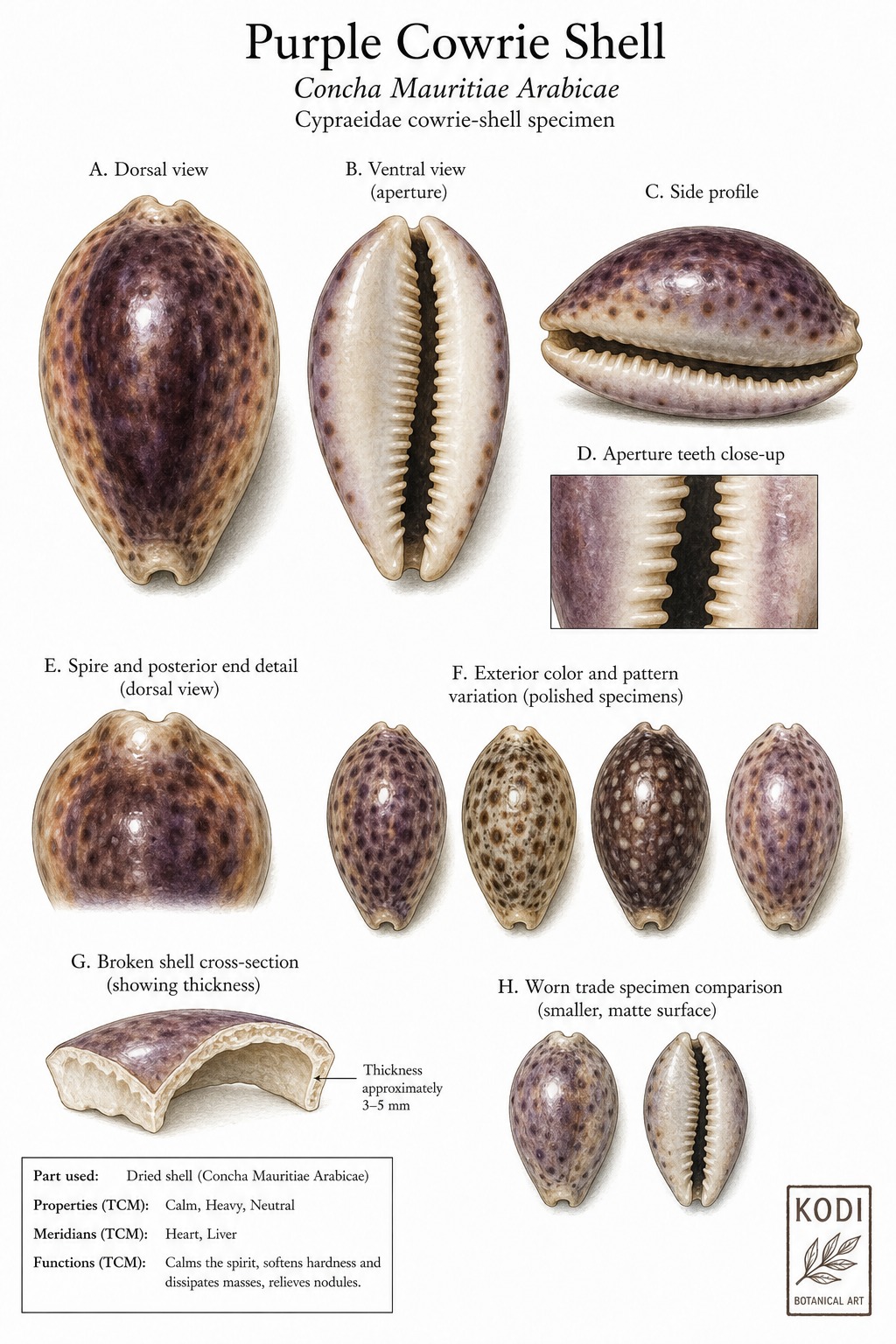
Known in TCM as Zi Bei Chi (紫贝齿), this salty, neutral herb enters the Liver and Heart. Traditionally, it calms the Liver and anchors floating yang ... Zi Bei Chi is used for dizziness, headache, red eyes, and visual strain when heat or rising Liver activity disturbs the upper body, most often applied for dizziness, blurred vision, and insomnia. Modern research has identified Calcium among its active constituents.
Part used: Shell
Also Known As
Latin: Concha Mauritiae Arabicae | Pinyin: Zi Bei Chi | Chinese: 紫贝齿
TCM Properties
- Taste
- salty
- Temperature
- neutral
- Channels
- Liver, Heart
Traditional Use
Primary Actions
- Calms the Liver and anchors floating yang ... Zi Bei Chi is used for dizziness, headache, red eyes, and visual strain when heat or rising Liver activity disturbs the upper body.
- Tranquilizes the spirit and settles fright ... older usage includes vexation, palpitations, insomnia, and childhood fright patterns where a heavy shell substance is employed.
- Clears Liver heat and brightens the eyes ... traditional application includes red painful eyes, superficial eye clouding, and irritative eye complaints.
Secondary Actions
- Zi Bei Chi belongs to the shell medicines that are often broken and pre-decocted ... it is chosen more for anchoring and eye use than for digestive astringency or acid neutralization.
- Source identity matters because cowrie-shell medicinals can be traded under several species names ... this page keeps the Mauritia arabica lane rather than flattening it into generic shell powder.
Classic Formulas
- Heavy-substance anchoring combinations pair Zi Bei Chi with Shi Jue Ming or Zhen Zhu Mu for headache, dizziness, and eye symptoms.
- Eye-focused powders combine it with Ye Ming Sha or Mi Meng Hua for red eyes and superficial visual obstruction.
- Spirit-calming combinations pair it with Long Gu or Mu Li when fright, palpitations, or restless sleep accompany upward agitation.
Classical References
- Traditional glossary and materia medica sources summarize Zi Bei Chi as a salty, neutral shell medicine used to calm the Heart, clear Liver heat, and brighten the eyes.
- Older usage also includes finely levigated topical eye applications, but modern practice usually treats those historical records cautiously rather than casually reproducing them.
Modern Research
Active Compounds
- Calcium carbonate mineral matrix ... the dominant structural component of cowrie shell medicines
- Trace magnesium and other shell-associated minerals ... variable constituents that affect hardness and ash profile
- Conchiolin-type organic shell matrix proteins ... minor biologic material within the shell structure
Studied Effects
- Specific indexed modern research on Zi Bei Chi itself is sparse, and most shell-medicine literature centers on identification, calcination, and mineral composition rather than human trials on this exact cowrie shell.
- Modern interpretation of the herb therefore remains anchored mainly in traditional shell-medicine theory and in the broader behavior of calcium-rich marine shell materials rather than in robust disease-specific clinical evidence.
- Because the evidence base is thin, this record keeps its modern claims conservative and does not overstate shell chemistry as proof of the traditional eye and calming indications.
Safety & Interactions
Contraindications
- Misidentified decorative or untreated shell material
- Cold or deficient digestive patterns that do poorly with heavy shell medicines
Cautions
- As a heavy shell medicine it is usually broken and decocted first ... polished souvenir shells or decorative shell powders are not equivalent to medicinally prepared material.
- Historical ophthalmic applications belong to supervised traditional practice and should not be read as support for do-it-yourself eye preparations.
Conditions
- Dizziness Traditional ★★★☆☆ JSON
- Blurred Vision Traditional ★★★☆☆ JSON
- Insomnia Traditional ★★☆☆☆ JSON
- Palpitations Traditional ★★☆☆☆ JSON
- Headache Traditional ★★☆☆☆ JSON
Frequently Asked Questions
What is Purple Cowrie Shell used for?
Purple Cowrie Shell is traditionally used to Calms the Liver and anchors floating yang ... Zi Bei Chi is used for dizziness, headache, red eyes, and visual strain when heat or rising Liver activity disturbs the upper body., Tranquilizes the spirit and settles fright ... older usage includes vexation, palpitations, insomnia, and childhood fright patterns where a heavy shell substance is employed., Clears Liver heat and brightens the eyes ... traditional application includes red painful eyes, superficial eye clouding, and irritative eye complaints.. Research has investigated its effects on: Specific indexed modern research on Zi Bei Chi itself is sparse, and most shell-medicine literature centers on identification, calcination, and mineral composition rather than human trials on this exact cowrie shell.; Modern interpretation of the herb therefore remains anchored mainly in traditional shell-medicine theory and in the broader behavior of calcium-rich marine shell materials rather than in robust disease-specific clinical evidence..
What are other names for Purple Cowrie Shell?
Purple Cowrie Shell is also known as Arabic Cowry Shell, Cowrie Shell, Mauritia. In TCM: 紫贝齿 (Zi Bei Chi); Concha Mauritiae Arabicae.
Is Purple Cowrie Shell safe during pregnancy?
The safety of Purple Cowrie Shell during pregnancy has not been established. Consult a qualified healthcare provider before use.
What are the contraindications for Purple Cowrie Shell?
Purple Cowrie Shell should not be used in: Misidentified decorative or untreated shell material; Cold or deficient digestive patterns that do poorly with heavy shell medicines. Consult a qualified healthcare provider before use.