Pumpkin Seed and Husks
- Chinese
- 南瓜子
- Pinyin
- Nan Gua Zi
- Latin
- Semen Cucurbitae Moschatae
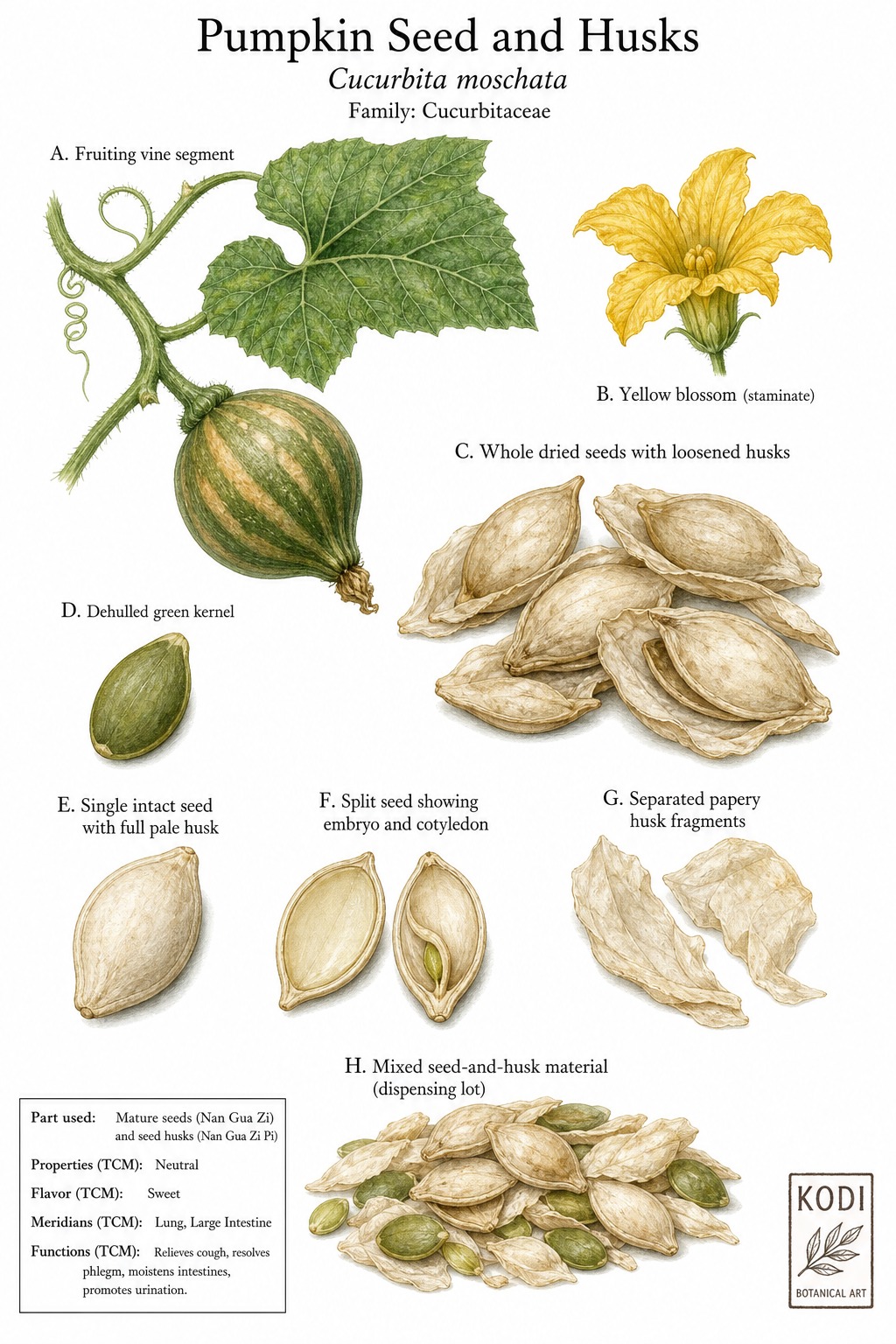
Known in TCM as Nan Gua Zi (南瓜子), this sweet, neutral herb enters the Large Intestine and Stomach. Traditionally, it expels intestinal parasites ... Nan Gua Zi is classically used for tapeworm and other worm patterns, especially when the patient is not strong enough for harsher antiparasitic medicinals, most often applied for intestinal parasites, frequent urination, and abdominal pain. Modern research has identified Cucurbitin among its active constituents.
Part used: Seed
Also Known As
Latin: Semen Cucurbitae Moschatae | Pinyin: Nan Gua Zi | Chinese: 南瓜子
TCM Properties
- Taste
- sweet
- Temperature
- neutral
- Channels
- Large Intestine, Stomach
Traditional Use
Primary Actions
- Expels intestinal parasites ... Nan Gua Zi is classically used for tapeworm and other worm patterns, especially when the patient is not strong enough for harsher antiparasitic medicinals.
- Supports the urinary tract and lower burner ... modern traditional use often extends to frequent urination and prostate-type complaints, even though the antihelminthic lane is older and more canonical.
- Provides a mild food-medicine bridge ... compared with many stronger parasite herbs, pumpkin seed is more nourishing and better tolerated in weak constitutions.
Secondary Actions
- This page stays on the mixed seed-and-husk medicinal material shown in the local prompt rather than on snack-food pepitas or decorative autumn-food imagery.
- The herb's gentleness is one reason it appears in community and home-style parasite protocols rather than only in harsh purge strategies.
Classic Formulas
- Nan Gua Zi with Bing Lang or other antiparasitic herbs ... classic combination for tapeworm and intestinal parasites.
- Mild lower-burner and urinary-support combinations ... pumpkin seed is often chosen when nourishment and tolerability matter.
- Food-medicine household use ... the seed may be taken more simply than many stronger parasite herbs.
Classical References
- Traditional medicine values Nan Gua Zi first for expelling worms and second for its mildness and relative tolerability.
- Its use in frequent urination and prostate-type discomfort is more familiar in later modern practice than in older core formula discussions.
- Because it is food-like, it is easier to misuse casually even though the intended medicinal direction is still pattern-based.
Modern Research
Active Compounds
- Cucurbitin and related antihelminthic-associated constituents ... often cited in traditional pumpkin-seed literature
- Phytosterols ... relevant to prostate and lower-urinary-tract research
- Fatty acids and seed oils ... important to broader metabolic and urinary studies
Studied Effects
- A 2012 community-based study in northwest Sichuan found pumpkin seeds useful when combined with areca nut extract in the treatment of human taeniasis, which directly supports the classic antihelminthic lane (PMID 22910218).
- A 2015 randomized placebo-controlled study found pumpkin seed reduced lower urinary tract symptoms in men with benign prostatic hyperplasia over one year, supporting the modern urinary-use tradition (PMID 25196580).
- A 2019 study reported anthelmintic potential of Cucurbita pepo seeds on Hymenolepis nana, reinforcing continued interest in the seed's parasite-focused activity (PMID 30778840).
PubMed References
- Usefulness of pumpkin seeds combined with areca nut extract in community-based treatment of human taeniasis in northwest Sichuan Province, China. (2012)
- Effects of pumpkin seed in men with lower urinary tract symptoms due to benign prostatic hyperplasia in the one-year, randomized, placebo-controlled GRANU study. (2015)
- Anthelmintic Potential of Cucurbita pepo Seeds on Hymenolepis nana. (2019)
Safety & Interactions
Contraindications
- None classically absolute, but parasite patterns still need accurate diagnosis
Cautions
- Pumpkin seed is food-like, but medicinal use for worms or urinary symptoms should not rely on casual snack amounts and guesswork alone.
- Human parasite protocols often combine Nan Gua Zi with other herbs or extracts rather than using it as a guaranteed stand-alone cure.
Conditions
- Intestinal Parasites Traditional ★★★★☆ JSON
- Frequent Urination Traditional ★★★☆☆ JSON
- Abdominal Pain Traditional ★★☆☆☆ JSON
- Poor Appetite Traditional ★★☆☆☆ JSON
Frequently Asked Questions
What is Pumpkin Seed and Husks used for?
Pumpkin Seed and Husks is traditionally used to Expels intestinal parasites ... Nan Gua Zi is classically used for tapeworm and other worm patterns, especially when the patient is not strong enough for harsher antiparasitic medicinals., Supports the urinary tract and lower burner ... modern traditional use often extends to frequent urination and prostate-type complaints, even though the antihelminthic lane is older and more canonical., Provides a mild food-medicine bridge ... compared with many stronger parasite herbs, pumpkin seed is more nourishing and better tolerated in weak constitutions.. Research has investigated its effects on: A 2012 community-based study in northwest Sichuan found pumpkin seeds useful when combined with areca nut extract in the treatment of human taeniasis, which directly supports the classic antihelminthic lane (PMID 22910218).; A 2015 randomized placebo-controlled study found pumpkin seed reduced lower urinary tract symptoms in men with benign prostatic hyperplasia over one year, supporting the modern urinary-use tradition (PMID 25196580)..
What are other names for Pumpkin Seed and Husks?
Pumpkin Seed and Husks is also known as Pumpkin Seed, Nan Gua Zi, Cucurbita. In TCM: 南瓜子 (Nan Gua Zi); Semen Cucurbitae Moschatae.
Is Pumpkin Seed and Husks safe during pregnancy?
The safety of Pumpkin Seed and Husks during pregnancy has not been established. Consult a qualified healthcare provider before use.
What are the contraindications for Pumpkin Seed and Husks?
Pumpkin Seed and Husks should not be used in: None classically absolute, but parasite patterns still need accurate diagnosis. Consult a qualified healthcare provider before use.