Prince's-Feather Fruit
- Chinese
- 水红花子
- Pinyin
- Shui Hong Hua Zi
- Latin
- Fructus Polygoni Orientalis
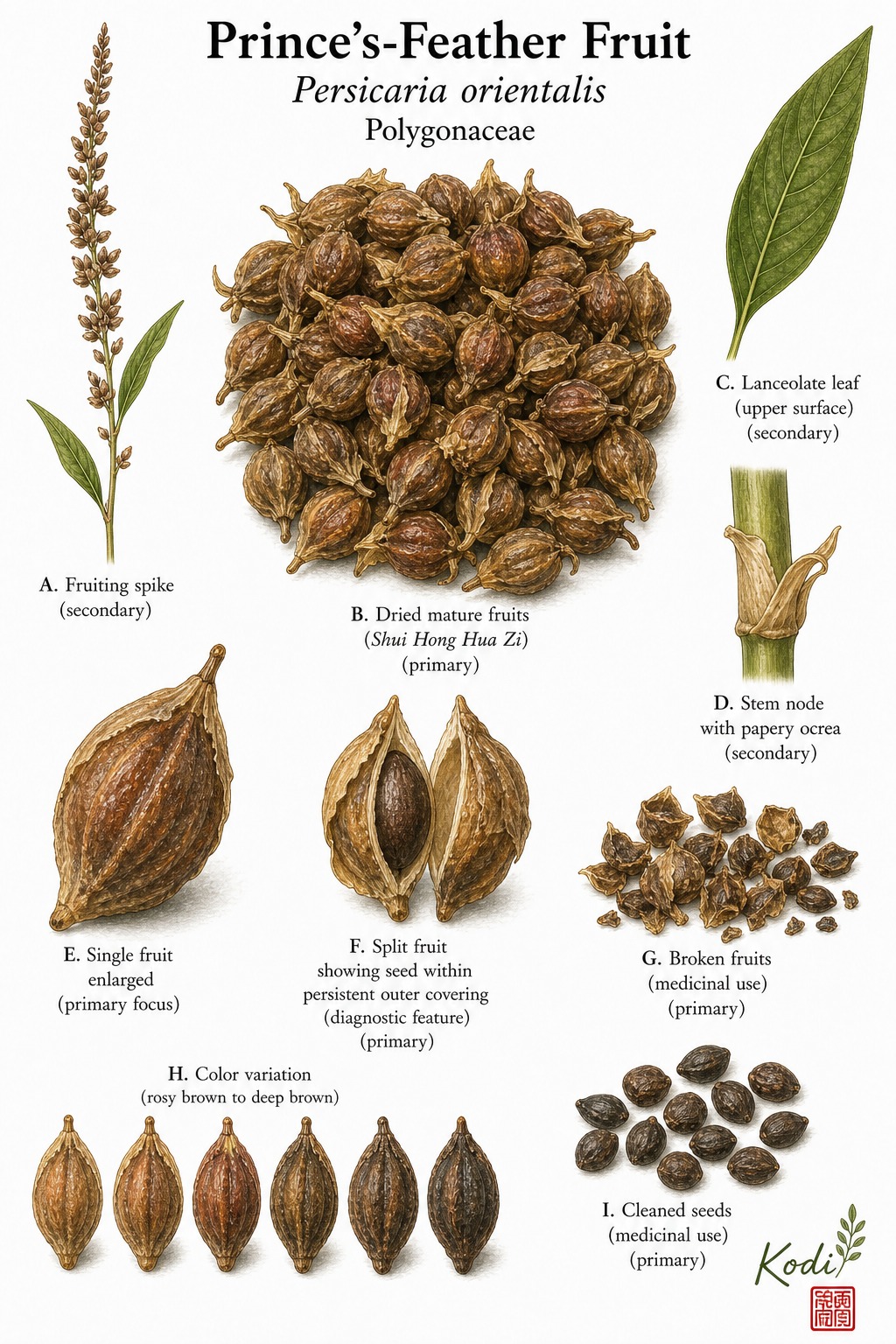
Known in TCM as Shui Hong Hua Zi (水红花子), this salty, slightly cold herb enters the Liver, Spleen, and Stomach. Traditionally, it breaks up accumulation and relieves abdominal fullness ... Shui Hong Hua Zi is used for abdominal distension, masses, and stagnant patterns where food, water, and blood stasis overlap, most often applied for edema, abdominal distension, and poor appetite. Modern research has identified Flavonoids among its active constituents.
Part used: Fruit
Also Known As
Latin: Fructus Polygoni Orientalis | Pinyin: Shui Hong Hua Zi | Chinese: 水红花子
TCM Properties
- Taste
- salty
- Temperature
- slightly cold
- Channels
- Liver, Spleen, Stomach
Traditional Use
Primary Actions
- Breaks up accumulation and relieves abdominal fullness ... Shui Hong Hua Zi is used for abdominal distension, masses, and stagnant patterns where food, water, and blood stasis overlap.
- Strengthens the Spleen and promotes digestion ... traditional use includes poor appetite, food stagnation, and a sluggish middle burner with damp retention.
- Promotes water movement and reduces swelling ... regional practice especially values it for edema, ascites-like patterns, and chronic hepatosplenic congestion.
Secondary Actions
- Traditional sources also describe Shui Hong Hua Zi as clearing Heat and brightening the eyes, but its stronger practical niche is the edema-accumulation-digestion lane rather than a pure eye herb.
- This is not a mainstream everyday single herb in the modern TCM classroom ... much of its living identity survives through regional liver, edema, and food-stagnation applications.
Classic Formulas
- Regional edema and ascites decoctions ... Shui Hong Hua Zi is used with blood-moving, Spleen-strengthening, and diuretic herbs when swelling and accumulation coexist.
- Food-stagnation and abdominal-distension prescriptions ... it can be added when the middle burner feels blocked and heavy.
- Blood-stasis or mass-softening combinations ... traditional use often places it beside stronger accumulation-breaking herbs rather than as a lone remedy.
Classical References
- Traditional descriptions emphasize breaking up accumulation, strengthening the Spleen, promoting diuresis, and easing abdominal fullness.
- Regional handbooks also connect the fruit with chronic hepatitis, cirrhotic ascites, splenic enlargement, and digestive stagnation patterns.
- Its slight coldness and moving quality explain why it is not treated as a gentle daily tonic.
Modern Research
Active Compounds
- Flavonoids such as taxifolin and related phenolics ... among the best-discussed constituents of Fructus Polygoni Orientalis
- Other polyphenols and antioxidant compounds ... central to anti-inflammatory and hepatoprotective studies
- Additional small molecules tracked by fingerprinting and pharmacokinetic work ... relevant to quality control of the fruit
Studied Effects
- A 2020 review summarized the traditional uses, phytochemistry, and pharmacology of Persicaria orientalis, confirming the broad regional medicinal profile of Shui Hong Hua Zi (PMID 31751652).
- A 2021 review focused on the traditional uses, phytochemistry, pharmacology, and quality control of Persicaria orientalis in China, reinforcing that the fruit remains a recognized ethnic-medicine material rather than just an ornamental plant (PMID 33127561).
- A 2018 mouse study reported hepatoprotective effects from Polygonum orientale ethanol extract against carbon-tetrachloride-induced acute liver injury, offering a plausible modern bridge to the herb's liver-and-edema traditions (PMID 29389576).
PubMed References
- Traditional uses, phytochemistry, and pharmacology of Persicaria orientalis (L.) Spach - A review. (2020)
- A review of the traditional uses, phytochemistry, pharmacology and quality control of the ethnic medicinal plant Persicaria orientalis (L.) Spach in China. (2021)
- Hepatoprotective effect of the ethanol extract of Polygonum orientale on carbon tetrachloride-induced acute liver injury in mice. (2018)
Safety & Interactions
Contraindications
- Pregnancy
- Marked deficiency without accumulation, edema, or food stagnation
Cautions
- Shui Hong Hua Zi is a moving and accumulation-resolving fruit rather than a gentle nutritive herb.
- Clinical identity varies by region, so sourcing and pattern matching matter more than the ornamental plant's familiarity suggests.
Drug Interactions
- Diuretics ... theoretical additive fluid-shifting effects may matter in edema-focused protocols
Conditions
- Edema Traditional ★★★☆☆ JSON
- Abdominal Distension Traditional ★★★☆☆ JSON
- Poor Appetite Traditional ★★☆☆☆ JSON
- Jaundice Traditional ★★☆☆☆ JSON
Frequently Asked Questions
What is Prince's-Feather Fruit used for?
Prince's-Feather Fruit is traditionally used to Breaks up accumulation and relieves abdominal fullness ... Shui Hong Hua Zi is used for abdominal distension, masses, and stagnant patterns where food, water, and blood stasis overlap., Strengthens the Spleen and promotes digestion ... traditional use includes poor appetite, food stagnation, and a sluggish middle burner with damp retention., Promotes water movement and reduces swelling ... regional practice especially values it for edema, ascites-like patterns, and chronic hepatosplenic congestion.. Research has investigated its effects on: A 2020 review summarized the traditional uses, phytochemistry, and pharmacology of Persicaria orientalis, confirming the broad regional medicinal profile of Shui Hong Hua Zi (PMID 31751652).; A 2021 review focused on the traditional uses, phytochemistry, pharmacology, and quality control of Persicaria orientalis in China, reinforcing that the fruit remains a recognized ethnic-medicine material rather than just an ornamental plant (PMID 33127561)..
What are other names for Prince's-Feather Fruit?
Prince's-Feather Fruit is also known as Shui Hong Hua Zi, Persicaria orientalis Fruit, Polygoni. In TCM: 水红花子 (Shui Hong Hua Zi); Fructus Polygoni Orientalis.
Is Prince's-Feather Fruit safe during pregnancy?
Prince's-Feather Fruit is not recommended during pregnancy.
What are the contraindications for Prince's-Feather Fruit?
Prince's-Feather Fruit should not be used in: Pregnancy; Marked deficiency without accumulation, edema, or food stagnation. Consult a qualified healthcare provider before use.
Does Prince's-Feather Fruit interact with any medications?
Prince's-Feather Fruit may interact with: Diuretics ... theoretical additive fluid-shifting effects may matter in edema-focused protocols. Always inform your healthcare provider of any herbal supplements you are taking.