Prepared He Zi Fruit
- Chinese
- 炮诃子
- Pinyin
- Pao He Zi
- Latin
- Fructus Chebulae Praeparatus
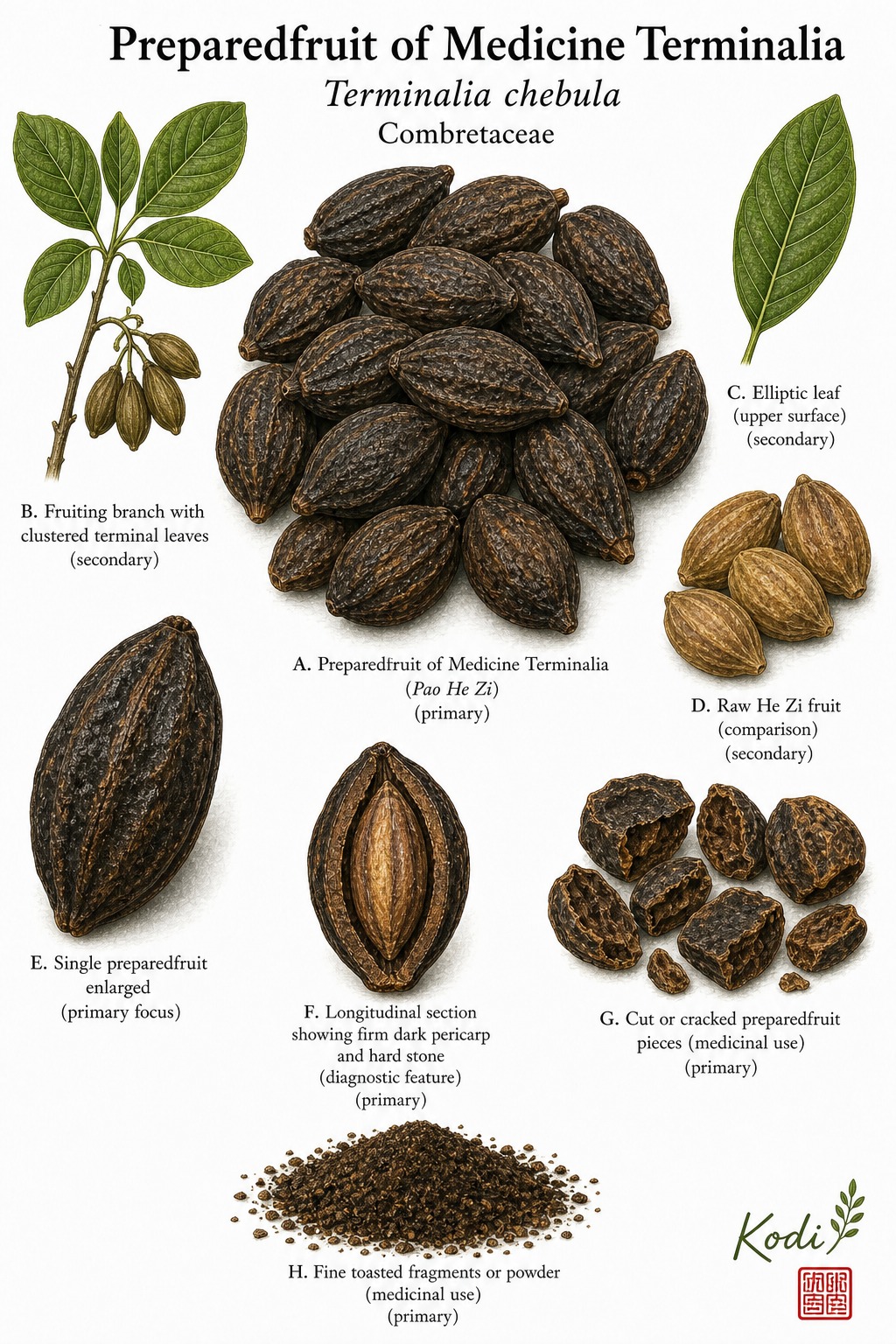
Known in TCM as Pao He Zi (炮诃子), this bitter and sour and astringent, warm herb enters the Lung, Large Intestine, and Stomach. Traditionally, it astringes the Intestines and stops chronic diarrhea ... prepared He Zi is especially used when long-standing loose stool or dysenteric leakage has a colder or more deficient middle-burner component, most often applied for diarrhea, dysentery, and cough. Modern research has identified Chebulagic among its active constituents.
Part used: Fruit
Also Known As
Latin: Fructus Chebulae Praeparatus | Pinyin: Pao He Zi | Chinese: 炮诃子
TCM Properties
- Taste
- bitter, sour, astringent
- Temperature
- warm
- Channels
- Lung, Large Intestine, Stomach
Traditional Use
Primary Actions
- Astringes the Intestines and stops chronic diarrhea ... prepared He Zi is especially used when long-standing loose stool or dysenteric leakage has a colder or more deficient middle-burner component.
- Astringes the Lung and helps contain chronic cough ... the fruit also remains useful for lingering cough, shortness of breath from leakage, and chronic voice weakness.
- Warms the middle and strengthens the binding effect of raw He Zi ... roasting or baking is classically said to favor the stabilizing diarrhea-stopping lane over the cooler raw-fruit expression.
Secondary Actions
- This page should stay distinct from the already-live raw `medicine-terminalia-fruit` record ... both are He Zi, but the prepared lane is darker, warmer, and more middle-stabilizing.
- It should also stay separate from `friot-of-belleric-terminalia` ... that sibling is Mao He Zi from Terminalia bellirica rather than Terminalia chebula.
Classic Formulas
- Zhen Ren Yang Zang Tang ... He Zi is commonly used to stabilize the intestines in chronic deficiency diarrhea.
- He Zi San and related cough or voice-loss powders ... the fruit helps astringe the Lung and benefit the throat.
- Modified sore-throat and chronic-dysentery formulas ... baked He Zi is often preferred when a warmer, more astringent direction is needed.
Classical References
- Traditional medicine treats He Zi as an astringent fruit for chronic cough, diarrhea, dysentery, and loss of voice.
- Classic preparation notes state that baked or roasted He Zi warms the middle and strengthens the bowel-binding action.
- The prepared form is most appropriate after the active pathogen has passed, not during early unresolved exterior or damp-heat presentations.
Modern Research
Active Compounds
- Chebulagic acid and chebulinic acid ... hallmark tannins central to Terminalia chebula pharmacology
- Gallic acid and ellagic acid ... major phenolics discussed in antioxidant and anti-inflammatory research
- Broad tannin-rich polyphenol fractions ... closely tied to the fruit's astringent character
Studied Effects
- A 2024 comprehensive review summarized Terminalia chebula's traditional uses, phytochemistry, pharmacology, toxicity, and pharmacokinetics, giving a current overview for He Zi research (PMID 39683707).
- A 2020 review focused specifically on the fruits of Terminalia chebula and confirmed sustained interest in antioxidant, antimicrobial, anti-inflammatory, and gastrointestinal activity (PMID 32307775).
- A 2013 review on the development of Terminalia chebula in clinical research documented how the fruit continued to move from traditional use into broader modern study programs (PMID 23620847).
PubMed References
- Comprehensive Review on Fruit of Terminalia chebula: Traditional Uses, Phytochemistry, Pharmacology, Toxicity, and Pharmacokinetics. (2024)
- Fruits of Terminalia chebula Retz.: A review on traditional uses, bioactive chemical constituents and pharmacological activities. (2020)
- The development of Terminalia chebula Retz. (Combretaceae) in clinical research. (2013)
Safety & Interactions
Contraindications
- Early-stage external cough or bowel disorders where astringing may trap the pathogen
- Active food stagnation or damp-heat diarrhea that still requires elimination rather than binding
Cautions
- The prepared form is more warming and more binding than the raw He Zi page.
- Astringent fruits can worsen retention if used before the underlying excess has cleared.
Conditions
Frequently Asked Questions
What is Prepared He Zi Fruit used for?
Prepared He Zi Fruit is traditionally used to Astringes the Intestines and stops chronic diarrhea ... prepared He Zi is especially used when long-standing loose stool or dysenteric leakage has a colder or more deficient middle-burner component., Astringes the Lung and helps contain chronic cough ... the fruit also remains useful for lingering cough, shortness of breath from leakage, and chronic voice weakness., Warms the middle and strengthens the binding effect of raw He Zi ... roasting or baking is classically said to favor the stabilizing diarrhea-stopping lane over the cooler raw-fruit expression.. Research has investigated its effects on: A 2024 comprehensive review summarized Terminalia chebula's traditional uses, phytochemistry, pharmacology, toxicity, and pharmacokinetics, giving a current overview for He Zi research (PMID 39683707).; A 2020 review focused specifically on the fruits of Terminalia chebula and confirmed sustained interest in antioxidant, antimicrobial, anti-inflammatory, and gastrointestinal activity (PMID 32307775)..
What are other names for Prepared He Zi Fruit?
Prepared He Zi Fruit is also known as Prepared Terminalia Fruit, Baked He Zi, Chebulic Myrobalan. In TCM: 炮诃子 (Pao He Zi); Fructus Chebulae Praeparatus.
Is Prepared He Zi Fruit safe during pregnancy?
The safety of Prepared He Zi Fruit during pregnancy has not been established. Consult a qualified healthcare provider before use.
What are the contraindications for Prepared He Zi Fruit?
Prepared He Zi Fruit should not be used in: Early-stage external cough or bowel disorders where astringing may trap the pathogen; Active food stagnation or damp-heat diarrhea that still requires elimination rather than binding. Consult a qualified healthcare provider before use.