Prepared Rhubarb Root
- Chinese
- 制大黄
- Pinyin
- Zhi Da Huang
- Latin
- Radix et Rhizoma Rhei Praeparata
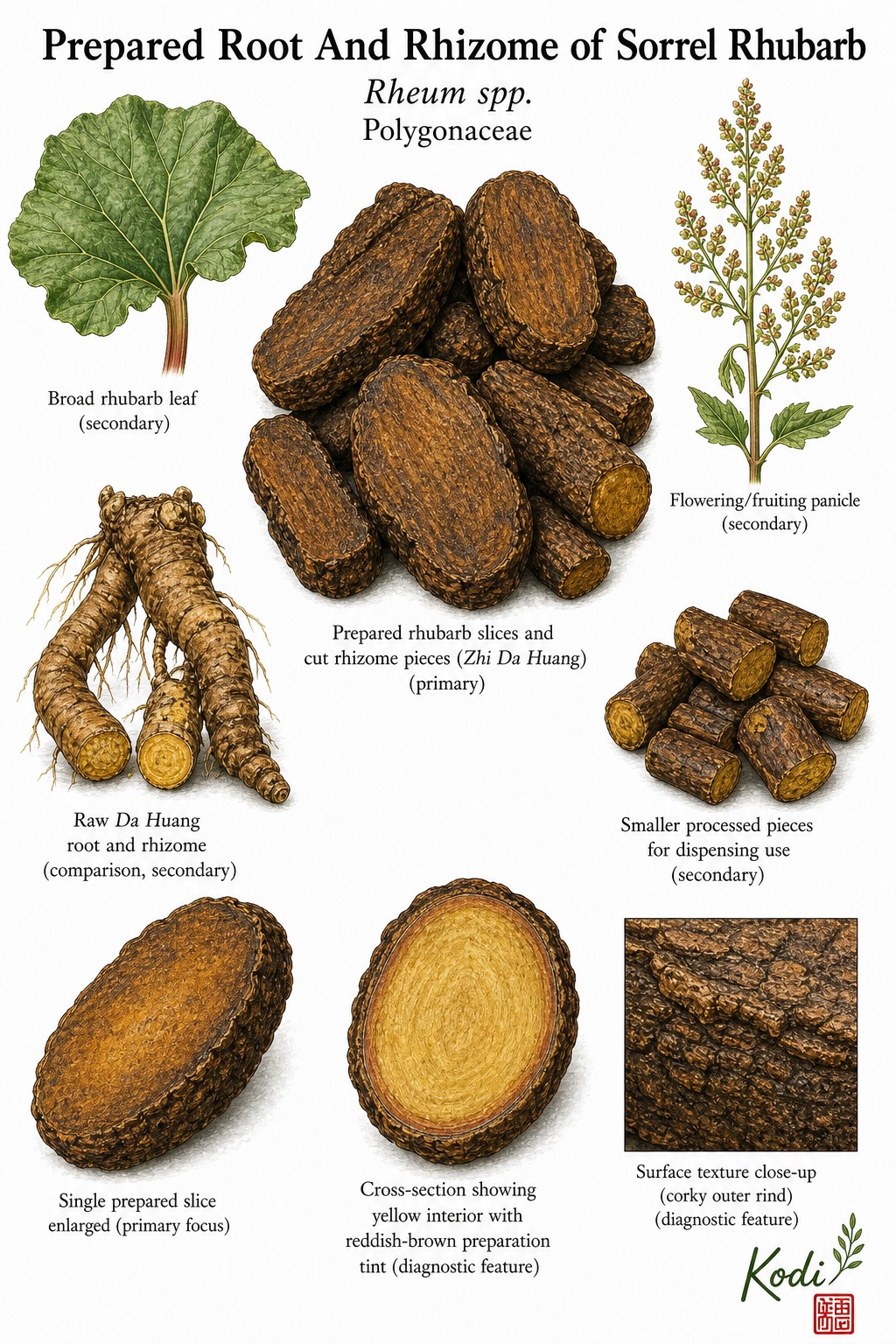
Known in TCM as Zhi Da Huang (制大黄), this bitter, slightly cold herb enters the Large Intestine, Liver, and Stomach. Traditionally, it moderates the harsh purgative force of raw Da Huang ... prepared rhubarb is used when the formula still needs bowel-unblocking, heat-clearing, or blood-moving action but in a less abrupt or less cold form, most often applied for constipation, jaundice, and dysmenorrhea. Modern research has identified Anthraquinones among its active constituents.
Part used: Root
Also Known As
Latin: Radix et Rhizoma Rhei Praeparata | Pinyin: Zhi Da Huang | Chinese: 制大黄
TCM Properties
- Taste
- bitter
- Temperature
- slightly cold
- Channels
- Large Intestine, Liver, Stomach
Traditional Use
Primary Actions
- Moderates the harsh purgative force of raw Da Huang ... prepared rhubarb is used when the formula still needs bowel-unblocking, heat-clearing, or blood-moving action but in a less abrupt or less cold form.
- Invigorates blood and disperses stasis ... it is used for fixed abdominal pain, traumatic injury, and menstrual pain when blood stasis and heat or accumulation are part of the pattern.
- Clears damp-heat and constrained accumulation ... traditional use extends to jaundice, focal distension, and internal heat obstruction where raw Da Huang would be too drastic.
Secondary Actions
- This page should stay distinct from the later wine-processed Da Huang sibling ... both are processed forms, but Zhi Da Huang is the broader prepared lane rather than the specifically upward-directing wine preparation.
- Compared with raw Da Huang, the prepared form is less strongly purgative and more often chosen when blood-moving or damp-heat logic matters alongside moderated bowel movement.
Classic Formulas
- Tao He Cheng Qi Tang modification logic ... when blood stasis and accumulation coexist but excessive purgation is not desired.
- Da Cheng Qi Tang lineage adaptation ... prepared Da Huang may be selected when opening the bowels is still needed but the raw herb would be too forceful.
- Trauma and gynecologic formulas ... processed rhubarb is used when blood stasis and heat need dispersing without overdriving the intestines.
Classical References
- Rhubarb processing traditions are among the classic examples of paozhi changing the balance between purgation, heat clearing, and blood-moving use.
- Materia medica teaching usually treats prepared Da Huang as milder on the bowels and somewhat more suitable for blood-stasis and recovery settings than the raw product.
Modern Research
Active Compounds
- Anthraquinones such as emodin, rhein, aloe-emodin, and chrysophanol ... hallmark rhubarb constituents
- Tannins and stilbene-related compounds ... secondary constituents relevant to processing changes
- Polysaccharides and other macromolecular fractions ... broader Rhubarb pharmacology components
Studied Effects
- A 2024 review summarized rhubarb compounds, processing methods, pharmacology, toxicology, and clinical research, directly supporting the importance of distinguishing among rhubarb concoctions rather than treating all Da Huang forms as identical (PMID 39170703).
- A 2020 comprehensive rhubarb review summarized anti-inflammatory, antibacterial, anti-fibrotic, and other broad pharmacologic interests while reinforcing the herb's complex multi-system activity (PMID 32863857).
- A 2020 review on Rhubarb hepatoprotection and hepatotoxicity highlighted both therapeutic potential and safety concerns, supporting a cautious approach to prolonged or high-dose use even with prepared forms (PMID 32559851).
PubMed References
- The application of rhubarb concoctions in traditional Chinese medicine and its compounds, processing methods, pharmacology, toxicology and clinical research. (2024)
- What we already know about rhubarb: a comprehensive review. (2020)
- Hepatoprotection and hepatotoxicity of Chinese herb Rhubarb (Dahuang): How to properly control the "General (Jiang Jun)" in Chinese medical herb. (2020)
Safety & Interactions
Contraindications
- Pregnancy unless specifically prescribed
- Loose stool, severe deficiency, bowel obstruction, or dehydration
- Long-term unsupervised use
Cautions
- Prepared rhubarb is milder than raw Da Huang but still not a casual digestive aid.
- Overuse can still cause diarrhea, electrolyte disturbance, and gastrointestinal irritation.
- Chronic or heavy use of rhubarb preparations carries genuine safety concerns, including liver-related questions discussed in the literature.
Drug Interactions
- Stimulant laxatives or bowel-cleansing agents ... additive purgative effect
- Diuretics or other potassium-lowering therapies ... possible additive electrolyte disturbance
- Anticoagulant or antiplatelet regimens ... bleeding patterns should be monitored when blood-moving use is involved
Conditions
- Constipation Traditional ★★★☆☆ JSON
- Jaundice Traditional ★★☆☆☆ JSON
- Dysmenorrhea Traditional ★★☆☆☆ JSON
- Traumatic Injury Traditional ★★☆☆☆ JSON
Frequently Asked Questions
What is Prepared Rhubarb Root used for?
Prepared Rhubarb Root is traditionally used to Moderates the harsh purgative force of raw Da Huang ... prepared rhubarb is used when the formula still needs bowel-unblocking, heat-clearing, or blood-moving action but in a less abrupt or less cold form., Invigorates blood and disperses stasis ... it is used for fixed abdominal pain, traumatic injury, and menstrual pain when blood stasis and heat or accumulation are part of the pattern., Clears damp-heat and constrained accumulation ... traditional use extends to jaundice, focal distension, and internal heat obstruction where raw Da Huang would be too drastic.. Research has investigated its effects on: A 2024 review summarized rhubarb compounds, processing methods, pharmacology, toxicology, and clinical research, directly supporting the importance of distinguishing among rhubarb concoctions rather than treating all Da Huang forms as identical (PMID 39170703).; A 2020 comprehensive rhubarb review summarized anti-inflammatory, antibacterial, anti-fibrotic, and other broad pharmacologic interests while reinforcing the herb's complex multi-system activity (PMID 32863857)..
What are other names for Prepared Rhubarb Root?
Prepared Rhubarb Root is also known as Prepared Da Huang, Processed Rhubarb, Rhei. In TCM: 制大黄 (Zhi Da Huang); Radix et Rhizoma Rhei Praeparata.
Is Prepared Rhubarb Root safe during pregnancy?
Prepared Rhubarb Root is not recommended during pregnancy.
What are the contraindications for Prepared Rhubarb Root?
Prepared Rhubarb Root should not be used in: Pregnancy unless specifically prescribed; Loose stool, severe deficiency, bowel obstruction, or dehydration; Long-term unsupervised use. Consult a qualified healthcare provider before use.
Does Prepared Rhubarb Root interact with any medications?
Prepared Rhubarb Root may interact with: Stimulant laxatives or bowel-cleansing agents ... additive purgative effect; Diuretics or other potassium-lowering therapies ... possible additive electrolyte disturbance; Anticoagulant or antiplatelet regimens ... bleeding patterns should be monitored when blood-moving use is involved. Always inform your healthcare provider of any herbal supplements you are taking.