Charred Cattail Pollen
- Chinese
- 蒲黄炭
- Pinyin
- Pu Huang Tan
- Latin
- Pollen Typhae Carbonisatum
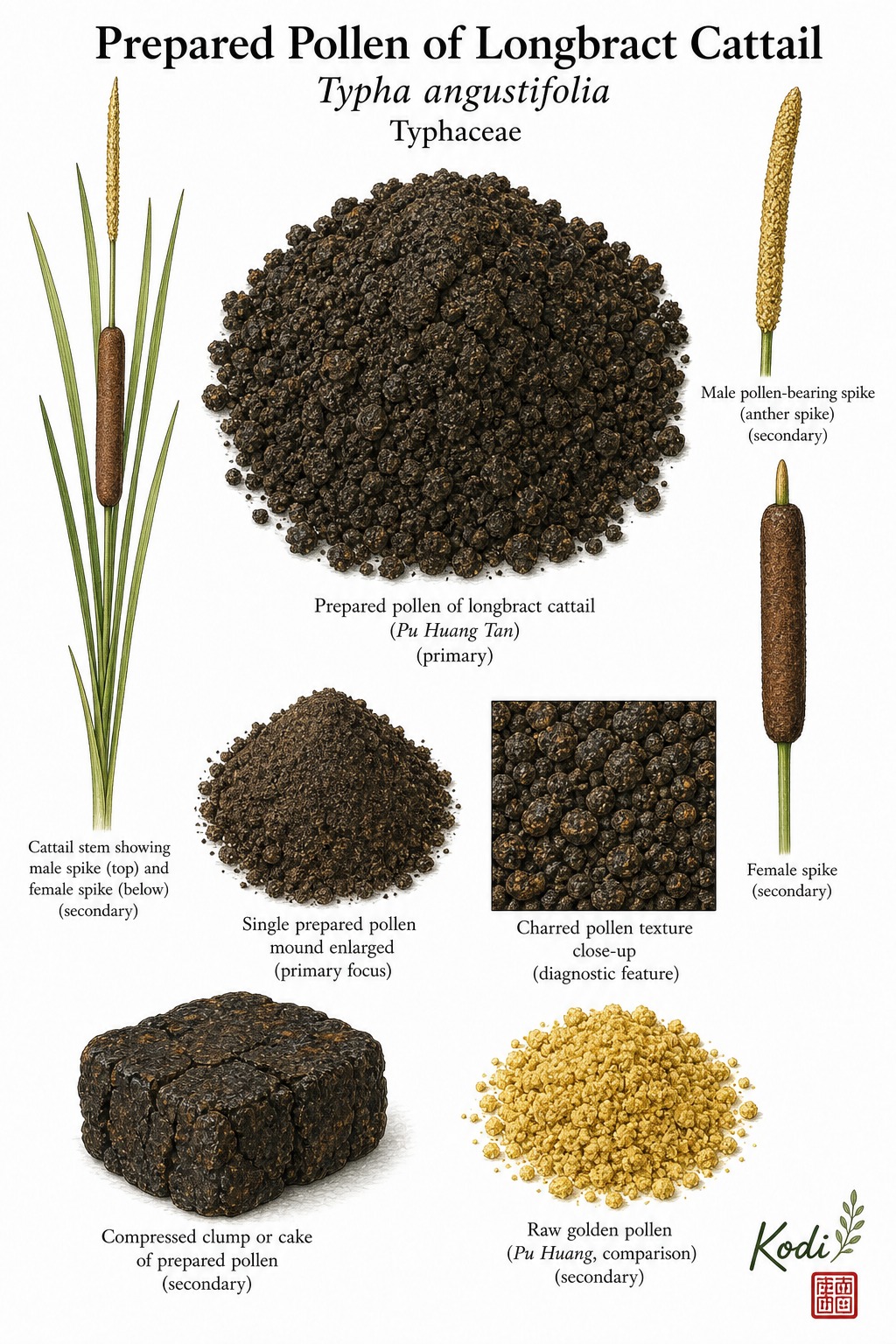
Known in TCM as Pu Huang Tan (蒲黄炭), this sweet and astringent, neutral herb enters the Liver and Pericardium. Traditionally, it stops bleeding more strongly than raw Pu Huang ... Pu Huang Tan is the charred pollen form chosen when the main goal is hemostasis rather than active movement of blood stasis, most often applied for abnormal uterine bleeding, hematuria, and hemoptysis. Modern research has identified Carbonization-modified among its active constituents.
Part used: Pollen
Also Known As
Latin: Pollen Typhae Carbonisatum | Pinyin: Pu Huang Tan | Chinese: 蒲黄炭
TCM Properties
- Taste
- sweet, astringent
- Temperature
- neutral
- Channels
- Liver, Pericardium
Traditional Use
Primary Actions
- Stops bleeding more strongly than raw Pu Huang ... Pu Huang Tan is the charred pollen form chosen when the main goal is hemostasis rather than active movement of blood stasis.
- Used for gynecologic, urinary, pulmonary, and trauma-related bleeding ... traditional indications include abnormal uterine bleeding, hematuria, hemoptysis, and external or traumatic bleeding.
- Retains only a lighter blood-stasis action ... compared with raw Pu Huang, the carbonized form is more firmly hemostatic and less strongly pain-moving.
Secondary Actions
- This page should stay clearly separate from raw Pu Huang ... raw pollen moves blood and relieves pain more strongly, while Pu Huang Tan is the safer choice when bleeding control comes first.
- Carbonization changes both color and therapeutic direction, so the forms are not interchangeable.
Classic Formulas
- Charred-hemostatic pairings with Ce Bai Ye Tan or Zong Lu Tan ... common practical logic when bleeding needs stronger restraint.
- Gynecologic bleeding formulas ... Pu Huang Tan is preferred when raw Pu Huang would move blood too much for the clinical goal.
Classical References
- Traditional sources repeatedly teach that stir-frying Pu Huang to charcoal strengthens its bleeding-stopping effect.
- The raw-versus-charred distinction is one of the clearer paozhi examples in the hemostatic herb category.
Modern Research
Active Compounds
- Carbonization-modified flavonoids ... transformed pollen constituents associated with altered pharmacology
- Fatty-acid and sterol fractions ... components tracked in pre- and post-carbonization analysis
- Anti-nociceptive and anti-inflammatory pollen constituents ... broader Typha pollen fractions retained or transformed by processing
Studied Effects
- A 2021 review summarized how carbonization alters the quality control profile, chemical composition, and pharmacology of Typhae Pollen, directly supporting the distinction between raw Pu Huang and Pu Huang Tan (PMID 33388428).
- Spectrum-effect analysis identified active ingredients in carbonized Typhae Pollen, reinforcing that the charred product has its own measurable pharmacologic profile rather than being a merely burnt version of the raw herb (PMID 37619295).
- Experimental work on Pollen Typhae supported hemostatic activity by both external and oral use, giving broader modern support to the pollen drug family from which Pu Huang Tan is derived (PMID 21934490).
PubMed References
- Effects of carbonized process on quality control, chemical composition and pharmacology of Typhae Pollen: A review. (2021)
- Identifying the active ingredients of carbonized Typhae Pollen by spectrum-effect relationship combined with MBPLS, PLS, and SVM algorithms. (2023)
- Experimental study on the hemostatc activity of Pollen Typhae: a traditional folk medicine used by external and oral application. (2011)
Safety & Interactions
Contraindications
- Pregnancy unless specifically prescribed
Cautions
- Although charred Pu Huang moves blood less than the raw form, it still belongs to a medicinal family used cautiously in pregnancy.
- Unexplained internal bleeding should receive proper medical evaluation rather than herb-only self-treatment.
Conditions
- Abnormal Uterine Bleeding Traditional ★★★★☆ JSON
- Hematuria Traditional ★★★☆☆ JSON
- Hemoptysis Traditional ★★★☆☆ JSON
- Traumatic Injury Traditional ★★☆☆☆ JSON
Frequently Asked Questions
What is Charred Cattail Pollen used for?
Charred Cattail Pollen is traditionally used to Stops bleeding more strongly than raw Pu Huang ... Pu Huang Tan is the charred pollen form chosen when the main goal is hemostasis rather than active movement of blood stasis., Used for gynecologic, urinary, pulmonary, and trauma-related bleeding ... traditional indications include abnormal uterine bleeding, hematuria, hemoptysis, and external or traumatic bleeding., Retains only a lighter blood-stasis action ... compared with raw Pu Huang, the carbonized form is more firmly hemostatic and less strongly pain-moving.. Research has investigated its effects on: A 2021 review summarized how carbonization alters the quality control profile, chemical composition, and pharmacology of Typhae Pollen, directly supporting the distinction between raw Pu Huang and Pu Huang Tan (PMID 33388428).; Spectrum-effect analysis identified active ingredients in carbonized Typhae Pollen, reinforcing that the charred product has its own measurable pharmacologic profile rather than being a merely burnt version of the raw herb (PMID 37619295)..
What are other names for Charred Cattail Pollen?
Charred Cattail Pollen is also known as Prepared Pollen of Longbract Cattail, Carbonized Typha Pollen, Typha. In TCM: 蒲黄炭 (Pu Huang Tan); Pollen Typhae Carbonisatum.
Is Charred Cattail Pollen safe during pregnancy?
Charred Cattail Pollen is not recommended during pregnancy. Although charred Pu Huang moves blood less than the raw form, it still belongs to a medicinal family used cautiously in pregnancy.
What are the contraindications for Charred Cattail Pollen?
Charred Cattail Pollen should not be used in: Pregnancy unless specifically prescribed. Consult a qualified healthcare provider before use.