Prepared Chuan Wu Root
- Chinese
- 制川乌
- Pinyin
- Zhi Chuan Wu
- Latin
- Aconiti Radix Cocta
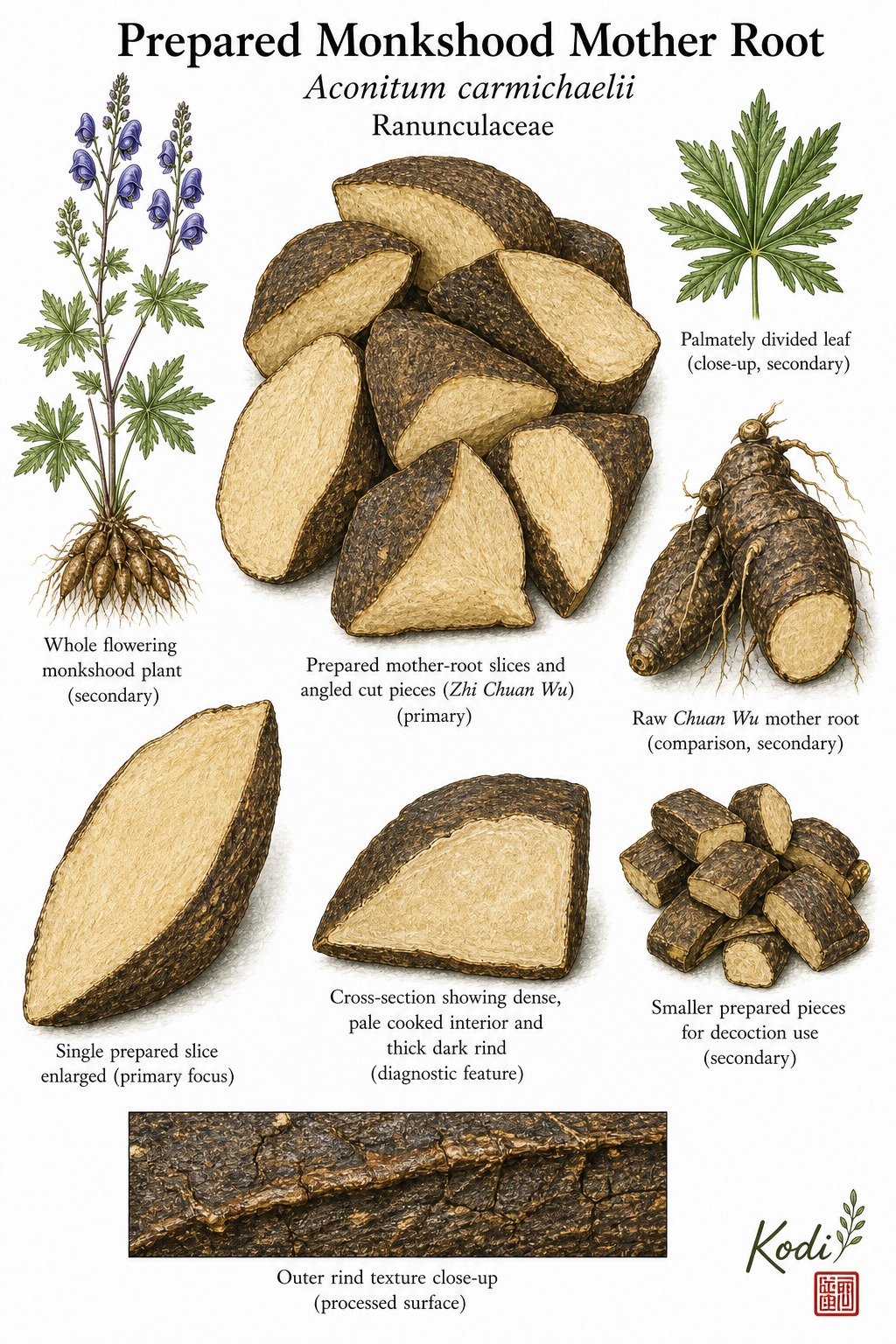
Known in TCM as Zhi Chuan Wu (制川乌), this acrid and bitter, hot herb enters the Kidney, Liver, and Spleen. Traditionally, it dispels wind, scatters cold, and relieves severe pain ... Zhi Chuan Wu is the processed mother-root lane of Aconitum carmichaelii, used for stubborn cold-damp painful obstruction and deeply fixed pain that clearly improves with warmth, most often applied for joint pain, rheumatism, and low back pain. Modern research has identified Aconitine, among its active constituents.
Part used: Root
Also Known As
Latin: Aconiti Radix Cocta | Pinyin: Zhi Chuan Wu | Chinese: 制川乌
TCM Properties
- Taste
- acrid, bitter
- Temperature
- hot
- Channels
- Kidney, Liver, Spleen
Traditional Use
Primary Actions
- Dispels wind, scatters cold, and relieves severe pain ... Zhi Chuan Wu is the processed mother-root lane of Aconitum carmichaelii, used for stubborn cold-damp painful obstruction and deeply fixed pain that clearly improves with warmth.
- Warms the channels and unblocks cold stagnation ... it is chosen when cold has lodged in the limbs, low back, abdomen, or joints strongly enough that milder warming herbs are insufficient.
- Addresses cold-type Bi and traumatic pain patterns ... traditional use includes rheumatic pain, cold low-back pain, neuralgic pain, and abdominal cold pain where toxic strong medicinals are considered necessary.
Secondary Actions
- This page should stay distinct from the Fu Zi family ... Chuan Wu is the mother root and is classically more pain-dispersing and externally cold-dispelling, while Fu Zi emphasizes rescuing Yang and restoring collapse.
- Processing lowers toxicity but does not make the herb casual or food-like ... Zhi Chuan Wu remains a strongly acting aconite medicine.
Classic Formulas
- Wu Tou Tang ... classical cold-damp painful-obstruction formula in which Chuan Wu supplies strong channel-warming analgesic force.
- Xiao Huo Luo Dan ... traditional formula for cold-phlegm and blood-stasis obstruction with chronic fixed pain and numbness.
- Regional arthralgia and trauma formulas ... prepared Chuan Wu is used when pain is severe, cold, fixed, and difficult to open.
Classical References
- Traditional materia medica consistently describes Chuan Wu as hot, acrid, bitter, toxic, and especially effective for dispelling wind, cold, damp, and pain.
- Processed Chuan Wu is preferred clinically because raw mother root toxicity is too dangerous for ordinary dispensing.
- Modern inference ... many research papers discuss Aconiti Radix Cocta broadly rather than isolating every local processing variant, so this record follows the prepared Chuan Wu lane within that broader category.
Modern Research
Active Compounds
- Aconitine, mesaconitine, and hypaconitine ... toxic diester diterpenoid alkaloids characteristic of raw Aconitum roots
- Benzoylaconine, benzoylmesaconine, and benzoylhypaconitine ... less toxic monoester products increased by proper processing
- Neoline-type aminoalcohol alkaloids ... processed aconite constituents discussed in analgesic and anti-inflammatory research
- Polysaccharides and other non-alkaloid fractions ... supportive constituents in broader Aconitum pharmacology reviews
Studied Effects
- A 2025 review summarized the compounds, pharmacology, toxicity, detoxification, and applications of Aconitum carmichaelii, reinforcing that processing changes but does not erase the herb's serious risk profile (PMID 39306209).
- Aconiti Radix Cocta improved rheumatoid arthritis outcomes in an experimental model through COX-related anti-inflammatory pathways, supporting the prepared mother root's traditional pain-focused use (PMID 34539799).
- A systematic pharmacology and UPLC-QTOF-MS/MS study on Aconiti Radix Cocta in gouty arthritis linked the processed herb with anti-inflammatory and analgesic activity relevant to cold painful-obstruction patterns (PMID 33995019).
PubMed References
- An overview of the research progress on Aconitum carmichaelii Debx.:active compounds, pharmacology, toxicity, detoxification, and applications. (2025)
- Traditional Chinese Medicine Aconiti Radix Cocta Improves Rheumatoid Arthritis via Suppressing COX-1 and COX-2. (2021)
- How Aconiti Radix Cocta can Treat Gouty Arthritis Based on Systematic Pharmacology and UPLC-QTOF-MS/MS. (2021)
Safety & Interactions
Contraindications
- Pregnancy
- Heat syndromes, Yin deficiency with heat, or true fluid depletion without cold
- Raw or inadequately processed aconite for internal use
- Known ventricular arrhythmia or unstable severe cardiac disease without expert supervision
Cautions
- Prepared Chuan Wu remains highly toxic and should be sourced only as an authenticated processed product.
- Improper dosing or under-processing can cause oral numbness, vomiting, diarrhea, weakness, hypotension, and life-threatening ventricular arrhythmias.
- It is a strong cold-pain herb rather than a general tonic, and it should not be self-prescribed for musculoskeletal pain.
Drug Interactions
- Cardiac glycosides such as digoxin ... additive arrhythmogenic risk
- Class I and III antiarrhythmic drugs ... unpredictable electrophysiologic interaction
- Beta-blockers or other rate-slowing agents ... may worsen bradycardia or mask early toxicity
- QT-prolonging medications ... additive risk of malignant ventricular arrhythmia
Conditions
- Joint Pain Traditional ★★★★☆ JSON
- Rheumatism Traditional ★★★★☆ JSON
- Low Back Pain Traditional ★★★☆☆ JSON
- Abdominal Pain Traditional ★★☆☆☆ JSON
Frequently Asked Questions
What is Prepared Chuan Wu Root used for?
Prepared Chuan Wu Root is traditionally used to Dispels wind, scatters cold, and relieves severe pain ... Zhi Chuan Wu is the processed mother-root lane of Aconitum carmichaelii, used for stubborn cold-damp painful obstruction and deeply fixed pain that clearly improves with warmth., Warms the channels and unblocks cold stagnation ... it is chosen when cold has lodged in the limbs, low back, abdomen, or joints strongly enough that milder warming herbs are insufficient., Addresses cold-type Bi and traumatic pain patterns ... traditional use includes rheumatic pain, cold low-back pain, neuralgic pain, and abdominal cold pain where toxic strong medicinals are considered necessary.. Research has investigated its effects on: A 2025 review summarized the compounds, pharmacology, toxicity, detoxification, and applications of Aconitum carmichaelii, reinforcing that processing changes but does not erase the herb's serious risk profile (PMID 39306209).; Aconiti Radix Cocta improved rheumatoid arthritis outcomes in an experimental model through COX-related anti-inflammatory pathways, supporting the prepared mother root's traditional pain-focused use (PMID 34539799)..
What are other names for Prepared Chuan Wu Root?
Prepared Chuan Wu Root is also known as Prepared Monkshood Mother Root, Prepared Chuan Wu, Aconiti. In TCM: 制川乌 (Zhi Chuan Wu); Aconiti Radix Cocta.
Is Prepared Chuan Wu Root safe during pregnancy?
Prepared Chuan Wu Root is not recommended during pregnancy.
What are the contraindications for Prepared Chuan Wu Root?
Prepared Chuan Wu Root should not be used in: Pregnancy; Heat syndromes, Yin deficiency with heat, or true fluid depletion without cold; Raw or inadequately processed aconite for internal use; Known ventricular arrhythmia or unstable severe cardiac disease without expert supervision. Consult a qualified healthcare provider before use.
Does Prepared Chuan Wu Root interact with any medications?
Prepared Chuan Wu Root may interact with: Cardiac glycosides such as digoxin ... additive arrhythmogenic risk; Class I and III antiarrhythmic drugs ... unpredictable electrophysiologic interaction; Beta-blockers or other rate-slowing agents ... may worsen bradycardia or mask early toxicity; QT-prolonging medications ... additive risk of malignant ventricular arrhythmia. Always inform your healthcare provider of any herbal supplements you are taking.