Honey-Fried Astragalus Root
- Chinese
- 炙黄芪
- Pinyin
- Zhi Huang Qi
- Latin
- Radix Astragali Praeparata
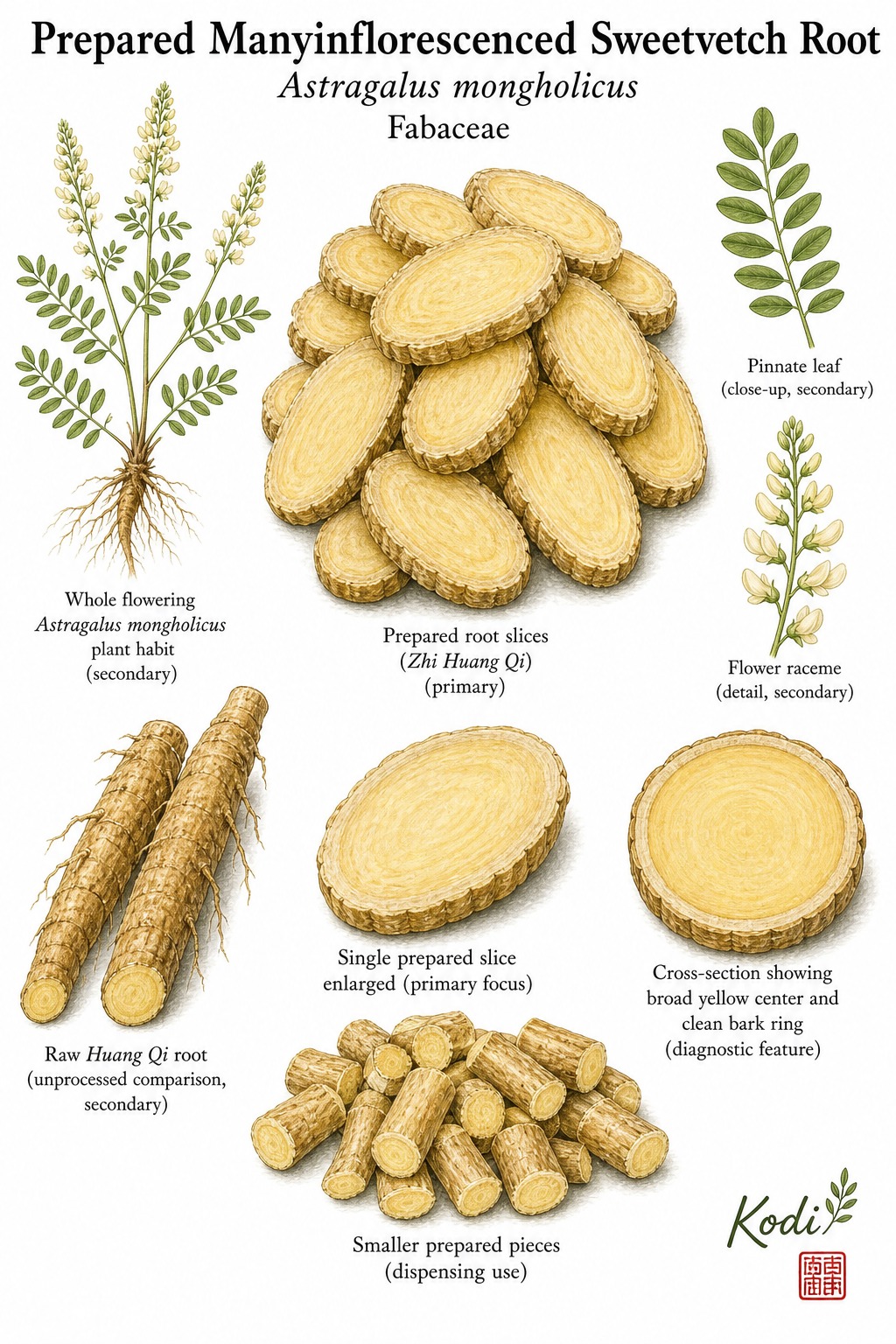
Known in TCM as Zhi Huang Qi (炙黄芪), this sweet, warm herb enters the Lung and Spleen. Traditionally, it tonifies Spleen and Lung Qi with an emphasis on deficiency recovery ... honey-fried Huang Qi is classically viewed as fuller, sweeter, and more center-strengthening than raw Huang Qi, most often applied for fatigue, immune deficiency, and spontaneous sweating. Modern research has identified Astragaloside among its active constituents.
Part used: Root
Also Known As
Latin: Radix Astragali Praeparata | Pinyin: Zhi Huang Qi | Chinese: 炙黄芪
TCM Properties
- Taste
- sweet
- Temperature
- warm
- Channels
- Lung, Spleen
Traditional Use
Primary Actions
- Tonifies Spleen and Lung Qi with an emphasis on deficiency recovery ... honey-fried Huang Qi is classically viewed as fuller, sweeter, and more center-strengthening than raw Huang Qi.
- Raises clear Yang and consolidates the exterior ... it is used for sinking or weak Qi patterns with spontaneous sweating, chronic fatigue, weak resistance, and prolapse-style deficiency logic.
- Promotes urination and reduces edema from Qi deficiency ... the prepared form helps restore transformation so fluid can move without directly draining.
- Supports tissue regeneration and recovery ... Zhi Huang Qi is widely associated with helping sores discharge, flesh regenerate, and chronic weakness rebuild over time.
Secondary Actions
- Despite the inherited sweetvetch slug, this record follows the accepted Astragalus mongholicus Huang Qi identity ... it should not be merged with the true Hedysarum Hong Qi sibling above.
- Honey processing pushes Huang Qi further toward tonifying and middle-burner support, so this page should read stronger and more deficiency-focused than the raw Astragalus root page.
Classic Formulas
- Bu Zhong Yi Qi Tang ... raises central Qi and treats fatigue, prolapse tendencies, and sinking patterns.
- Yu Ping Feng San ... consolidates the exterior for recurrent colds and spontaneous sweating due to defensive-Qi weakness.
- Dang Gui Bu Xue Tang ... tonifies Qi to generate Blood in deficiency and recovery states.
- Huang Qi Jian Zhong Tang ... warms and supplements the middle while relieving chronic deficiency discomfort.
Classical References
- Ben Cao Gang Mu elevates Huang Qi as a premier tonic herb, and later teaching preserves the honey-fried form as the more strongly supplementing prepared lane.
- Chinese Pharmacopoeia and paozhi texts treat honey-processing as a meaningful modification of Huang Qi's clinical direction rather than a cosmetic preparation detail.
- Modern inference ... some research below is on honey-processed Astragalus directly and some on Astragalus chemistry broadly, because both inform how Zhi Huang Qi differs from raw Huang Qi.
Modern Research
Active Compounds
- Astragaloside IV ... flagship saponin associated with immune and tissue-protective research
- Astragalus polysaccharides ... major water-soluble fractions central to tonifying and immunomodulatory studies
- Calycosin and formononetin ... characteristic isoflavonoids used in quality and activity profiling
- Cycloastragenol ... triterpenoid metabolite investigated in restorative and anti-aging research
Studied Effects
- Urine metabolomics work on honey-processed Astragalus found biomarker and pathway changes consistent with stronger Qi-tonifying activity than raw Astragali Radix in a spleen-Qi-deficiency model (PMID 29570937).
- A structural study found that honey processing changes Astragalus polysaccharides and demonstrated anti-inflammatory activity from the processed polysaccharide fraction in vitro (PMID 29342936).
- A 2025 study reported that honey-processed Astragalus polysaccharides improved intestinal immune function in spleen-Qi-deficiency mice, with linked microbiome and metabolomic changes supporting the prepared herb's stronger tonic reputation (PMID 39462888).
PubMed References
- Application of pathways activity profiling to urine metabolomics for screening Qi-tonifying biomarkers and metabolic pathways of honey-processed Astragalus. (2018)
- Structure Characterization of Honey-Processed Astragalus Polysaccharides and Its Anti-Inflammatory Activity In Vitro. (2018)
- Evidence of honey-processed Astragalus polysaccharides improving intestinal immune function in spleen Qi deficiency mice integrated with microbiomics and metabolomics analysis. (2025)
Safety & Interactions
Contraindications
- Excess heat conditions or unresolved acute infection
- Yin deficiency with heat signs
- Organ transplant recipients or patients taking immunosuppressants without specialist oversight
Cautions
- The honey-fried form is more tonifying than raw Huang Qi and may be the wrong fit when pathogens are not yet cleared.
- Use cautiously in autoimmune conditions or alongside strong immune-active therapies because Astragalus products can shift immune signaling.
Drug Interactions
- Immunosuppressants such as tacrolimus ... may oppose intended immunosuppressive effect
- Anticoagulants or antiplatelet drugs ... theoretical additive bleeding risk
- Antihypertensives or diuretics ... possible additive hemodynamic or fluid-regulating effects
Conditions
- Fatigue Traditional ★★★★★ JSON
- Immune Deficiency Research ★★★☆☆ JSON
- Spontaneous Sweating Traditional ★★★★☆ JSON
- Edema Traditional ★★★☆☆ JSON
Frequently Asked Questions
What is Honey-Fried Astragalus Root used for?
Honey-Fried Astragalus Root is traditionally used to Tonifies Spleen and Lung Qi with an emphasis on deficiency recovery ... honey-fried Huang Qi is classically viewed as fuller, sweeter, and more center-strengthening than raw Huang Qi., Raises clear Yang and consolidates the exterior ... it is used for sinking or weak Qi patterns with spontaneous sweating, chronic fatigue, weak resistance, and prolapse-style deficiency logic., Promotes urination and reduces edema from Qi deficiency ... the prepared form helps restore transformation so fluid can move without directly draining., Supports tissue regeneration and recovery ... Zhi Huang Qi is widely associated with helping sores discharge, flesh regenerate, and chronic weakness rebuild over time.. Research has investigated its effects on: Urine metabolomics work on honey-processed Astragalus found biomarker and pathway changes consistent with stronger Qi-tonifying activity than raw Astragali Radix in a spleen-Qi-deficiency model (PMID 29570937).; A structural study found that honey processing changes Astragalus polysaccharides and demonstrated anti-inflammatory activity from the processed polysaccharide fraction in vitro (PMID 29342936)..
What are other names for Honey-Fried Astragalus Root?
Honey-Fried Astragalus Root is also known as Prepared Huang Qi, Honey-Processed Astragalus, Astragali. In TCM: 炙黄芪 (Zhi Huang Qi); Radix Astragali Praeparata.
Is Honey-Fried Astragalus Root safe during pregnancy?
The safety of Honey-Fried Astragalus Root during pregnancy has not been established. Consult a qualified healthcare provider before use.
What are the contraindications for Honey-Fried Astragalus Root?
Honey-Fried Astragalus Root should not be used in: Excess heat conditions or unresolved acute infection; Yin deficiency with heat signs; Organ transplant recipients or patients taking immunosuppressants without specialist oversight. Consult a qualified healthcare provider before use.
Does Honey-Fried Astragalus Root interact with any medications?
Honey-Fried Astragalus Root may interact with: Immunosuppressants such as tacrolimus ... may oppose intended immunosuppressive effect; Anticoagulants or antiplatelet drugs ... theoretical additive bleeding risk; Antihypertensives or diuretics ... possible additive hemodynamic or fluid-regulating effects. Always inform your healthcare provider of any herbal supplements you are taking.