Honey-Fried Hedysarum Root
- Chinese
- 炙红芪
- Pinyin
- Zhi Hong Qi
- Latin
- Radix Hedysari Praeparata
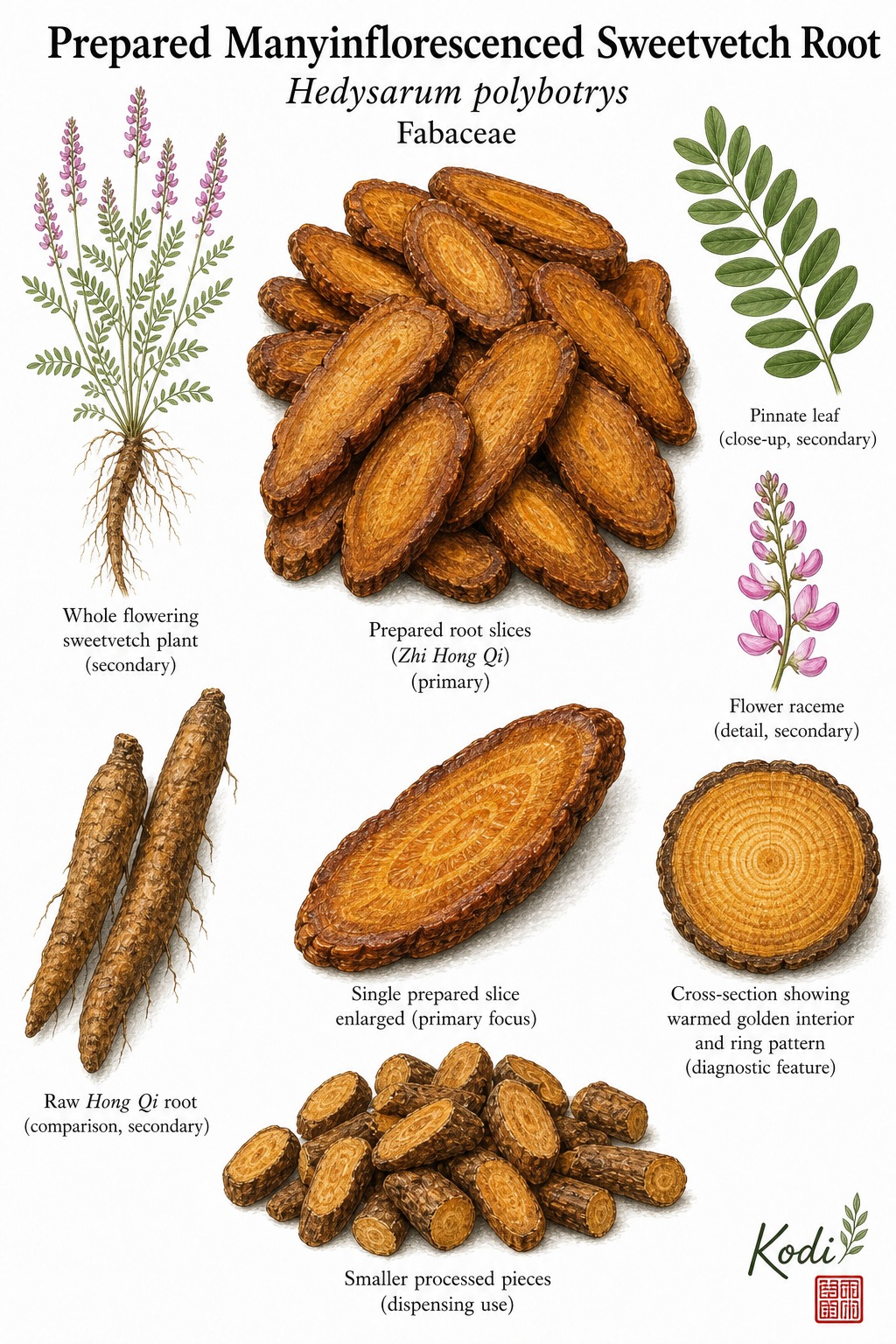
Known in TCM as Zhi Hong Qi (炙红芪), this sweet, slightly warm herb enters the Lung and Spleen. Traditionally, it tonifies Spleen and Lung Qi ... Zhi Hong Qi is the honey-fried Hedysarum lane used when fatigue, weak appetite, and reduced defensive Qi call for a gentler regional tonic herb, most often applied for fatigue, immune deficiency, and spontaneous sweating. Modern research has identified Hedysari among its active constituents.
Part used: Root
Also Known As
Latin: Radix Hedysari Praeparata | Pinyin: Zhi Hong Qi | Chinese: 炙红芪
TCM Properties
- Taste
- sweet
- Temperature
- slightly warm
- Channels
- Lung, Spleen
Traditional Use
Primary Actions
- Tonifies Spleen and Lung Qi ... Zhi Hong Qi is the honey-fried Hedysarum lane used when fatigue, weak appetite, and reduced defensive Qi call for a gentler regional tonic herb.
- Strengthens the exterior and supports recovery from deficiency ... it is used for weak resistance, spontaneous sweating, and recurrent depletion patterns in the same general clinical territory as Huang Qi.
- Promotes urination and reduces edema from Qi deficiency ... the prepared form supports fluid transformation when swelling reflects weak Qi rather than excess obstruction.
- Supports tissue repair and recovery ... traditional use extends to helping sores discharge and knit when underlying Qi weakness slows healing.
Secondary Actions
- This page should stay on true Hedysarum polybotrys ... Hong Qi is often traded as a Huang Qi substitute in northwest China, but it remains a separate medicinal identity with its own chemistry and should not be collapsed into Astragalus.
- Honey processing shifts the emphasis toward tonifying and center-supporting use, so Zhi Hong Qi reads warmer and fuller than the raw Hong Qi root page.
Classic Formulas
- Yu Ping Feng San adaptation logic ... Hong Qi is used regionally in Huang Qi's defensive-Qi role when consolidating the exterior and reducing spontaneous sweating.
- Bu Zhong Yi Qi Tang adaptation logic ... the prepared Hong Qi lane can stand in for stronger Qi tonics when raising clear Yang and supporting the middle burner.
- Dang Gui Bu Xue Tang substitution logic ... Hong Qi may appear in regional blood-and-Qi rebuilding strategies where a Huang Qi-like tonic is desired.
Classical References
- Chinese Pharmacopoeia lists Hong Qi separately from Huang Qi even though the trade names overlap and substitution occurs in regional practice.
- Northwest materia medica traditions especially in Gansu treat Hong Qi as a recognized tonic-root medicine rather than a mere misidentified Huang Qi.
- Modern inference ... most modern studies investigate Radix Hedysari or Hedysarum polysaccharides rather than the honey-fried slice specifically, so the research section below is applied from the broader Hong Qi material to this prepared form.
Modern Research
Active Compounds
- Hedysari polysaccharides ... major water-soluble fractions associated with immune and restorative research
- Flavonoids including formononetin-related isoflavonoids ... quality markers discussed in Hedysarum studies
- Triterpene saponins ... secondary metabolites contributing to tonic-herb pharmacology
- Phenolic compounds and amino-acid-rich fractions ... supportive constituents described in phytochemical reviews
Studied Effects
- A review of Hedysarum species summarizes broad phytochemistry and pharmacology, including antioxidant, immune-supportive, anti-aging, and anti-inflammatory potential relevant to the Hong Qi tradition (PMID 23866043).
- Hedysarum polybotrys extract showed anti-inflammatory and immunomodulatory effects in macrophage, splenocyte, and leucopenia models, supporting its traditional role as a restorative Qi tonic (PMID 24300120).
- Polysaccharides from Radix Hedysari protected against acetic-acid-induced gastric ulcer injury in rats, adding modern support for the herb's broader restorative and tissue-protective reputation (PMID 31204764).
PubMed References
- Phytochemicals and biological studies of plants in genus Hedysarum. (2013)
- Immunomodulatory effects of Hedysarum polybotrys extract in mice macrophages, splenocytes and leucopenia. (2013)
- Protective effect of polysaccharides from Radix Hedysari on gastric ulcers induced by acetic acid in rats. (2019)
Safety & Interactions
Contraindications
- Excess heat patterns or Yin deficiency with obvious heat signs
Cautions
- Do not assume complete interchangeability with Huang Qi in every formula just because both may circulate under overlapping tonic-root trade language.
- Prepared tonic roots can trap pathogens if used too early in an unresolved acute exterior invasion.
Conditions
- Fatigue Traditional ★★★☆☆ JSON
- Immune Deficiency Research ★★☆☆☆ JSON
- Spontaneous Sweating Traditional ★★☆☆☆ JSON
- Edema Traditional ★★☆☆☆ JSON
Frequently Asked Questions
What is Honey-Fried Hedysarum Root used for?
Honey-Fried Hedysarum Root is traditionally used to Tonifies Spleen and Lung Qi ... Zhi Hong Qi is the honey-fried Hedysarum lane used when fatigue, weak appetite, and reduced defensive Qi call for a gentler regional tonic herb., Strengthens the exterior and supports recovery from deficiency ... it is used for weak resistance, spontaneous sweating, and recurrent depletion patterns in the same general clinical territory as Huang Qi., Promotes urination and reduces edema from Qi deficiency ... the prepared form supports fluid transformation when swelling reflects weak Qi rather than excess obstruction., Supports tissue repair and recovery ... traditional use extends to helping sores discharge and knit when underlying Qi weakness slows healing.. Research has investigated its effects on: A review of Hedysarum species summarizes broad phytochemistry and pharmacology, including antioxidant, immune-supportive, anti-aging, and anti-inflammatory potential relevant to the Hong Qi tradition (PMID 23866043).; Hedysarum polybotrys extract showed anti-inflammatory and immunomodulatory effects in macrophage, splenocyte, and leucopenia models, supporting its traditional role as a restorative Qi tonic (PMID 24300120)..
What are other names for Honey-Fried Hedysarum Root?
Honey-Fried Hedysarum Root is also known as Prepared Hong Qi, Honey-Fried Sweetvetch Root, Hedysari. In TCM: 炙红芪 (Zhi Hong Qi); Radix Hedysari Praeparata.
Is Honey-Fried Hedysarum Root safe during pregnancy?
Honey-Fried Hedysarum Root is generally considered safe during pregnancy in normal amounts. Therapeutic or concentrated doses should be discussed with a qualified healthcare provider before use.
What are the contraindications for Honey-Fried Hedysarum Root?
Honey-Fried Hedysarum Root should not be used in: Excess heat patterns or Yin deficiency with obvious heat signs. Consult a qualified healthcare provider before use.