Honey-Fried Loquat Leaf
- Chinese
- 炙柷杷叶
- Pinyin
- Zhi Pi Pa Ye
- Latin
- Folium Eriobotryae Praeparata
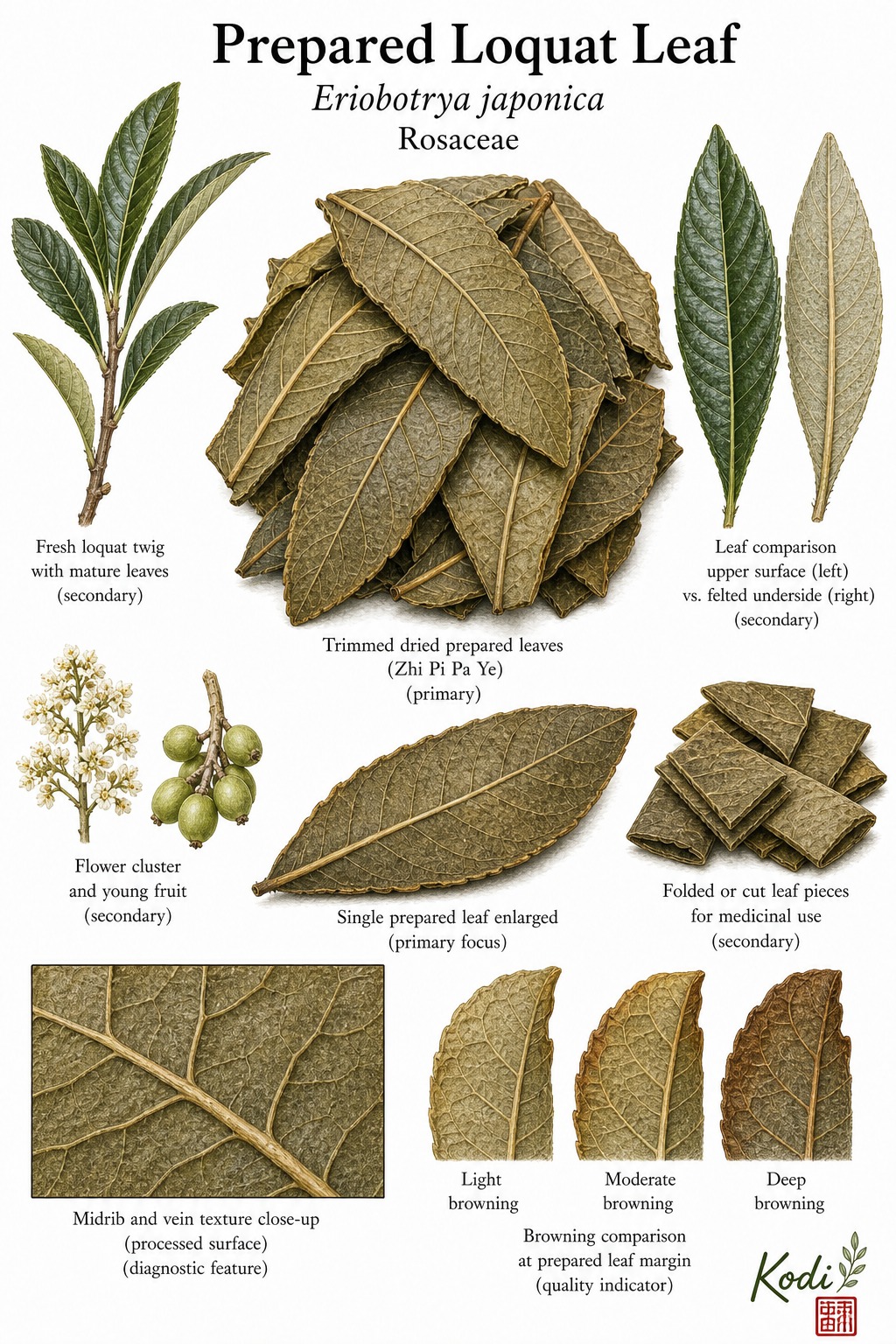
Known in TCM as Zhi Pi Pa Ye (炙柷杷叶), this bitter and slightly sweet, slightly cool herb enters the Lung and Stomach. Traditionally, it moistens the Lungs and stops cough ... honey-fried Pi Pa Ye is favored for dry, weak, or lingering cough when the raw leaf would be too cold or too harsh, most often applied for dry cough, cough, and productive cough. Modern research has identified Ursolic among its active constituents.
Part used: Leaf
Also Known As
Latin: Folium Eriobotryae Praeparata | Pinyin: Zhi Pi Pa Ye | Chinese: 炙柷杷叶
TCM Properties
- Taste
- bitter, slightly sweet
- Temperature
- slightly cool
- Channels
- Lung, Stomach
Traditional Use
Primary Actions
- Moistens the Lungs and stops cough ... honey-fried Pi Pa Ye is favored for dry, weak, or lingering cough when the raw leaf would be too cold or too harsh.
- Descends Lung Qi and gently transforms phlegm ... the prepared form still addresses cough with sputum, but with a softer more moistening profile than raw Pi Pa Ye.
- Redirects rebellious Stomach Qi downward ... it is used for nausea, vomiting, or retching when Stomach Qi counterflows upward.
- Reduces the irritant nature of the raw leaf surface ... processing helps make the leaf more suitable for formula use after the troublesome hairs have been handled.
Secondary Actions
- Compared with raw Pi Pa Ye, the prepared form is less cold and more often discussed for chronic or deficiency-pattern cough instead of pronounced Lung-Heat.
- This page should stay leaf-forward and processed ... it is not a loquat fruit remedy, syrup brand, or tea-marketing variation.
Classic Formulas
- Pi Pa Ye Gao ... classic loquat-leaf syrup tradition for cough, throat irritation, and descending rebellious Lung Qi.
- Chuan Bei Pi Pa Gao lineage ... later syrup-style cough preparations often rely on prepared Pi Pa Ye for a smoother moistening effect.
- Clinical pairings with Zhu Ru or Lu Gen ... common materia medica logic when prepared Pi Pa Ye is used to redirect Stomach Qi downward and stop nausea.
Classical References
- Ben Cao Gang Mu records Pi Pa Ye for clearing Lung heat and redirecting rebellious Stomach Qi downward.
- Traditional processing texts note that prepared loquat leaf is better suited to cough use after reducing irritation and moderating excessive coldness.
- Modern teaching continues the distinction ... raw Pi Pa Ye is more cold and heat-clearing, while prepared Pi Pa Ye is gentler and more moistening.
Modern Research
Active Compounds
- Ursolic acid ... major triterpene acid studied for airway and anti-inflammatory effects
- Oleanolic acid and corosolic acid ... loquat triterpenes associated with anti-inflammatory and metabolic research
- Maslinic acid ... pentacyclic triterpene contributing to anti-inflammatory profiling
- Quercetin and kaempferol glycosides ... flavonoids linked to antioxidant and expectorant activity
Studied Effects
- A 2022 review summarizes the traditional uses, phytochemistry, pharmacology, and toxicity data for Eriobotrya japonica leaves, highlighting their long-standing use for cough, dyspnea, and respiratory inflammation (PMID 35870687).
- Loquat leaf extract attenuated airway inflammation in an ovalbumin-induced asthma model, supporting the traditional use of Pi Pa Ye for wheezing and reactive airway patterns (PMID 31310829).
- Triterpene acids from loquat leaf improved inflammation in a cigarette-smoke COPD model through AMPK, Nrf2, and NF-kB related pathways, offering a modern correlate for the prepared leaf's Lung-soothing reputation (PMID 32121228).
PubMed References
- Traditional uses, phytochemistry, pharmacology, and toxicity of Eriobotrya japonica leaves: A summary. (2022)
- Eriobotrya japonica leaf extract attenuates airway inflammation in ovalbumin-induced mice model of asthma. (2020)
- Triterpene Acids of Loquat Leaf Improve Inflammation in Cigarette Smoking Induced COPD by Regulating AMPK/Nrf2 and NF-kB Pathways (2020)
Safety & Interactions
Contraindications
- Cold-phlegm or wind-cold cough without heat or dryness signs
Cautions
- The leaf should be brushed or prepared so its hairs do not irritate the throat and worsen coughing.
- Prepared Pi Pa Ye is gentler than raw leaf, but it is still not the best choice for obvious cold cough without heat, dryness, or rebellious Qi.
Conditions
Frequently Asked Questions
What is Honey-Fried Loquat Leaf used for?
Honey-Fried Loquat Leaf is traditionally used to Moistens the Lungs and stops cough ... honey-fried Pi Pa Ye is favored for dry, weak, or lingering cough when the raw leaf would be too cold or too harsh., Descends Lung Qi and gently transforms phlegm ... the prepared form still addresses cough with sputum, but with a softer more moistening profile than raw Pi Pa Ye., Redirects rebellious Stomach Qi downward ... it is used for nausea, vomiting, or retching when Stomach Qi counterflows upward., Reduces the irritant nature of the raw leaf surface ... processing helps make the leaf more suitable for formula use after the troublesome hairs have been handled.. Research has investigated its effects on: A 2022 review summarizes the traditional uses, phytochemistry, pharmacology, and toxicity data for Eriobotrya japonica leaves, highlighting their long-standing use for cough, dyspnea, and respiratory inflammation (PMID 35870687).; Loquat leaf extract attenuated airway inflammation in an ovalbumin-induced asthma model, supporting the traditional use of Pi Pa Ye for wheezing and reactive airway patterns (PMID 31310829)..
What are other names for Honey-Fried Loquat Leaf?
Honey-Fried Loquat Leaf is also known as Prepared Loquat Leaf, Processed Pi Pa Ye, Eriobotrya. In TCM: 炙柷杷叶 (Zhi Pi Pa Ye); Folium Eriobotryae Praeparata.
Is Honey-Fried Loquat Leaf safe during pregnancy?
Honey-Fried Loquat Leaf is generally considered safe during pregnancy in normal amounts. Therapeutic or concentrated doses should be discussed with a qualified healthcare provider before use.
What are the contraindications for Honey-Fried Loquat Leaf?
Honey-Fried Loquat Leaf should not be used in: Cold-phlegm or wind-cold cough without heat or dryness signs. Consult a qualified healthcare provider before use.