Honey-Fried Licorice Root
- Chinese
- 炙甘草
- Pinyin
- Zhi Gan Cao
- Latin
- Radix Glycyrrhizae Praeparata
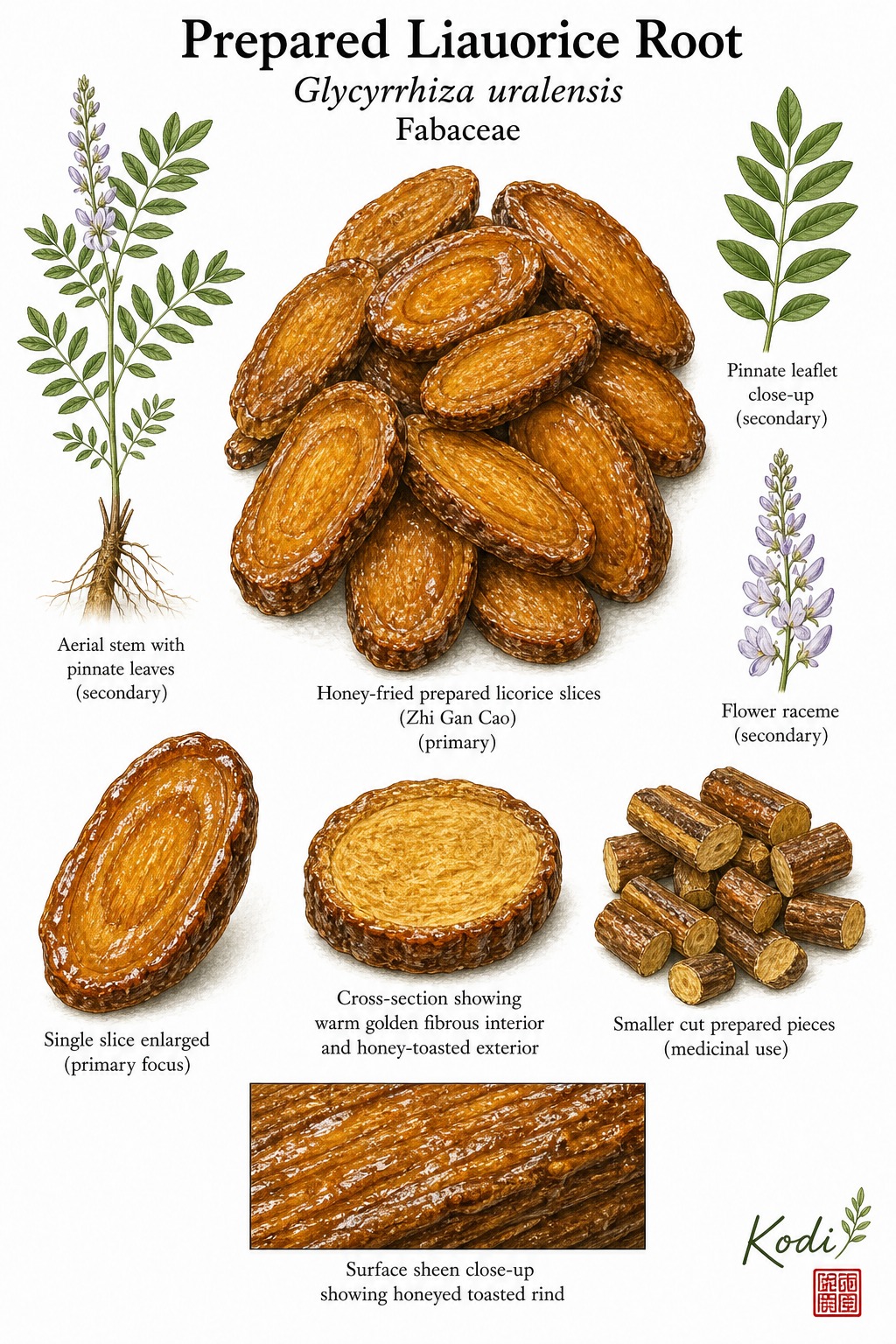
Known in TCM as Zhi Gan Cao (炙甘草), this sweet, warm herb enters the Heart, Lung, Spleen, and Stomach. Traditionally, it tonifies Spleen Qi and strengthens the middle burner ... Zhi Gan Cao is sweeter, warmer, and more Qi-supportive than raw Gan Cao, so it is favored in deficiency and recovery formulas, most often applied for fatigue, dry cough, and palpitations. Modern research has identified Glycyrrhizin among its active constituents.
Part used: Root
Also Known As
Latin: Radix Glycyrrhizae Praeparata | Pinyin: Zhi Gan Cao | Chinese: 炙甘草
TCM Properties
- Taste
- sweet
- Temperature
- warm
- Channels
- Heart, Lung, Spleen, Stomach
Traditional Use
Primary Actions
- Tonifies Spleen Qi and strengthens the middle burner ... Zhi Gan Cao is sweeter, warmer, and more Qi-supportive than raw Gan Cao, so it is favored in deficiency and recovery formulas.
- Moistens the Lungs and stops cough ... the honey-fried form is especially associated with dry, weak, or lingering cough rather than the more detoxifying sore-throat lane of raw licorice.
- Moderates spasms and relieves pain ... it is classically used for abdominal cramping, urgent pain, or muscle spasm when sweetness and harmonization are needed.
- Benefits Qi and restores the pulse while harmonizing other herbs ... this is the licorice form linked to Zhi Gan Cao Tang and to formula traditions that support palpitations, depleted Qi, and irregular pulse.
Secondary Actions
- Compared with raw Gan Cao, honey-fried licorice is more tonifying and center-focused, while raw licorice is more often discussed for clearing heat, detoxifying, or soothing sore throat.
- This page should stay distinct from the later `prepared-root-of-ural-licorice` sibling ... that prompt points to a drier plain-processed Zhi Cao lane, while this record is the classic glossy honey-fried Zhi Gan Cao form.
Classic Formulas
- Zhi Gan Cao Tang ... classical formula for irregular pulse, palpitations, and combined Qi-Yin deficiency.
- Si Jun Zi Tang ... supports Spleen Qi and digestion, with Zhi Gan Cao harmonizing and reinforcing the center.
- Li Zhong Tang ... middle-burner warming formula for deficient cold, poor appetite, and abdominal discomfort.
- Shao Yao Gan Cao Tang ... classic pair for cramping pain and sudden muscle spasm.
Classical References
- Shang Han Lun gives Zhi Gan Cao a special status in pulse-restoring and deficiency-recovery contexts through Zhi Gan Cao Tang.
- Traditional materia medica consistently separates honey-fried licorice from raw licorice ... the honey-fried form supplements and harmonizes more strongly.
- Modern paozhi teaching likewise describes honey-processing as enhancing Gan Cao's Qi-tonifying and Lung-moistening direction.
Modern Research
Active Compounds
- Glycyrrhizin ... major triterpene saponin associated with anti-inflammatory effects and pseudoaldosteronism risk
- Glycyrrhetinic acid ... active metabolite linked to mineralocorticoid-like adverse effects
- Liquiritin and liquiritigenin ... characteristic flavonoids studied for anti-inflammatory and antispasmodic activity
- Isoliquiritigenin ... chalcone constituent with antioxidant and signaling effects
- Licochalcone A ... bioactive licorice flavonoid investigated in inflammation research
Studied Effects
- A major licorice review summarizes broad phytochemistry and pharmacology, including anti-inflammatory, antiviral, hepatoprotective, and harmonizing actions across Glycyrrhiza species (PMID 31811935).
- Research comparing honey-fried licorice with other fried licorice forms found that honey processing materially changes chemical composition and is associated with stronger immunomodulatory, anti-inflammatory, and hepatoprotective effects in the tested models (PMID 36270557).
- A narrative review of licorice-induced pseudoaldosteronism details the clinically important risks of hypokalemia, edema, hypertension, and arrhythmia from excessive or prolonged glycyrrhizin exposure ... a key safety issue even for traditional prepared forms (PMID 34604277).
PubMed References
- An "essential herbal medicine"-licorice: A review of phytochemicals and its effects in combination preparations (2020)
- Chemical and pharmacological difference between honey-fried licorice and fried licorice. (2023)
- Clinical Risk Factors of Licorice-Induced Pseudoaldosteronism Based on Glycyrrhizin-Metabolite Concentrations: A Narrative Review (2021)
Safety & Interactions
Contraindications
- Uncontrolled hypertension, edema, or hypokalemia
- Severe heart failure, chronic kidney disease, or known pseudoaldosteronism history
- High-dose or prolonged unsupervised use
Cautions
- Licorice can raise blood pressure, lower potassium, and promote fluid retention when used in excess or for long periods.
- The honey-fried form is still real licorice ... preparation style does not remove glycyrrhizin-related safety issues.
- Patients with palpitations or edema should not assume that a sweet tonic herb is automatically low risk.
Drug Interactions
- Loop or thiazide diuretics ... additive potassium loss and arrhythmia risk
- Digoxin and other cardiac glycosides ... hypokalemia may increase toxicity risk
- Corticosteroids ... additive mineralocorticoid-like effects
- Antihypertensives or antiarrhythmics ... licorice-related electrolyte changes may complicate therapy
Conditions
- Fatigue Traditional ★★★★☆ JSON
- Dry Cough Traditional ★★★☆☆ JSON
- Palpitations Traditional ★★★☆☆ JSON
- Abdominal Pain Traditional ★★☆☆☆ JSON
Frequently Asked Questions
What is Honey-Fried Licorice Root used for?
Honey-Fried Licorice Root is traditionally used to Tonifies Spleen Qi and strengthens the middle burner ... Zhi Gan Cao is sweeter, warmer, and more Qi-supportive than raw Gan Cao, so it is favored in deficiency and recovery formulas., Moistens the Lungs and stops cough ... the honey-fried form is especially associated with dry, weak, or lingering cough rather than the more detoxifying sore-throat lane of raw licorice., Moderates spasms and relieves pain ... it is classically used for abdominal cramping, urgent pain, or muscle spasm when sweetness and harmonization are needed., Benefits Qi and restores the pulse while harmonizing other herbs ... this is the licorice form linked to Zhi Gan Cao Tang and to formula traditions that support palpitations, depleted Qi, and irregular pulse.. Research has investigated its effects on: A major licorice review summarizes broad phytochemistry and pharmacology, including anti-inflammatory, antiviral, hepatoprotective, and harmonizing actions across Glycyrrhiza species (PMID 31811935).; Research comparing honey-fried licorice with other fried licorice forms found that honey processing materially changes chemical composition and is associated with stronger immunomodulatory, anti-inflammatory, and hepatoprotective effects in the tested models (PMID 36270557)..
What are other names for Honey-Fried Licorice Root?
Honey-Fried Licorice Root is also known as Prepared Licorice, Roasted Licorice, Glycyrrhiza. In TCM: 炙甘草 (Zhi Gan Cao); Radix Glycyrrhizae Praeparata.
Is Honey-Fried Licorice Root safe during pregnancy?
The safety of Honey-Fried Licorice Root during pregnancy has not been established. Consult a qualified healthcare provider before use.
What are the contraindications for Honey-Fried Licorice Root?
Honey-Fried Licorice Root should not be used in: Uncontrolled hypertension, edema, or hypokalemia; Severe heart failure, chronic kidney disease, or known pseudoaldosteronism history; High-dose or prolonged unsupervised use. Consult a qualified healthcare provider before use.
Does Honey-Fried Licorice Root interact with any medications?
Honey-Fried Licorice Root may interact with: Loop or thiazide diuretics ... additive potassium loss and arrhythmia risk; Digoxin and other cardiac glycosides ... hypokalemia may increase toxicity risk; Corticosteroids ... additive mineralocorticoid-like effects; Antihypertensives or antiarrhythmics ... licorice-related electrolyte changes may complicate therapy. Always inform your healthcare provider of any herbal supplements you are taking.