Prepared Aconite Root Slices
- Chinese
- 制附子
- Pinyin
- Zhi Fu Zi
- Latin
- Aconiti Lateralis Radix Praeparata
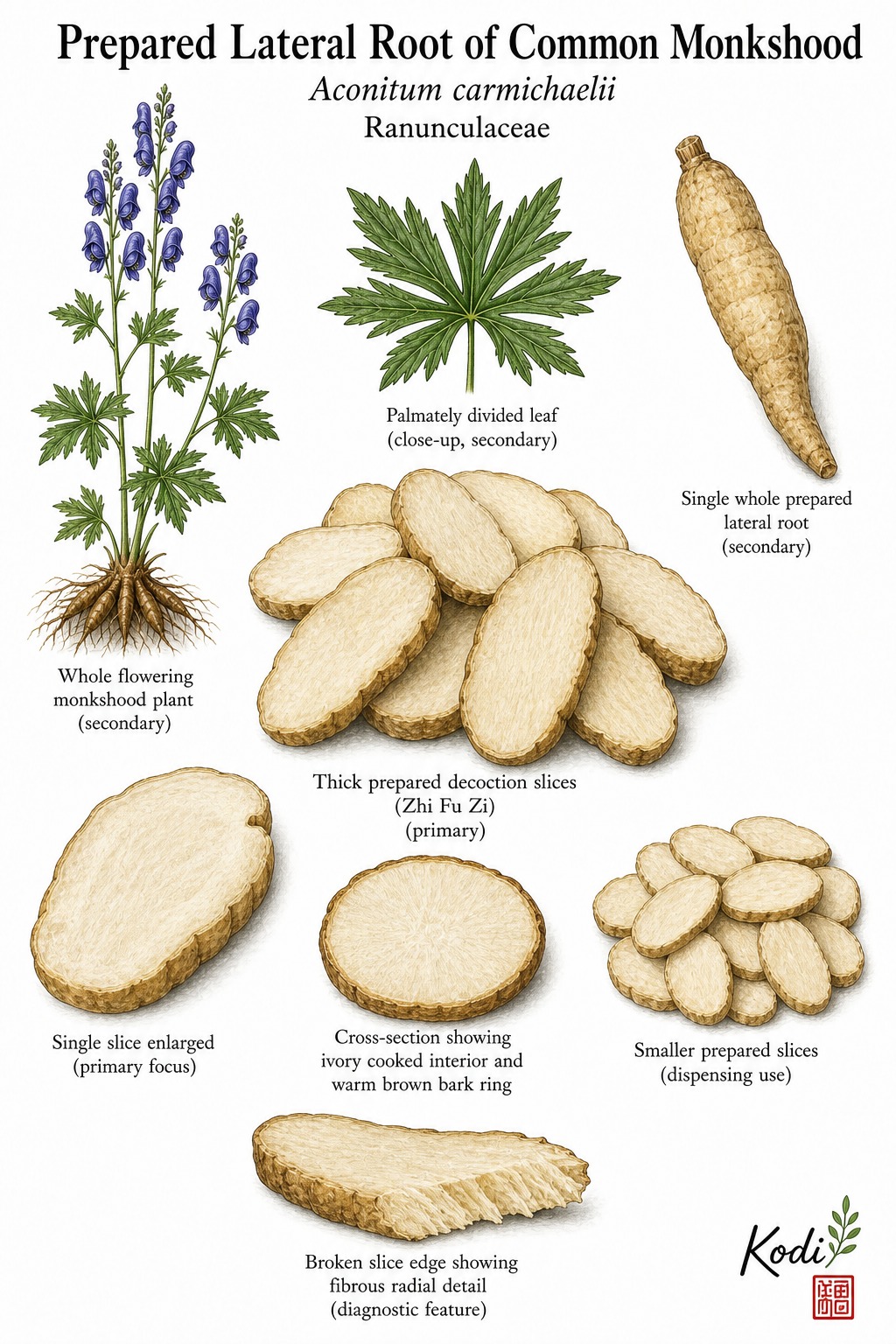
Known in TCM as Zhi Fu Zi (制附子), this acrid and sweet, hot herb enters the Heart, Kidney, and Spleen. Traditionally, it restores collapsed Yang and rescues cold collapse ... Zhi Fu Zi is the classic processed Fu Zi lane used when cold exhaustion has reached the pulse, circulation, and core vitality, most often applied for kidney yang deficiency, low back pain, and joint pain. Modern research has identified Aconitine, among its active constituents.
Also Known As
Latin: Aconiti Lateralis Radix Praeparata | Pinyin: Zhi Fu Zi | Chinese: 制附子
TCM Properties
- Taste
- acrid, sweet
- Temperature
- hot
- Channels
- Heart, Kidney, Spleen
Traditional Use
Primary Actions
- Restores collapsed Yang and rescues cold collapse ... Zhi Fu Zi is the classic processed Fu Zi lane used when cold exhaustion has reached the pulse, circulation, and core vitality.
- Warms Heart, Spleen, and Kidney Yang ... the prepared slice form is used for edema, chronic diarrhea, cold abdominal pain, weak lower back and knees, and deficient-cold water retention.
- Warms the channels and relieves cold-damp pain ... it is widely dispensed for cold Bi, deep aching joints, and low-back pain that worsens in cold weather and improves with heat.
- Assists fire and supports lower-burner function ... it appears in formulas for chronic Yang decline with weakness, frequent urination, cold womb, or poor transformative power.
Secondary Actions
- This Zhi Fu Zi page should stay distinct from the darker whole-root-forward Pao Fu Zi sibling ... the emphasis here is the paler standardized prepared slice lot used in decoction practice.
- It also differs from the already-live Fu Pian and Shou Fu Pian records ... all belong to the prepared aconite family, but Zhi Fu Zi functions as the broad processed Fu Zi dispensing lane rather than a black-and-white slice comparison or cooked-slice subtype.
Classic Formulas
- Si Ni Tang ... core rescue formula for devastated Yang, icy extremities, and a faint or nearly extinguished pulse.
- Zhen Wu Tang ... warms Spleen and Kidney Yang while mobilizing retained fluids for edema, dizziness, and abdominal pain.
- Gui Zhi Fu Zi Tang ... channel-warming formula for wind-cold-damp painful obstruction with fixed joint pain.
- You Gui Wan ... deeply warms Kidney Yang and gate-of-vitality fire for chronic cold debility and lower-body weakness.
Classical References
- Shang Han Lun and Jin Gui Yao Lue establish prepared Fu Zi as a central rescue and warming herb for Shaoyin collapse, edema, cold pain, and severe Yang deficiency.
- Chinese Pharmacopoeia guidance continues the classical distinction that only prepared lateral root is used internally ... never raw aconite.
- Modern dispensing inference ... most pharmacology sources discuss prepared Fu Zi broadly rather than separating Zhi Fu Zi from other processed slice names, so this record represents the slice-dominant prepared lane within that shared tradition.
Modern Research
Active Compounds
- Aconitine, mesaconitine, and hypaconitine ... toxic diester alkaloids reduced by proper processing
- Benzoylaconine, benzoylmesaconine, and benzoylhypaconine ... less toxic monoester hydrolysis products enriched by decoction and processing
- Aminoalcohol-diterpenoid alkaloids ... processed aconite constituents studied for cardioprotective effects
- C19-diterpenoid alkaloid arabinosides ... aqueous-extract compounds associated with analgesic activity
- Fuzi polysaccharides ... non-alkaloid fractions investigated for immunomodulatory effects
Studied Effects
- A 2023 Fu Zi review concluded that processing shifts toxic chemistry toward less dangerous forms while preserving clinically relevant cardiovascular, anti-inflammatory, and immunoregulatory effects across the prepared lateral-root family (PMID 36257343).
- Several aqueous-extract arabinoside alkaloids from Aconitum carmichaelii showed strong analgesic activity in a mouse writhing model, supporting the continued use of prepared aconite slices in cold painful-obstruction formulas (PMID 29881680).
- Aminoalcohol-diterpenoid alkaloids from Aconitum carmichaelii protected H9c2 cardiomyocytes against doxorubicin injury, offering a modern correlate to the traditional use of prepared aconite for Heart-Yang weakness and weak circulation (PMID 33387644).
PubMed References
- Ethnopharmacological use, pharmacology, toxicology, phytochemistry, and progress in Chinese crude drug processing of the lateral root of Aconitum carmichaelii Debeaux. (Fuzi): A review (2023)
- C19-Diterpenoid alkaloid arabinosides from an aqueous extract of the lateral root of Aconitum carmichaelii and their analgesic activities (2018)
- Cardioprotective effects and concentration-response relationship of aminoalcohol-diterpenoid alkaloids from Aconitum carmichaelii (2021)
Safety & Interactions
Contraindications
- Pregnancy
- Heat patterns, Yin deficiency with heat, or clear internal heat without cold
- Raw or inadequately processed aconite for internal use
- Unsupervised use in frail patients, children, or anyone with major arrhythmia risk
Cautions
- Zhi Fu Zi is processed but still toxic and generally needs pre-decoction, authenticated sourcing, and formula-based supervision.
- Toxicity can begin with mouth numbness, tingling, nausea, vomiting, diarrhea, weakness, and hypotension before progressing to dangerous arrhythmias.
- Traditional incompatibility cautions remain for Ban Xia, the Gua Lou group, Tian Hua Fen, Bai Ji, Bai Lian, and the Bei Mu group.
Drug Interactions
- Cardiac glycosides such as digoxin ... additive arrhythmogenic risk
- Class I and III antiarrhythmic drugs ... unpredictable electrophysiologic interaction
- Beta-blockers or other rate-slowing agents ... may worsen bradycardia or mask early toxicity
- QT-prolonging medications ... additive risk of malignant ventricular arrhythmia
Conditions
- Kidney Yang Deficiency Traditional ★★★★★ JSON
- Low Back Pain Traditional ★★★☆☆ JSON
- Joint Pain Traditional ★★★☆☆ JSON
- Abdominal Pain Traditional ★★★☆☆ JSON
Frequently Asked Questions
What is Prepared Aconite Root Slices used for?
Prepared Aconite Root Slices is traditionally used to Restores collapsed Yang and rescues cold collapse ... Zhi Fu Zi is the classic processed Fu Zi lane used when cold exhaustion has reached the pulse, circulation, and core vitality., Warms Heart, Spleen, and Kidney Yang ... the prepared slice form is used for edema, chronic diarrhea, cold abdominal pain, weak lower back and knees, and deficient-cold water retention., Warms the channels and relieves cold-damp pain ... it is widely dispensed for cold Bi, deep aching joints, and low-back pain that worsens in cold weather and improves with heat., Assists fire and supports lower-burner function ... it appears in formulas for chronic Yang decline with weakness, frequent urination, cold womb, or poor transformative power.. Research has investigated its effects on: A 2023 Fu Zi review concluded that processing shifts toxic chemistry toward less dangerous forms while preserving clinically relevant cardiovascular, anti-inflammatory, and immunoregulatory effects across the prepared lateral-root family (PMID 36257343).; Several aqueous-extract arabinoside alkaloids from Aconitum carmichaelii showed strong analgesic activity in a mouse writhing model, supporting the continued use of prepared aconite slices in cold painful-obstruction formulas (PMID 29881680)..
What are other names for Prepared Aconite Root Slices?
Prepared Aconite Root Slices is also known as Prepared Fu Zi, Processed Aconite, Aconiti. In TCM: 制附子 (Zhi Fu Zi); Aconiti Lateralis Radix Praeparata.
Is Prepared Aconite Root Slices safe during pregnancy?
Prepared Aconite Root Slices is not recommended during pregnancy.
What are the contraindications for Prepared Aconite Root Slices?
Prepared Aconite Root Slices should not be used in: Pregnancy; Heat patterns, Yin deficiency with heat, or clear internal heat without cold; Raw or inadequately processed aconite for internal use; Unsupervised use in frail patients, children, or anyone with major arrhythmia risk. Consult a qualified healthcare provider before use.
Does Prepared Aconite Root Slices interact with any medications?
Prepared Aconite Root Slices may interact with: Cardiac glycosides such as digoxin ... additive arrhythmogenic risk; Class I and III antiarrhythmic drugs ... unpredictable electrophysiologic interaction; Beta-blockers or other rate-slowing agents ... may worsen bradycardia or mask early toxicity; QT-prolonging medications ... additive risk of malignant ventricular arrhythmia. Always inform your healthcare provider of any herbal supplements you are taking.