Roasted Aconite Lateral Root
- Chinese
- 炮附子
- Pinyin
- Pao Fu Zi
- Latin
- Aconiti Lateralis Radix Praeparata
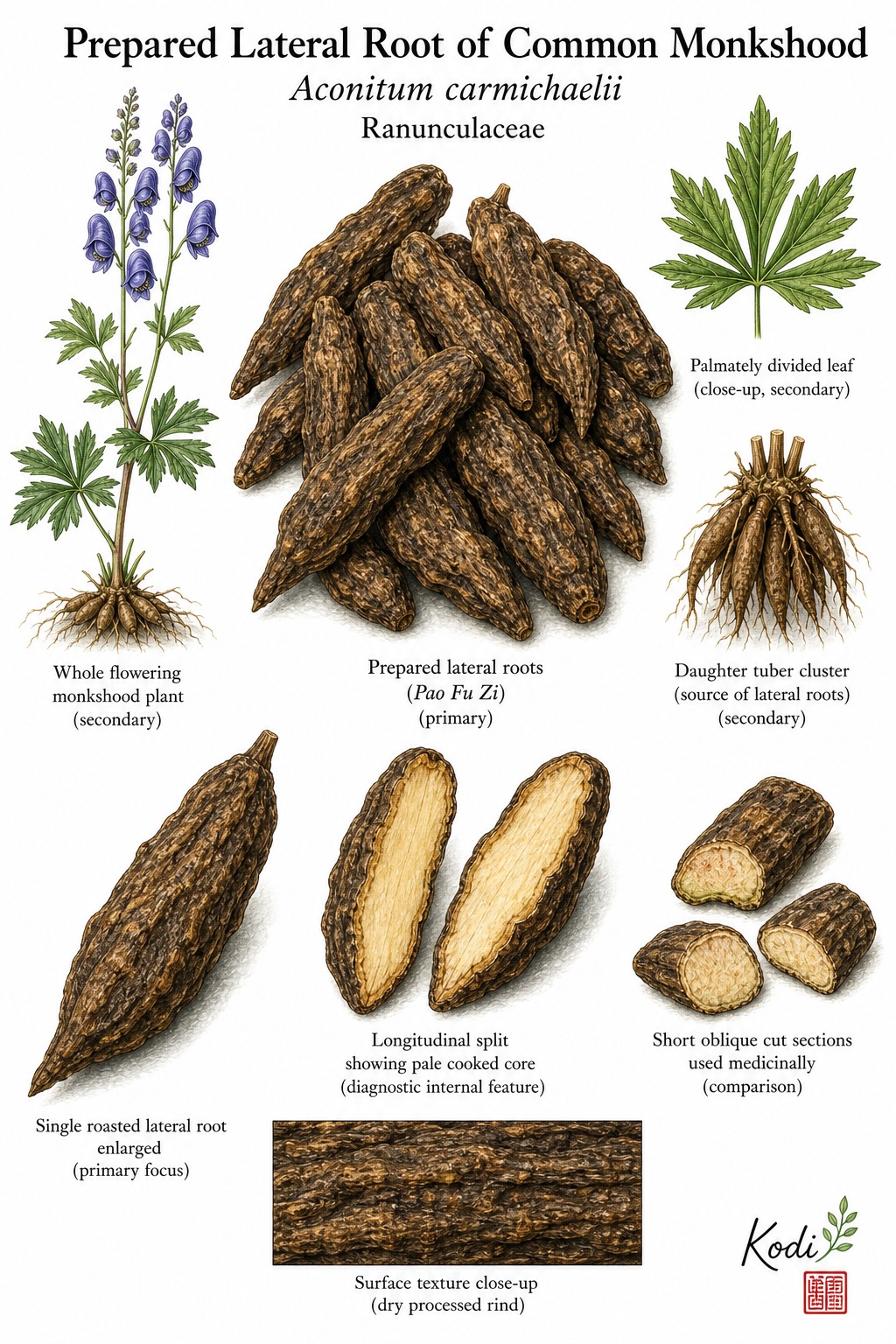
Known in TCM as Pao Fu Zi (炮附子), this acrid and sweet, hot herb enters the Heart, Kidney, and Spleen. Traditionally, it restores collapsed Yang and revives devastated fire ... Pao Fu Zi is a strongly warming prepared aconite lane used when cold collapse presents with icy limbs, faint pulse, somnolence, or severe Yang exhaustion, most often applied for kidney yang deficiency, diarrhea, and edema. Modern research has identified Aconitine, among its active constituents.
Also Known As
Latin: Aconiti Lateralis Radix Praeparata | Pinyin: Pao Fu Zi | Chinese: 炮附子
TCM Properties
- Taste
- acrid, sweet
- Temperature
- hot
- Channels
- Heart, Kidney, Spleen
Traditional Use
Primary Actions
- Restores collapsed Yang and revives devastated fire ... Pao Fu Zi is a strongly warming prepared aconite lane used when cold collapse presents with icy limbs, faint pulse, somnolence, or severe Yang exhaustion.
- Warms Heart, Spleen, and Kidney Yang ... it is used for deep deficiency-cold patterns with diarrhea, edema, abdominal cold pain, weak circulation, and failure of water transformation.
- Warms the channels and disperses severe cold pain ... the roasted whole-root-forward form is associated with stubborn cold-damp painful obstruction, weak low back, and fixed pain that improves with heat.
- Supports the pulse and lower-burner fire ... it is chosen when profound Yang weakness affects palpitations, chronic fatigue, or collapse-level cold.
Secondary Actions
- This Pao Fu Zi page should stay distinct from the paler slice-dominant Zhi Fu Zi sibling ... the emphasis here is the darker roasted prepared lateral root rather than a uniform decoction-slice lot.
- Like all Fu Zi family medicinals, it is almost always pre-decocted and paired with harmonizing herbs such as Gan Jiang, Zhi Gan Cao, Bai Zhu, or Fu Ling rather than used by itself.
Classic Formulas
- Si Ni Tang ... archetypal rescue formula for Shaoyin collapse, cold extremities, and a nearly extinguished pulse.
- Zhen Wu Tang ... warms Spleen and Kidney Yang while mobilizing retained fluids for edema, dizziness, and abdominal pain.
- Fu Zi Li Zhong Tang ... strongly warms the middle burner for chronic diarrhea, weak digestion, and deep interior cold.
- You Gui Wan ... restores Mingmen fire for chronic lower-body cold, weakness, and Kidney-Yang deficiency.
Classical References
- Classical Fu Zi traditions in Shang Han Lun and Jin Gui Yao Lue treat the prepared lateral root as indispensable for restoring Yang, warming fire, and dispersing severe cold, while always respecting its toxicity.
- Paozhi literature differentiates whole-root and slice forms because roasting, steaming, and slicing affect handling, decoction, and the balance between rescue, warming, and pain-relieving uses.
- Modern dispensing inference ... most current sources discuss prepared Fu Zi broadly rather than isolating Pao Fu Zi as a separate pharmacology category, so this page follows the whole-root roasted lane within that broader prepared-aconite family.
Modern Research
Active Compounds
- Aconitine, mesaconitine, and hypaconitine ... toxic diester diterpenoid alkaloids characteristic of raw aconite
- Benzoylaconine, benzoylmesaconine, and benzoylhypaconine ... less toxic monoester alkaloids increased by processing and decoction
- Aminoalcohol-diterpenoid alkaloids ... processed aconite constituents studied for cardioprotective effects
- Fuzi polysaccharides and glucans ... non-alkaloid fractions with emerging immunomodulatory interest
Studied Effects
- A 2023 review concluded that processing is what makes Fu Zi clinically usable at all, because it materially changes toxicity, chemistry, and pharmacology while preserving cardiovascular, anti-inflammatory, and immunoregulatory activity across the prepared lateral-root family (PMID 36257343).
- Ginger enhanced the anti-heart-failure effect of Aconiti Lateralis Radix Praeparata in an acute heart-failure rat model, supporting the traditional pairing of Fu Zi with warming assistants when rescue-level Yang deficiency is present (PMID 28987949).
- Aminoalcohol-diterpenoid alkaloids isolated from Aconitum carmichaelii protected H9c2 cardiomyocytes against doxorubicin injury, offering a modern correlate for the classic Heart-Yang and pulse-supporting reputation of prepared aconite products (PMID 33387644).
PubMed References
- Ethnopharmacological use, pharmacology, toxicology, phytochemistry, and progress in Chinese crude drug processing of the lateral root of Aconitum carmichaelii Debeaux. (Fuzi): A review (2023)
- Zingiberis rhizoma mediated enhancement of the pharmacological effect of aconiti lateralis radix praeparata against acute heart failure and the underlying biological mechanisms (2017)
- Cardioprotective effects and concentration-response relationship of aminoalcohol-diterpenoid alkaloids from Aconitum carmichaelii (2021)
Safety & Interactions
Contraindications
- Pregnancy
- Heat syndromes, Yin deficiency with heat, or true fluid depletion without cold
- Raw, under-processed, or under-decocted aconite for internal use
- Known ventricular arrhythmia or unstable severe cardiac disease without expert supervision
Cautions
- Pao Fu Zi remains highly toxic despite processing and should only be used as an authenticated prepared product under experienced supervision.
- Pre-decoction is standard because inadequate cooking leaves dangerous diester alkaloids active.
- Early poisoning can present with oral numbness, tingling, nausea, vomiting, diarrhea, weakness, hypotension, and life-threatening ventricular arrhythmias.
Drug Interactions
- Cardiac glycosides such as digoxin ... additive arrhythmogenic risk
- Class I and III antiarrhythmic drugs ... unpredictable electrophysiologic interaction
- Beta-blockers or other rate-slowing agents ... may worsen bradycardia or mask early toxicity
- QT-prolonging medications ... additive risk of malignant ventricular arrhythmia
Conditions
- Kidney Yang Deficiency Traditional ★★★★★ JSON
- Diarrhea Traditional ★★★★☆ JSON
- Edema Traditional ★★★★☆ JSON
- Palpitations Traditional ★★★☆☆ JSON
Frequently Asked Questions
What is Roasted Aconite Lateral Root used for?
Roasted Aconite Lateral Root is traditionally used to Restores collapsed Yang and revives devastated fire ... Pao Fu Zi is a strongly warming prepared aconite lane used when cold collapse presents with icy limbs, faint pulse, somnolence, or severe Yang exhaustion., Warms Heart, Spleen, and Kidney Yang ... it is used for deep deficiency-cold patterns with diarrhea, edema, abdominal cold pain, weak circulation, and failure of water transformation., Warms the channels and disperses severe cold pain ... the roasted whole-root-forward form is associated with stubborn cold-damp painful obstruction, weak low back, and fixed pain that improves with heat., Supports the pulse and lower-burner fire ... it is chosen when profound Yang weakness affects palpitations, chronic fatigue, or collapse-level cold.. Research has investigated its effects on: A 2023 review concluded that processing is what makes Fu Zi clinically usable at all, because it materially changes toxicity, chemistry, and pharmacology while preserving cardiovascular, anti-inflammatory, and immunoregulatory activity across the prepared lateral-root family (PMID 36257343).; Ginger enhanced the anti-heart-failure effect of Aconiti Lateralis Radix Praeparata in an acute heart-failure rat model, supporting the traditional pairing of Fu Zi with warming assistants when rescue-level Yang deficiency is present (PMID 28987949)..
What are other names for Roasted Aconite Lateral Root?
Roasted Aconite Lateral Root is also known as Prepared Aconite, Roasted Fu Zi, Aconiti. In TCM: 炮附子 (Pao Fu Zi); Aconiti Lateralis Radix Praeparata.
Is Roasted Aconite Lateral Root safe during pregnancy?
Roasted Aconite Lateral Root is not recommended during pregnancy.
What are the contraindications for Roasted Aconite Lateral Root?
Roasted Aconite Lateral Root should not be used in: Pregnancy; Heat syndromes, Yin deficiency with heat, or true fluid depletion without cold; Raw, under-processed, or under-decocted aconite for internal use; Known ventricular arrhythmia or unstable severe cardiac disease without expert supervision. Consult a qualified healthcare provider before use.
Does Roasted Aconite Lateral Root interact with any medications?
Roasted Aconite Lateral Root may interact with: Cardiac glycosides such as digoxin ... additive arrhythmogenic risk; Class I and III antiarrhythmic drugs ... unpredictable electrophysiologic interaction; Beta-blockers or other rate-slowing agents ... may worsen bradycardia or mask early toxicity; QT-prolonging medications ... additive risk of malignant ventricular arrhythmia. Always inform your healthcare provider of any herbal supplements you are taking.