Prepared Cao Wu Root
- Chinese
- 制草乌
- Pinyin
- Zhi Cao Wu
- Latin
- Radix Aconiti Kusnezoffii Praeparata
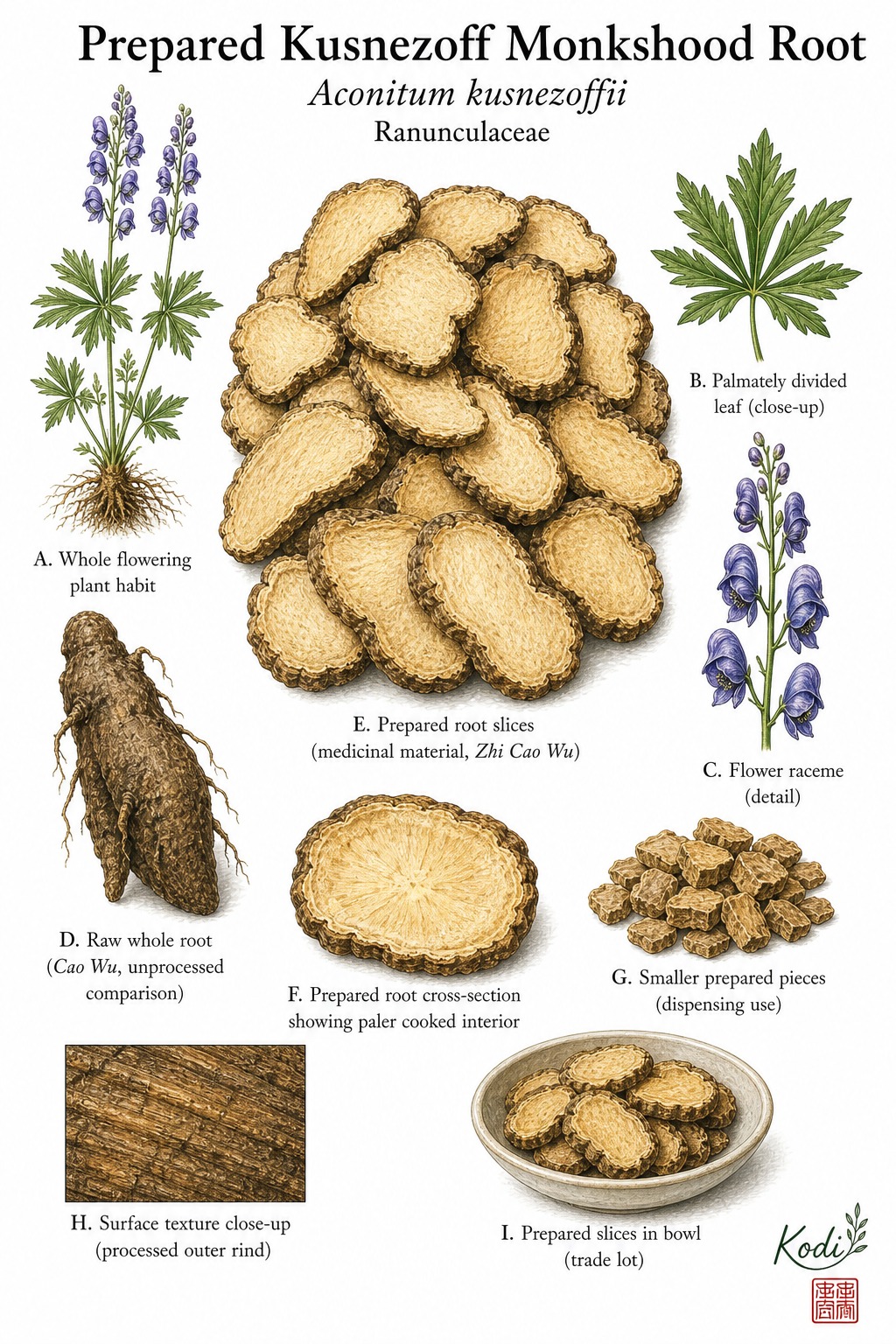
Known in TCM as Zhi Cao Wu (制草乌), this acrid and bitter, hot herb enters the Heart, Liver, Kidney, and Spleen. Traditionally, it dispels wind-damp and strongly stops pain ... Zhi Cao Wu is used for severe cold-damp painful obstruction with fixed, penetrating, deep pain in the joints, tendons, and bones, most often applied for joint pain, rheumatism, and low back pain. Modern research has identified Aconitine, among its active constituents.
Part used: Root
Also Known As
Latin: Radix Aconiti Kusnezoffii Praeparata | Pinyin: Zhi Cao Wu | Chinese: 制草乌
TCM Properties
- Taste
- acrid, bitter
- Temperature
- hot
- Channels
- Heart, Liver, Kidney, Spleen
Traditional Use
Primary Actions
- Dispels wind-damp and strongly stops pain ... Zhi Cao Wu is used for severe cold-damp painful obstruction with fixed, penetrating, deep pain in the joints, tendons, and bones.
- Warms the channels and scatters cold ... traditional indications include cold abdominal pain, cold hernia pain, and deeply lodged painful conditions that improve with heat.
- Retains the strong analgesic identity of Cao Wu while making internal use somewhat more clinically workable through processing.
Secondary Actions
- Compared with raw Cao Wu, the prepared form is less toxic and more suitable for tightly controlled internal formula use, but it remains a high-risk aconite medicinal.
- This page should stay distinct from Fu Zi family products ... Cao Wu is more pain-focused and more aggressive, even after processing.
Classic Formulas
- Chuan Wu and Cao Wu severe-cold-pain pairings ... classical strategy for stubborn wind-cold-damp painful obstruction.
- Processed aconite pain pills and powders ... later traditions use Zhi Cao Wu when strong cold-pain relief is required but raw root harshness is excessive.
- External trauma and arthralgia applications ... processed Cao Wu also appears in plasters, wines, and wash formulas for severe cold pain.
Classical References
- Traditional references describe Cao Wu as acrid, bitter, hot, and toxic, with processing used to reduce but not erase that toxicity.
- Classical incompatibility cautions remain with Ban Xia, Gua Lou, Tian Hua Fen, Bai Ji, Bai Lian, and the Bei Mu species.
- PREPARATION NOTE: Zhi Cao Wu is still a safety-critical aconite root and should never be mistaken for a routine warming herb.
Modern Research
Active Compounds
- Aconitine, mesaconitine, and hypaconitine ... the major toxic diester diterpenoid alkaloids of raw Cao Wu
- Benzoylaconine-type hydrolysis products ... less toxic alkaloids that increase after processing and prolonged decoction
- Norditerpenoid alkaloids ... structurally diverse compounds associated with analgesic and anti-inflammatory investigation
Studied Effects
- A 2026 review of Aconitum kusnezoffii summarized long-standing use for rheumatic pain and other severe pain settings while emphasizing that pharmacology and toxicity remain inseparable in this species (PMID 41151648).
- A 2017 metabolomics study found that Caowu-induced toxicity involved heart and central nervous system injury patterns and that compatibility strategies altered the toxic profile, reinforcing why expert handling remains essential (PMID 29200734).
- A 2016 analytical study showed that processing Radix Aconiti Kusnezoffii reduces highly toxic alkaloids and changes the chemical profile substantially, providing a modern rationale for keeping Zhi Cao Wu separate from raw Cao Wu (PMID 27019554).
PubMed References
- A comprehensive review of the traditional usages, phytochemistry, pharmacology, toxicology, quality control and other applications of Aconitum kusnezoffii Reichb. (2026)
- Toxicity and Detoxification Effects of Herbal Caowu via Ultra Performance Liquid Chromatography/Mass Spectrometry Metabolomics Analyzed using Pattern Recognition Method. (2017)
- An Efficient High-performance Liquid Chromatography Combined with Electrospray Ionization Tandem Mass Spectrometry Method to Elaborate the Changes of Components Between the Raw and Processed Radix Aconitum kusnezoffii. (2016)
Safety & Interactions
Contraindications
- Pregnancy
- Heat syndromes, Yin deficiency with heat, or true fluid depletion without cold
- Known ventricular arrhythmia or unstable severe cardiac disease
- Concurrent use with Ban Xia, Gua Lou, Tian Hua Fen, Bai Ji, Bai Lian, or Bei Mu species
Cautions
- Processing reduces but does not neutralize the cardiotoxic and neurotoxic risk of Cao Wu.
- Aconite poisoning can present with mouth numbness, tingling, nausea, vomiting, weakness, hypotension, and life-threatening arrhythmias.
- Zhi Cao Wu remains an expert-use medicinal rather than a self-care pain herb.
Drug Interactions
- Cardiac glycosides such as digoxin ... additive arrhythmogenic risk
- Class I and III antiarrhythmic drugs ... unpredictable electrophysiologic interaction
- QT-prolonging medications ... additive risk of malignant ventricular arrhythmia
Conditions
- Joint Pain Traditional ★★★★☆ JSON
- Rheumatism Traditional ★★★★☆ JSON
- Low Back Pain Traditional ★★★☆☆ JSON
- Abdominal Pain Traditional ★★☆☆☆ JSON
Frequently Asked Questions
What is Prepared Cao Wu Root used for?
Prepared Cao Wu Root is traditionally used to Dispels wind-damp and strongly stops pain ... Zhi Cao Wu is used for severe cold-damp painful obstruction with fixed, penetrating, deep pain in the joints, tendons, and bones., Warms the channels and scatters cold ... traditional indications include cold abdominal pain, cold hernia pain, and deeply lodged painful conditions that improve with heat., Retains the strong analgesic identity of Cao Wu while making internal use somewhat more clinically workable through processing.. Research has investigated its effects on: A 2026 review of Aconitum kusnezoffii summarized long-standing use for rheumatic pain and other severe pain settings while emphasizing that pharmacology and toxicity remain inseparable in this species (PMID 41151648).; A 2017 metabolomics study found that Caowu-induced toxicity involved heart and central nervous system injury patterns and that compatibility strategies altered the toxic profile, reinforcing why expert handling remains essential (PMID 29200734)..
What are other names for Prepared Cao Wu Root?
Prepared Cao Wu Root is also known as Prepared Kusnezoff Monkshood Root, Processed Cao Wu, Aconiti. In TCM: 制草乌 (Zhi Cao Wu); Radix Aconiti Kusnezoffii Praeparata.
Is Prepared Cao Wu Root safe during pregnancy?
Prepared Cao Wu Root is not recommended during pregnancy.
What are the contraindications for Prepared Cao Wu Root?
Prepared Cao Wu Root should not be used in: Pregnancy; Heat syndromes, Yin deficiency with heat, or true fluid depletion without cold; Known ventricular arrhythmia or unstable severe cardiac disease; Concurrent use with Ban Xia, Gua Lou, Tian Hua Fen, Bai Ji, Bai Lian, or Bei Mu species. Consult a qualified healthcare provider before use.
Does Prepared Cao Wu Root interact with any medications?
Prepared Cao Wu Root may interact with: Cardiac glycosides such as digoxin ... additive arrhythmogenic risk; Class I and III antiarrhythmic drugs ... unpredictable electrophysiologic interaction; QT-prolonging medications ... additive risk of malignant ventricular arrhythmia. Always inform your healthcare provider of any herbal supplements you are taking.