Roasted Ginger
- Chinese
- 炮姜
- Pinyin
- Pao Jiang
- Latin
- Rhizoma Zingiberis Praeparatum
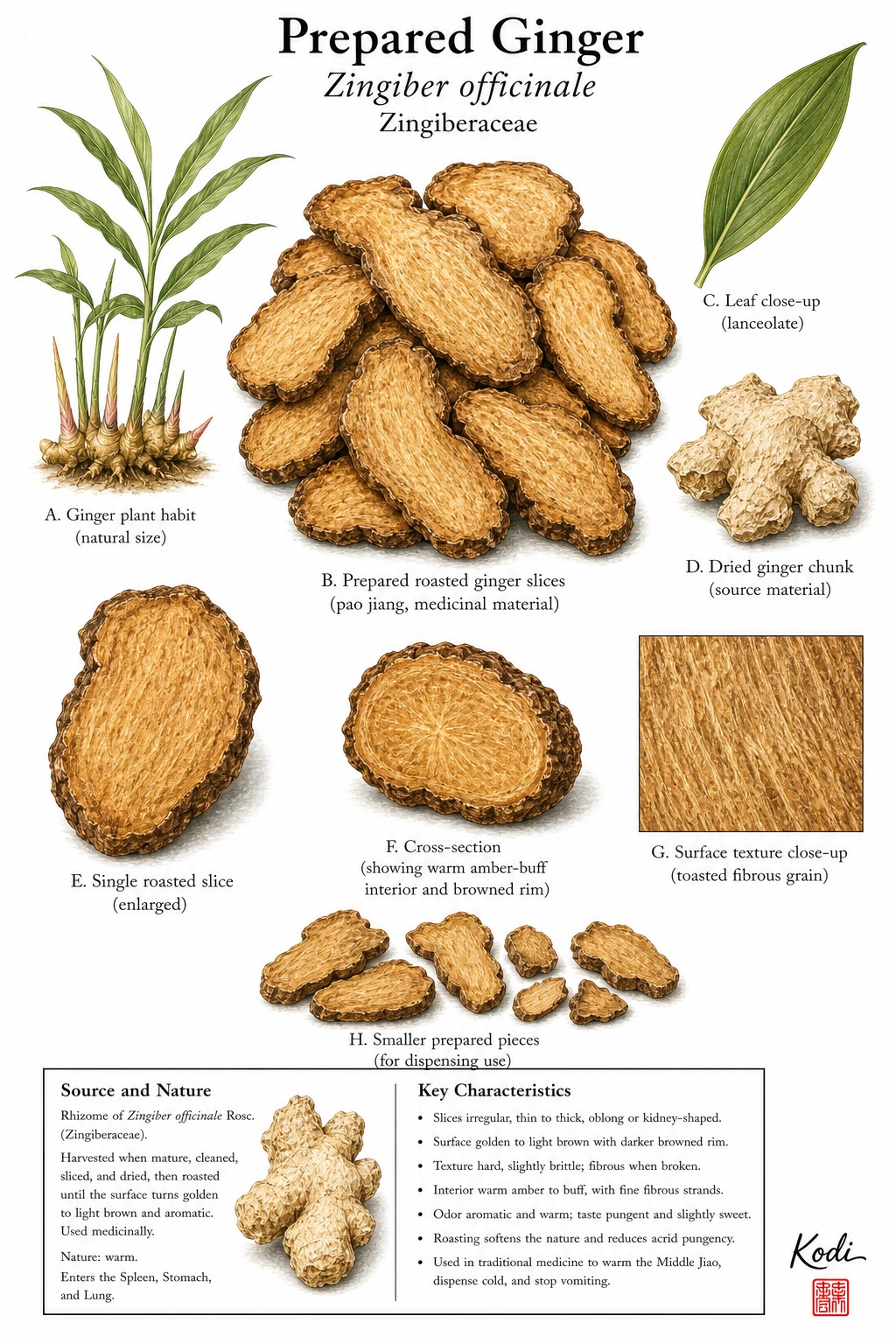
Known in TCM as Pao Jiang (炮姜), this bitter and astringent, warm herb enters the Spleen, Liver, and Stomach. Traditionally, it warms the middle and dispels interior cold ... Pao Jiang is used for abdominal pain, diarrhea, weak digestion, and cold middle-burner patterns that need deeper warming than fresh ginger, most often applied for abdominal pain, diarrhea, and abnormal uterine bleeding. Modern research has identified 6-Shogaol-enriched among its active constituents.
Part used: Rhizome
Also Known As
Latin: Rhizoma Zingiberis Praeparatum | Pinyin: Pao Jiang | Chinese: 炮姜
TCM Properties
- Taste
- bitter, astringent
- Temperature
- warm
- Channels
- Spleen, Liver, Stomach
Traditional Use
Primary Actions
- Warms the middle and dispels interior cold ... Pao Jiang is used for abdominal pain, diarrhea, weak digestion, and cold middle-burner patterns that need deeper warming than fresh ginger.
- Warms the channels and stops bleeding ... it is a classic choice for uterine bleeding, blood in the stool, or other hemorrhagic patterns rooted in deficient cold.
- Bridges the gap between Gan Jiang and ginger charcoal ... it still warms and moves more than the darker Hei Jiang form while carrying a clearer hemostatic role than plain dried ginger.
Secondary Actions
- Compared with Gan Jiang, Pao Jiang is less purely pungent-warming and more directed toward cold-pattern bleeding and channel warming.
- Compared with Hei Jiang, it remains lighter in color, less carbonized, and more clearly focused on warming the middle in addition to stopping bleeding.
Classic Formulas
- Ru Sheng San (如圣散) ... classic pairing approach for cold-type uterine bleeding and insecure Chong-Ren patterns.
- Warming-hemostatic formulas with Ai Ye, Zong Lv Tan, or E Jiao ... traditional strategy when bleeding reflects cold and weakness rather than heat.
- Middle-burner deficiency-cold modifications ... used when diarrhea, abdominal pain, and bleeding overlap.
Classical References
- Traditional teaching explicitly treats Pao Jiang as the ginger form for warming the channels and stopping bleeding while still addressing middle-burner cold.
- Processing reduces the dispersing quality of ordinary ginger and steers the herb toward internal warming and hemostatic use.
- PREPARATION NOTE: this page is for the roasted ginger medicinal and should not be merged back into either plain Gan Jiang or the darker Hei Jiang page.
Modern Research
Active Compounds
- 6-Shogaol-enriched processed ginger fractions ... compounds favored by heating and drying
- Residual gingerols and zingerone-related phenolics ... supportive pungent constituents in roasted ginger
- Processing-generated Maillard products ... relevant to the chemistry shift from plain dried ginger to Pao Jiang
Studied Effects
- A 2024 review of processed ginger products noted that baked ginger is intended to warm the middle and that ginger-charcoal products shift further toward hemostatic use, giving modern processing support to the classical Pao Jiang distinction (PMID 38997763).
- Quality-assessment work confirms that drying and processing materially change ginger chemistry, enriching heat-processed compounds and altering the medicinal profile compared with fresh ginger (PMID 41508197).
- Most biomedical evidence remains on parent ginger chemistry rather than on Pao Jiang alone, so clinical interpretation still depends heavily on traditional processing logic.
PubMed References
- Pharmacological activity and clinical application analysis of traditional Chinese medicine ginger from the perspective of one source and multiple substances (2024)
- Quality assessment of commercial dried ginger: an in-depth analysis of phytochemical composition, quality markers, and safety aspects (2024)
Safety & Interactions
Contraindications
- Heat-pattern bleeding
- Excess heat or Yin deficiency heat patterns
- Dry cough from heat or fluid depletion
Cautions
- Pao Jiang is much more medicinally warming than ordinary food ginger and should not be treated as a casual kitchen equivalent.
- Wrong-pattern use can aggravate thirst, irritability, or heat signs.
- Serious or unexplained bleeding should not be self-managed with roasted ginger alone.
Conditions
- Abdominal Pain Traditional ★★★★☆ JSON
- Diarrhea Traditional ★★★★☆ JSON
- Abnormal Uterine Bleeding Traditional ★★★☆☆ JSON
- Dysmenorrhea Traditional ★★★☆☆ JSON
Frequently Asked Questions
What is Roasted Ginger used for?
Roasted Ginger is traditionally used to Warms the middle and dispels interior cold ... Pao Jiang is used for abdominal pain, diarrhea, weak digestion, and cold middle-burner patterns that need deeper warming than fresh ginger., Warms the channels and stops bleeding ... it is a classic choice for uterine bleeding, blood in the stool, or other hemorrhagic patterns rooted in deficient cold., Bridges the gap between Gan Jiang and ginger charcoal ... it still warms and moves more than the darker Hei Jiang form while carrying a clearer hemostatic role than plain dried ginger.. Research has investigated its effects on: A 2024 review of processed ginger products noted that baked ginger is intended to warm the middle and that ginger-charcoal products shift further toward hemostatic use, giving modern processing support to the classical Pao Jiang distinction (PMID 38997763).; Quality-assessment work confirms that drying and processing materially change ginger chemistry, enriching heat-processed compounds and altering the medicinal profile compared with fresh ginger (PMID 41508197)..
What are other names for Roasted Ginger?
Roasted Ginger is also known as Prepared Ginger, Baked Ginger, Blast-Fried Ginger. In TCM: 炮姜 (Pao Jiang); Rhizoma Zingiberis Praeparatum.
Is Roasted Ginger safe during pregnancy?
The safety of Roasted Ginger during pregnancy has not been established. Consult a qualified healthcare provider before use.
What are the contraindications for Roasted Ginger?
Roasted Ginger should not be used in: Heat-pattern bleeding; Excess heat or Yin deficiency heat patterns; Dry cough from heat or fluid depletion. Consult a qualified healthcare provider before use.