Prepared Fleeceflower Root
- Chinese
- 制首乌
- Pinyin
- Zhi Shou Wu
- Latin
- Radix Polygoni Multiflori Praeparata
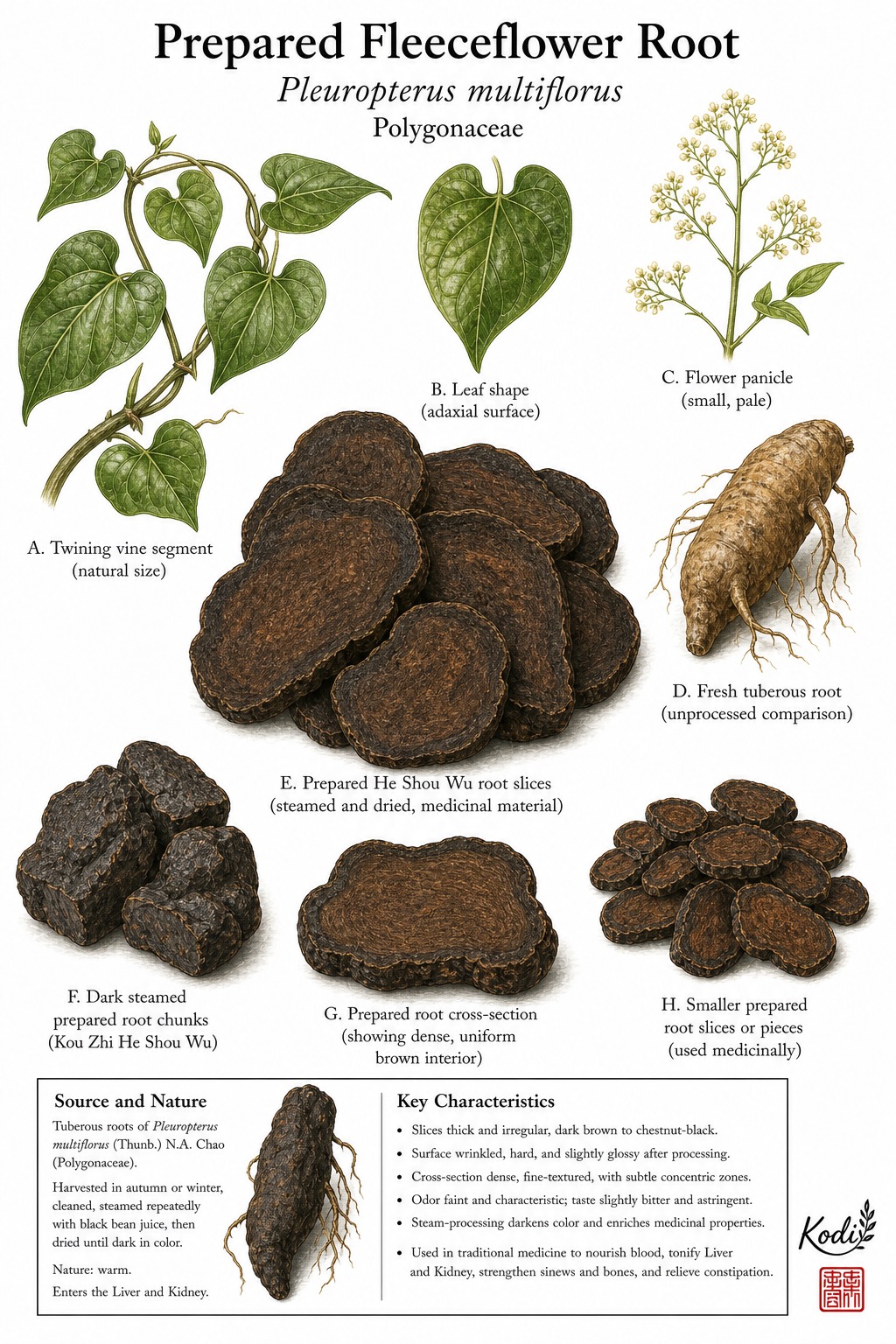
Known in TCM as Zhi Shou Wu (制首乌), this sweet and bitter and astringent, slightly warm herb enters the Liver and Kidney. Traditionally, it tonifies the Liver and Kidney and nourishes essence and blood ... Zhi Shou Wu is used for dizziness, weak lower back and knees, tinnitus, and depletion patterns associated with aging or long illness, most often applied for dizziness, insomnia, and low back pain. Modern research has identified Stilbene among its active constituents.
Part used: Root
Also Known As
Latin: Radix Polygoni Multiflori Praeparata | Pinyin: Zhi Shou Wu | Chinese: 制首乌
TCM Properties
- Taste
- sweet, bitter, astringent
- Temperature
- slightly warm
- Channels
- Liver, Kidney
Traditional Use
Primary Actions
- Tonifies the Liver and Kidney and nourishes essence and blood ... Zhi Shou Wu is used for dizziness, weak lower back and knees, tinnitus, and depletion patterns associated with aging or long illness.
- Nourishes blood and supports the hair ... traditional use especially emphasizes premature graying, hair thinning, and dryness linked to Liver-Blood and Kidney-essence insufficiency.
- Strengthens sinews and bones ... the processed form is preferred when long-term deficiency has led to weakness, soreness, or reduced structural resilience.
Secondary Actions
- Compared with raw He Shou Wu, the prepared form is much less centered on detoxifying sores or moistening the intestines and much more centered on tonic use.
- Classical processing with black soybean juice is meant to temper harshness and shift the herb away from its more purgative raw direction toward a steadier Liver-Kidney tonic profile.
Classic Formulas
- Qi Bao Mei Ran Dan (七宝美髯丹) ... famous essence-and-blood tonic formula for premature graying, weakness, dizziness, and hair depletion in which He Shou Wu is a central herb.
- Shou Wu Yan Shou Dan (首乌延寿丹) ... longevity-tonic lineage emphasizing the prepared root for chronic deficiency and aging-related weakness.
- Liver-Kidney tonic pairings with Gou Qi Zi, Nu Zhen Zi, or Hei Zhi Ma ... common traditional strategies when hair, tendons, and essence-blood all need support.
Classical References
- Materia medica tradition sharply distinguishes raw and prepared He Shou Wu ... raw for toxin and bowel-moistening use, prepared for nourishing the Liver, Kidneys, blood, and hair.
- Processing with black soybean is one of the best-known examples of paozhi changing both therapeutic emphasis and toxicity handling.
- PREPARATION NOTE: this page is specifically for the processed tonic form and should not be flattened back into raw He Shou Wu.
Modern Research
Active Compounds
- Stilbene glycosides such as THSG ... prominent signature constituents discussed in both pharmacology and toxicity literature
- Anthraquinones including emodin and physcion derivatives ... major compounds relevant to purgative action and hepatotoxicity concern
- Phospholipids, tannins, and flavonoids ... supportive compound groups repeatedly discussed in broader review literature
- Processing-altered constituent fractions ... important because steaming changes the balance of the herb's key chemical classes
Studied Effects
- A major review summarized the botany, traditional uses, phytochemistry, pharmacology, and toxicology of Polygonum multiflorum, confirming both its tonic reputation and its substantial safety controversy (PMID 25449462).
- A review of Heshouwu's paradoxical effects concluded that both raw and prepared forms have reported hepatoprotective and hepatotoxic potential, making context, product quality, and dose especially important (PMID 27484243).
- A processing-focused study found that liver injury from Polygonum multiflorum was negatively correlated with processing time, supporting the traditional claim that correct preparation moderates toxicity even though it does not eliminate risk (PMID 32215041).
PubMed References
- Traditional usages, botany, phytochemistry, pharmacology and toxicology of Polygonum multiflorum Thunb.: A review (2015)
- Hepatoprotection and hepatotoxicity of Heshouwu, a Chinese medicinal herb: Context of the paradoxical effect (2017)
- Effects of Different Processed Products of Polygonum multiflorum on the Liver (2020)
Safety & Interactions
Contraindications
- Active liver disease or unexplained liver-enzyme elevation
- Long-term unsupervised tonic use
- Clear damp-heat or excess patterns without deficiency background
Cautions
- Prepared He Shou Wu is still associated with clinically important liver-injury reports and should not be romanticized as a harmless anti-aging supplement.
- Processing can reduce toxicity but does not remove the need for authenticated sourcing, dose control, and monitoring when prolonged use is contemplated.
- The herb occupies a narrow line between celebrated tonic and well-documented hepatotoxic risk.
Conditions
Frequently Asked Questions
What is Prepared Fleeceflower Root used for?
Prepared Fleeceflower Root is traditionally used to Tonifies the Liver and Kidney and nourishes essence and blood ... Zhi Shou Wu is used for dizziness, weak lower back and knees, tinnitus, and depletion patterns associated with aging or long illness., Nourishes blood and supports the hair ... traditional use especially emphasizes premature graying, hair thinning, and dryness linked to Liver-Blood and Kidney-essence insufficiency., Strengthens sinews and bones ... the processed form is preferred when long-term deficiency has led to weakness, soreness, or reduced structural resilience.. Research has investigated its effects on: A major review summarized the botany, traditional uses, phytochemistry, pharmacology, and toxicology of Polygonum multiflorum, confirming both its tonic reputation and its substantial safety controversy (PMID 25449462).; A review of Heshouwu's paradoxical effects concluded that both raw and prepared forms have reported hepatoprotective and hepatotoxic potential, making context, product quality, and dose especially important (PMID 27484243)..
What are other names for Prepared Fleeceflower Root?
Prepared Fleeceflower Root is also known as Prepared He Shou Wu, Fo-Ti Root (processed), Processed Polygonum multiflorum root. In TCM: 制首乌 (Zhi Shou Wu); Radix Polygoni Multiflori Praeparata.
Is Prepared Fleeceflower Root safe during pregnancy?
The safety of Prepared Fleeceflower Root during pregnancy has not been established. Consult a qualified healthcare provider before use.
What are the contraindications for Prepared Fleeceflower Root?
Prepared Fleeceflower Root should not be used in: Active liver disease or unexplained liver-enzyme elevation; Long-term unsupervised tonic use; Clear damp-heat or excess patterns without deficiency background. Consult a qualified healthcare provider before use.