Prepared Cassia Twig
- Chinese
- 制桂枝
- Pinyin
- Zhi Gui Zhi
- Latin
- Ramulus Cinnamomi Praeparata
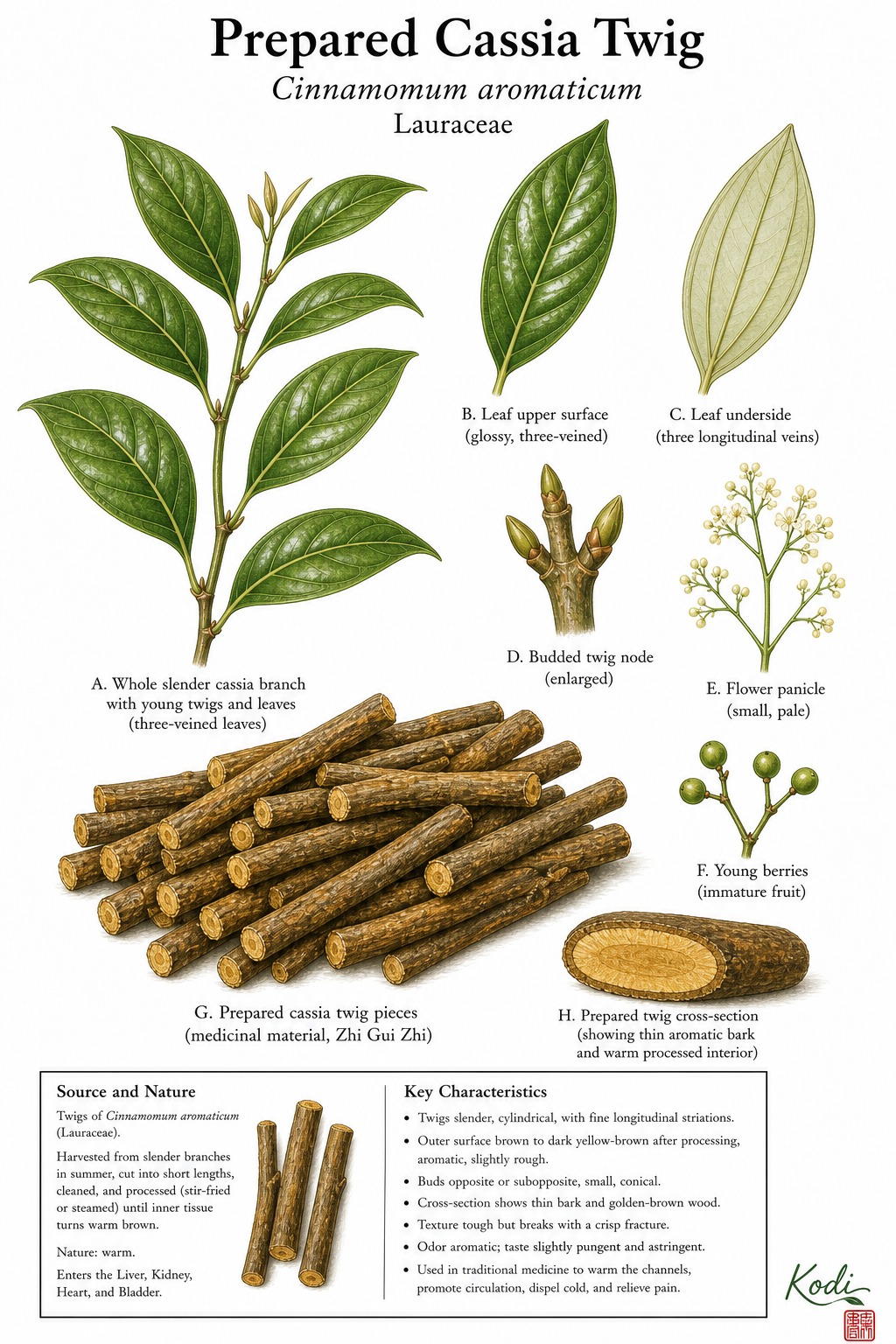
Known in TCM as Zhi Gui Zhi (制桂枝), this acrid and sweet, warm herb enters the Heart, Lung, and Bladder. Traditionally, it warms and unblocks the channels and collaterals ... Zhi Gui Zhi is used for cold-damp joint pain, numbness, cold-constrained menstruation, and channel obstruction where circulation needs light warming rather than fierce interior heat, most often applied for common cold, joint pain, and dysmenorrhea. Modern research has identified Cinnamaldehyde among its active constituents.
Part used: Twig
Also Known As
Latin: Ramulus Cinnamomi Praeparata | Pinyin: Zhi Gui Zhi | Chinese: 制桂枝
TCM Properties
- Taste
- acrid, sweet
- Temperature
- warm
- Channels
- Heart, Lung, Bladder
Traditional Use
Primary Actions
- Warms and unblocks the channels and collaterals ... Zhi Gui Zhi is used for cold-damp joint pain, numbness, cold-constrained menstruation, and channel obstruction where circulation needs light warming rather than fierce interior heat.
- Releases the exterior and harmonizes Ying and Wei ... it remains part of the Gui Zhi family used for Wind-Cold with spontaneous sweating, aversion to wind, and stiff neck, though the processed form is often thought of as a little less raw and dispersing than fresh twig.
- Warms Yang and assists Qi transformation ... useful when cold impairs fluid movement, contributing to edema, chest fullness, or difficulty with the Bladder's transforming function.
- Unblocks Heart Yang and moves chest Qi ... it can be selected when palpitations, chest discomfort, or cold-phlegm obstruction require a warming twig rather than a deeper bark tonic like Rou Gui.
Secondary Actions
- Processing is generally used to make the twig slightly gentler, cleaner, and better suited to repeated internal use while preserving the characteristic Gui Zhi action of warming circulation and harmonizing the surface.
- This page should remain distinct from Rou Gui ... both come from the cassia tree, but Gui Zhi works more at the surface, channels, and Heart-Yang interface.
Classic Formulas
- Gui Zhi Tang (桂枝汤) ... foundational Shang Han Lun formula for Wind-Cold with spontaneous sweating and Ying-Wei disharmony.
- Dang Gui Si Ni Tang (当归四逆汤) ... classic formula for cold in the channels with cold extremities, where Gui Zhi helps warm and unblock the vessels.
- Wen Jing Tang (温经汤) ... gynecologic classic using Gui Zhi to warm the channels and dispel congealed cold.
- Zhi Shi Xie Bai Gui Zhi Tang (枳实薤白桂枝汤) ... formula for chest Bi in which Gui Zhi opens Yang and moves constrained cold in the chest.
Classical References
- Traditional references describe Gui Zhi as warm, acrid, and sweet, entering the Heart, Lung, and Bladder and especially suited to releasing Wind-Cold while warming channels and assisting fluid transformation.
- Processed Gui Zhi is a preparation-focused variation rather than a different medicinal identity ... the twig still differs from Rou Gui by acting more lightly and more superficially.
- PREPARATION NOTE: Zhi Gui Zhi indicates a clinically prepared cassia twig form with the same core therapeutic family as Gui Zhi but a somewhat moderated and tidied presentation.
Modern Research
Active Compounds
- Cinnamaldehyde ... the best-known bioactive cinnamon constituent and a major anti-inflammatory research marker in twig as well as bark preparations
- 2-methoxycinnamaldehyde and related cinnamaldehyde derivatives ... compounds tied to nitric-oxide and cytokine modulation in experimental inflammation studies
- Coumarin ... a safety-relevant constituent when cinnamon products are used in large or prolonged doses
- Linalool, camphor, and related essential-oil terpenoids ... part of the aromatic volatile fraction isolated from cassia twigs
- Phenolic compounds ... broader antioxidant and signaling constituents discussed in cinnamon pharmacology reviews
Studied Effects
- Essential oil isolated from Cinnamomum cassia twigs alleviated experimental pain and inflammation in mice, giving twig-specific support to Gui Zhi's warming-and-unblocking reputation (PMID 27780753).
- A rat study found anti-inflammatory and anti-arthritic effects from Cinnamomum cassia twigs in both acute and chronic arthritis models, aligning with traditional use for painful obstruction (PMID 34015366).
- A broad review of Cinnamomum cassia summarizes the plant's phytochemistry, pharmacology, and toxicology, including twig-related essential-oil constituents and anti-inflammatory activity (PMID 31557828).
- Modern publications generally do not distinguish Zhi Gui Zhi from Gui Zhi in a robust way, so processed-form interpretation still depends mainly on materia medica tradition.
PubMed References
- The essential oil from the twigs of Cinnamomum cassia Presl alleviates pain and inflammation in mice (2016)
- Anti-inflammatory, and anti-arthritic effects by the twigs of Cinnamomum cassia on complete Freund's adjuvant-induced arthritis in rats (2021)
- Cinnamomum cassia Presl: A Review of Its Traditional Uses, Phytochemistry, Pharmacology and Toxicology (2019)
Safety & Interactions
Contraindications
- Warm or febrile disorders without cold involvement
- Yin deficiency with Heat signs
- Blood-heat bleeding or excessive sweating from fluid depletion
Cautions
- Even in prepared form, Gui Zhi can aggravate heat signs, thirst, restlessness, or bleeding if used in the wrong pattern.
- Some cinnamon products contain coumarin levels high enough to raise liver-safety concerns with excessive or prolonged intake.
- Gastrointestinal upset and allergic reactions have been reported with cinnamon products.
Drug Interactions
- CYP450 substrate drugs … Preclinical studies suggest cinnamon may alter CYP-mediated drug metabolism (Moderate) Source: Memorial Sloan Kettering Integrative Medicine - Cinnamon
- Statins … Concurrent use has been associated with hepatitis in a case report (Moderate) Source: Memorial Sloan Kettering Integrative Medicine - Cinnamon
- Pioglitazone … Animal studies suggest cinnamon can increase pioglitazone bioavailability (Moderate) Source: Memorial Sloan Kettering Integrative Medicine - Cinnamon
Conditions
- Common Cold Traditional ★★★★☆ JSON
- Joint Pain Traditional ★★★★☆ JSON
- Dysmenorrhea Traditional ★★★☆☆ JSON
- Edema Traditional ★★★☆☆ JSON
- Chest Pain Traditional ★★★☆☆ JSON
Frequently Asked Questions
What is Prepared Cassia Twig used for?
Prepared Cassia Twig is traditionally used to Warms and unblocks the channels and collaterals ... Zhi Gui Zhi is used for cold-damp joint pain, numbness, cold-constrained menstruation, and channel obstruction where circulation needs light warming rather than fierce interior heat., Releases the exterior and harmonizes Ying and Wei ... it remains part of the Gui Zhi family used for Wind-Cold with spontaneous sweating, aversion to wind, and stiff neck, though the processed form is often thought of as a little less raw and dispersing than fresh twig., Warms Yang and assists Qi transformation ... useful when cold impairs fluid movement, contributing to edema, chest fullness, or difficulty with the Bladder's transforming function., Unblocks Heart Yang and moves chest Qi ... it can be selected when palpitations, chest discomfort, or cold-phlegm obstruction require a warming twig rather than a deeper bark tonic like Rou Gui.. Research has investigated its effects on: Essential oil isolated from Cinnamomum cassia twigs alleviated experimental pain and inflammation in mice, giving twig-specific support to Gui Zhi's warming-and-unblocking reputation (PMID 27780753).; A rat study found anti-inflammatory and anti-arthritic effects from Cinnamomum cassia twigs in both acute and chronic arthritis models, aligning with traditional use for painful obstruction (PMID 34015366)..
What are other names for Prepared Cassia Twig?
Prepared Cassia Twig is also known as Cinnamomi, Processed Gui Zhi. In TCM: 制桂枝 (Zhi Gui Zhi); Ramulus Cinnamomi Praeparata.
Is Prepared Cassia Twig safe during pregnancy?
The safety of Prepared Cassia Twig during pregnancy has not been established. Consult a qualified healthcare provider before use.
What are the contraindications for Prepared Cassia Twig?
Prepared Cassia Twig should not be used in: Warm or febrile disorders without cold involvement; Yin deficiency with Heat signs; Blood-heat bleeding or excessive sweating from fluid depletion. Consult a qualified healthcare provider before use.
Does Prepared Cassia Twig interact with any medications?
Prepared Cassia Twig may interact with: CYP450 substrate drugs - Preclinical studies suggest cinnamon may alter CYP-mediated drug metabolism - (Moderate severity); Statins - Concurrent use has been associated with hepatitis in a case report - (Moderate severity); Pioglitazone - Animal studies suggest cinnamon can increase pioglitazone bioavailability - (Moderate severity). Always inform your healthcare provider of any herbal supplements you are taking.