Prepared Lily Bulb
- Chinese
- 制百合
- Pinyin
- Zhi Bai He
- Latin
- Bulbus Lilii Praeparata
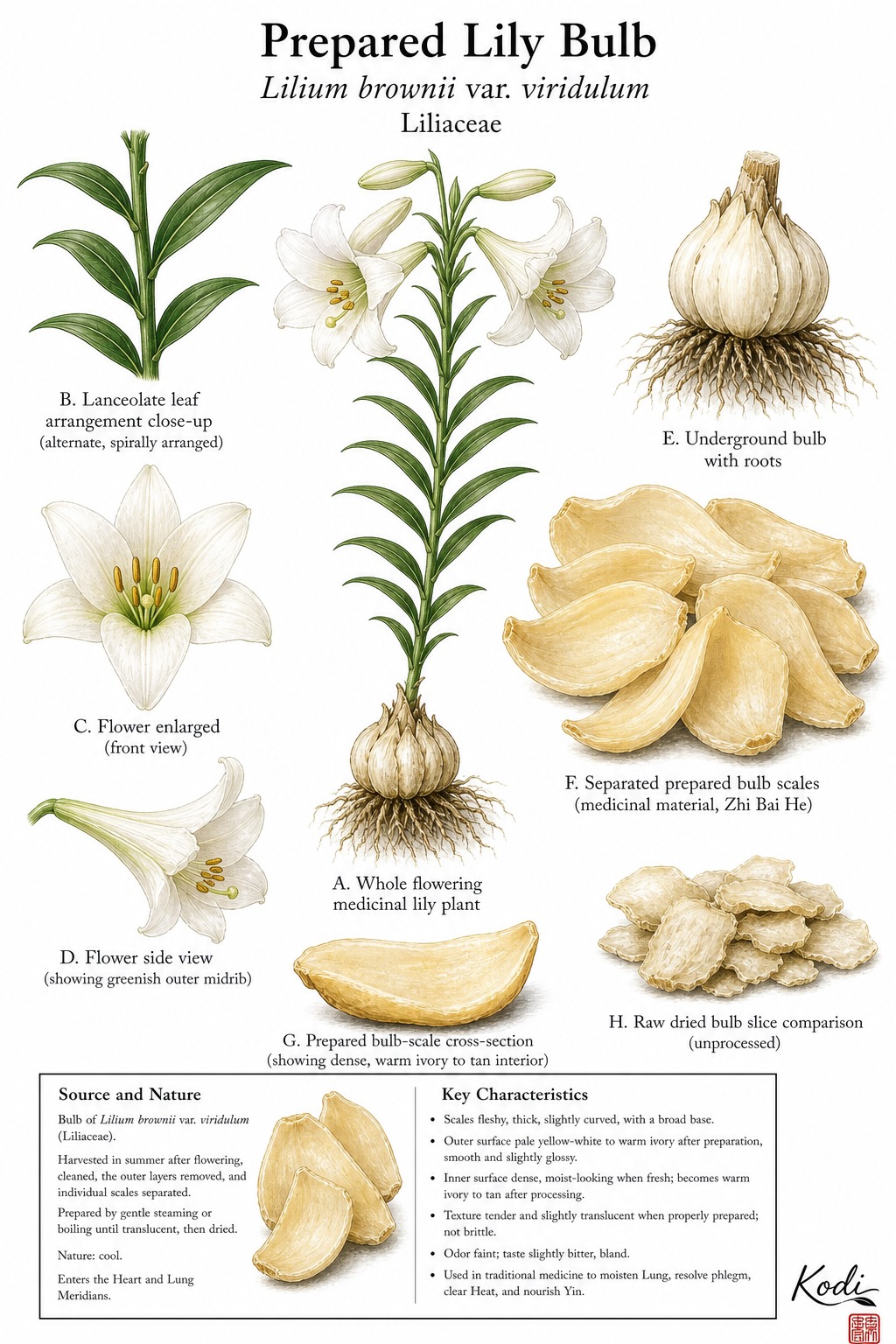
Known in TCM as Zhi Bai He (制百合), this sweet and slightly bitter, neutral herb enters the Heart and Lung. Traditionally, it nourishes Lung Yin and moistens dryness ... Zhi Bai He is especially valued for chronic dry cough, scanty sputum, dry throat, and lingering cough after heat or long illness has consumed fluids, most often applied for dry cough, cough, and insomnia. Modern research has identified Lilium among its active constituents.
Part used: Bulb
Also Known As
Latin: Bulbus Lilii Praeparata | Pinyin: Zhi Bai He | Chinese: 制百合
TCM Properties
- Taste
- sweet, slightly bitter
- Temperature
- neutral
- Channels
- Heart, Lung
Traditional Use
Primary Actions
- Nourishes Lung Yin and moistens dryness ... Zhi Bai He is especially valued for chronic dry cough, scanty sputum, dry throat, and lingering cough after heat or long illness has consumed fluids.
- Stops cough gently without trapping pathogens ... it is favored when the clinical picture is deficiency-dryness rather than thick phlegm or acute exterior invasion.
- Clears residual vexation and calms the spirit ... the Lily Bulb family is classically used for insomnia, restlessness, post-febrile agitation, and the Bai He Bing pattern in which Yin injury and lingering heat disturb the Shen.
- Supports recovery after illness ... the prepared form keeps Bai He's food-medicine character while making it feel somewhat denser, softer, and more directly focused on moistening and soothing.
Secondary Actions
- Compared with raw Bai He, the prepared form is commonly understood as a little less cooling and more centered on moistening the Lung and relieving cough, while the raw form retains stronger association with lingering heat and classical Bai He Bing restlessness.
- Different markets use different processing methods, but the therapeutic lane remains the same medicinal lily bulb rather than a separate species or culinary sweet-lily product.
Classic Formulas
- Bai He Gu Jin Tang (百合固金汤) ... signature Lung-Yin formula pairing Bai He with Sheng Di Huang, Shu Di Huang, Mai Men Dong, and Chuan Bei Mu for chronic dry cough and dry sore throat.
- Bai He Di Huang Tang (百合地黄汤) ... from Jin Gui Yao Lue, using Bai He to address Bai He Bing with restlessness, emotional instability, and lingering heat after febrile disease.
- Bai He Zhi Mu Tang (百合知母汤) ... classical combination where Bai He nourishes Yin while Zhi Mu clears residual deficiency heat and vexation.
- Dietary congee and soup applications ... medicinal Bai He is often used in food-style recovery preparations when dryness, weakness, and irritability overlap.
Classical References
- Traditional references describe Bai He as entering the Heart and Lung, nourishing Yin, moistening the Lung, and calming the spirit in post-illness and dry-cough patterns.
- Later clinical teaching often distinguishes raw Bai He from processed Bai He by emphasis rather than by creating a new therapeutic family ... raw for more heat and vexation, processed for more moistening cough support.
- PREPARATION NOTE: Zhi Bai He is the clinically prepared form of medicinal lily bulb, not a separate lily species and not simply a dessert ingredient.
Modern Research
Active Compounds
- Lilium polysaccharides and glucomannan-rich fractions ... macromolecules linked with antioxidant, immunomodulatory, and gut-brain research
- Steroidal saponins ... characteristic lily constituents isolated from Lilium brownii var. viridulum
- Phenolic acid glycerides ... neuroprotective research constituents highlighted in recent work
- Flavonoids and other phenolic compounds ... supportive antioxidant constituents repeatedly discussed in nutraceutical reviews
- Minor alkaloid fractions ... less emphasized than polysaccharides and saponins but part of the broader phytochemical profile
Studied Effects
- Comprehensive review literature summarizes antidepressant, sedative-hypnotic, anti-inflammatory, antioxidant, immunomodulatory, and antitumor activity across Lilium brownii and Bai He extracts and constituents (PMID 39338404).
- Insomnia-model research found Lilium brownii improved neurotransmitter and gut-metabolic abnormalities in p-chlorophenylalanine insomnia rats, supporting the traditional spirit-calming use (PMID 34978949).
- Neuroprotection research in Parkinson's models found Lilium brownii extracts improved motor dysfunction and oxidative-stress markers through the p62-Keap1-Nrf2 pathway (PMID 39060803).
- Published literature generally indexes Bai He as a whole rather than Zhi Bai He specifically, so the processed form should be understood through the broader medicinal-lily evidence base.
PubMed References
- Lilium brownii/ Baihe as Nutraceuticals: Insights into Its Composition and Therapeutic Properties (2024)
- A comprehensive study on the relieving effect of Lilium brownii on the intestinal flora and metabolic disorder in p-chlorphenylalanine induced insomnia rats (2022)
- Neuroprotective properties of the Lilium brownii extracts in the experimental model of Parkinson's disease (2024)
Safety & Interactions
Contraindications
- Wind-Cold or phlegm-damp cough with copious thin sputum
- Spleen and Stomach deficiency-cold with loose stools or diarrhea
- Excess dampness without significant dryness or Yin injury
Cautions
- Although gentle and food-like, Zhi Bai He can still worsen cold, damp, or early-stage exterior coughs if used in the wrong pattern.
- Use caution in pregnancy at medicinal doses because modern safety summaries for Bai He note incomplete reassurance at high-dose extract levels even though culinary use is common.
- Market confusion between true medicinal Bai He and sweeter edible lily cultivars remains a quality issue.
Conditions
Frequently Asked Questions
What is Prepared Lily Bulb used for?
Prepared Lily Bulb is traditionally used to Nourishes Lung Yin and moistens dryness ... Zhi Bai He is especially valued for chronic dry cough, scanty sputum, dry throat, and lingering cough after heat or long illness has consumed fluids., Stops cough gently without trapping pathogens ... it is favored when the clinical picture is deficiency-dryness rather than thick phlegm or acute exterior invasion., Clears residual vexation and calms the spirit ... the Lily Bulb family is classically used for insomnia, restlessness, post-febrile agitation, and the Bai He Bing pattern in which Yin injury and lingering heat disturb the Shen., Supports recovery after illness ... the prepared form keeps Bai He's food-medicine character while making it feel somewhat denser, softer, and more directly focused on moistening and soothing.. Research has investigated its effects on: Comprehensive review literature summarizes antidepressant, sedative-hypnotic, anti-inflammatory, antioxidant, immunomodulatory, and antitumor activity across Lilium brownii and Bai He extracts and constituents (PMID 39338404).; Insomnia-model research found Lilium brownii improved neurotransmitter and gut-metabolic abnormalities in p-chlorophenylalanine insomnia rats, supporting the traditional spirit-calming use (PMID 34978949)..
What are other names for Prepared Lily Bulb?
Prepared Lily Bulb is also known as Lilium, Processed Bai He. In TCM: 制百合 (Zhi Bai He); Bulbus Lilii Praeparata.
Is Prepared Lily Bulb safe during pregnancy?
The safety of Prepared Lily Bulb during pregnancy has not been established. Consult a qualified healthcare provider before use.
What are the contraindications for Prepared Lily Bulb?
Prepared Lily Bulb should not be used in: Wind-Cold or phlegm-damp cough with copious thin sputum; Spleen and Stomach deficiency-cold with loose stools or diarrhea; Excess dampness without significant dryness or Yin injury. Consult a qualified healthcare provider before use.