Prepared Magnolia Bark
- Chinese
- 制厚朴
- Pinyin
- Zhi Hou Po
- Latin
- Cortex Magnoliae Officinalis Praeparata
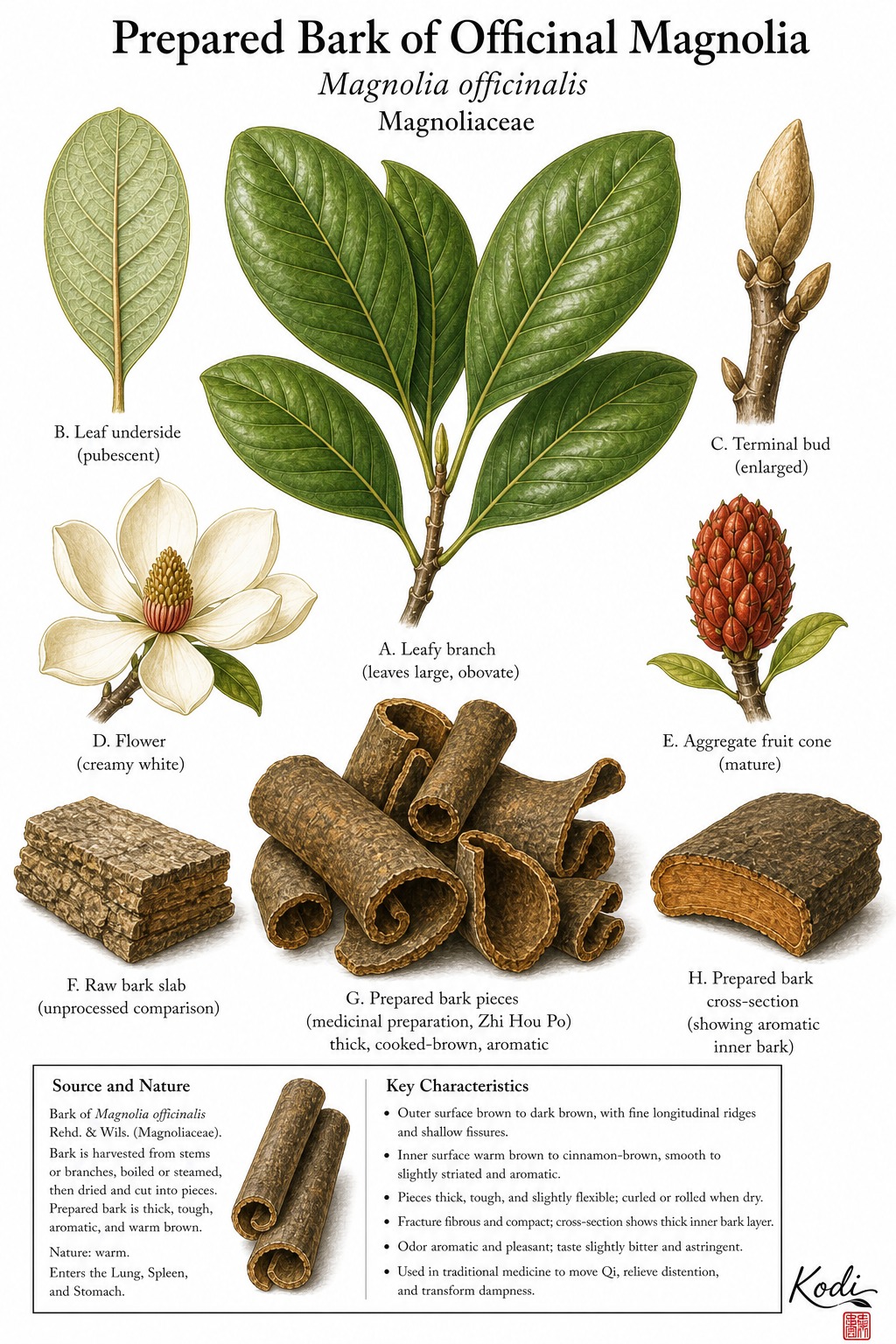
Known in TCM as Zhi Hou Po (制厚朴), this bitter and acrid, warm herb enters the Lung, Large Intestine, Spleen, and Stomach. Traditionally, it moves Qi and relieves focal distention ... Zhi Hou Po is used when fullness, bloating, epigastric oppression, abdominal pain, or food stagnation are driven by middle-burner Qi blockage, most often applied for abdominal pain, constipation, and acid reflux. Modern research has identified Magnolol among its active constituents.
Part used: Bark
Also Known As
Latin: Cortex Magnoliae Officinalis Praeparata | Pinyin: Zhi Hou Po | Chinese: 制厚朴
TCM Properties
- Taste
- bitter, acrid
- Temperature
- warm
- Channels
- Lung, Large Intestine, Spleen, Stomach
Traditional Use
Primary Actions
- Moves Qi and relieves focal distention ... Zhi Hou Po is used when fullness, bloating, epigastric oppression, abdominal pain, or food stagnation are driven by middle-burner Qi blockage.
- Dries Dampness and harmonizes the Spleen and Stomach ... it remains a standard choice when damp obstruction leads to poor appetite, nausea, greasy coating, loose stool, or a heavy obstructed digestive sensation.
- Descends rebellious Qi and transforms phlegm ... the prepared bark is used for cough, wheezing, chest congestion, and plum-pit Qi when phlegm and constrained descent bind the chest and throat.
- Promotes downward movement in the intestines ... especially when constipation coexists with distention, pressure, and stubborn Qi stagnation rather than simple dryness.
Secondary Actions
- Compared with raw Hou Pu, the prepared form is generally understood as a little cleaner, more clinically manageable, and somewhat better suited to routine internal prescribing where roughness or excessive aromatic harshness is undesirable.
- Exact local processing methods vary, but the clinical identity remains that of Hou Pu rather than a separate herb ... strong downward movement, dampness transformation, and relief of middle-burner fullness.
Classic Formulas
- Ban Xia Hou Pu Tang (半夏厚朴汤) ... classic Jin Gui Yao Lue formula using Hou Pu for plum-pit Qi, throat obstruction, nausea, and emotional constraint with phlegm.
- Ping Wei San (平胃散) ... dampness-transforming formula in which Hou Pu moves Qi, dries damp, and relieves epigastric and abdominal fullness.
- Hou Pu San Wu Tang (厚朴三物汤) ... abdominal fullness, pain, and constipation driven by pronounced Qi stagnation.
- Ma Zi Ren Wan (麻子仁丸) ... includes Hou Pu to move constrained Qi and help bowel movement when distention accompanies dry constipation.
Classical References
- Classical materia medica consistently describe Hou Pu as bitter, acrid, warm, and aromatic, entering the Spleen and Stomach to move Qi, dry dampness, and direct stagnation downward.
- Formula tradition uses processed and unprocessed Hou Pu in overlapping ways, but the prepared form is commonly preferred when a cleaner and slightly moderated interior use is desired.
- PREPARATION NOTE: Zhi Hou Po is not a distinct species or a different medicinal family ... it is the clinically prepared bark form of Magnolia officinalis used to make the crude bark easier to handle and prescribe.
Modern Research
Active Compounds
- Magnolol ... one of the signature neolignans in Magnolia officinalis bark with anti-inflammatory, antiplatelet, and neuroactive effects
- Honokiol ... major anxiolytic, anti-inflammatory, and antitumor research constituent
- Obovatol and related biphenolic neolignans ... contribute to anti-inflammatory and neuroprotective research interest
- 4-O-methylhonokiol and related derivatives ... studied for signaling, neuroprotective, and anti-inflammatory potential
- Volatile aromatic terpenes and bark essential-oil fractions ... relevant to the traditional digestive and phlegm-resolving profile
Studied Effects
- Mechanistic review literature details anti-inflammatory, antioxidant, antimicrobial, and apoptosis-targeting anticancer actions of magnolol and honokiol from Magnolia officinalis bark (PMID 22466367).
- Honokiol and magnolol reduced glutamatergic and inflammatory pain responses in animal models, supporting the traditional picture of fullness, obstruction, and pain relief (PMID 19832997).
- Recent review work summarizes broad structure-activity and pharmacologic findings for honokiol and magnolol derivatives, reinforcing continued interest in anti-inflammatory, neuroactive, and antitumor applications (PMID 38714288).
- Modern indexing is usually on Magnolia officinalis bark as a whole rather than specifically on Zhi Hou Po, so processed-form claims should be interpreted as extensions of the parent bark literature rather than as separate clinical proof.
PubMed References
- Targeting apoptosis pathways in cancer with magnolol and honokiol, bioactive constituents of the bark of Magnolia officinalis (2011)
- Antinociceptive actions of honokiol and magnolol on glutamatergic and inflammatory pain (2009)
- Honokiol and magnolol: A review of structure-activity relationships of their derivatives (2024)
Safety & Interactions
Contraindications
- Qi deficiency or dryness without true stagnation, dampness, or phlegm obstruction
- Yin deficiency dryness with depleted fluids and no damp blockage
Cautions
- Its warm, aromatic, drying nature can aggravate thirst, dry constipation, or fluid depletion if used too aggressively in already dry patients.
- Use with caution during pregnancy because the herb strongly moves and descends Qi.
- Prepared Hou Pu is still an active Qi-moving bark, not a gentle food herb, and should not be used casually for nonspecific bloating.
Drug Interactions
- Diabetes medications … Magnolia bark extract may enhance glucose-lowering effects and increase the risk of hypoglycemia (Moderate) Source: Memorial Sloan Kettering Integrative Medicine - Magnolia officinalis
- Sleep or anxiety medications … Magnolia bark extract may increase sedative or anxiolytic effects (Moderate) Source: Memorial Sloan Kettering Integrative Medicine - Magnolia officinalis
- Blood thinners … Magnolia bark extract may increase bleeding risk (Moderate) Source: Memorial Sloan Kettering Integrative Medicine - Magnolia officinalis
Conditions
- Abdominal Pain Traditional ★★★★☆ JSON
- Constipation Traditional ★★★★☆ JSON
- Acid Reflux Traditional ★★★☆☆ JSON
- Phlegm Accumulation Traditional ★★★★☆ JSON
- Nausea Traditional ★★★★☆ JSON
Frequently Asked Questions
What is Prepared Magnolia Bark used for?
Prepared Magnolia Bark is traditionally used to Moves Qi and relieves focal distention ... Zhi Hou Po is used when fullness, bloating, epigastric oppression, abdominal pain, or food stagnation are driven by middle-burner Qi blockage., Dries Dampness and harmonizes the Spleen and Stomach ... it remains a standard choice when damp obstruction leads to poor appetite, nausea, greasy coating, loose stool, or a heavy obstructed digestive sensation., Descends rebellious Qi and transforms phlegm ... the prepared bark is used for cough, wheezing, chest congestion, and plum-pit Qi when phlegm and constrained descent bind the chest and throat., Promotes downward movement in the intestines ... especially when constipation coexists with distention, pressure, and stubborn Qi stagnation rather than simple dryness.. Research has investigated its effects on: Mechanistic review literature details anti-inflammatory, antioxidant, antimicrobial, and apoptosis-targeting anticancer actions of magnolol and honokiol from Magnolia officinalis bark (PMID 22466367).; Honokiol and magnolol reduced glutamatergic and inflammatory pain responses in animal models, supporting the traditional picture of fullness, obstruction, and pain relief (PMID 19832997)..
What are other names for Prepared Magnolia Bark?
Prepared Magnolia Bark is also known as Magnolia, Processed Hou Po. In TCM: 制厚朴 (Zhi Hou Po); Cortex Magnoliae Officinalis Praeparata.
Is Prepared Magnolia Bark safe during pregnancy?
The safety of Prepared Magnolia Bark during pregnancy has not been established. Consult a qualified healthcare provider before use.
What are the contraindications for Prepared Magnolia Bark?
Prepared Magnolia Bark should not be used in: Qi deficiency or dryness without true stagnation, dampness, or phlegm obstruction; Yin deficiency dryness with depleted fluids and no damp blockage. Consult a qualified healthcare provider before use.
Does Prepared Magnolia Bark interact with any medications?
Prepared Magnolia Bark may interact with: Diabetes medications - Magnolia bark extract may enhance glucose-lowering effects and increase the risk of hypoglycemia - (Moderate severity); Sleep or anxiety medications - Magnolia bark extract may increase sedative or anxiolytic effects - (Moderate severity); Blood thinners - Magnolia bark extract may increase bleeding risk - (Moderate severity). Always inform your healthcare provider of any herbal supplements you are taking.