Whole Poppy Capsule
- Chinese
- 罂粟壳
- Pinyin
- Ying Su Qiao
- Latin
- Capsula Papaveris
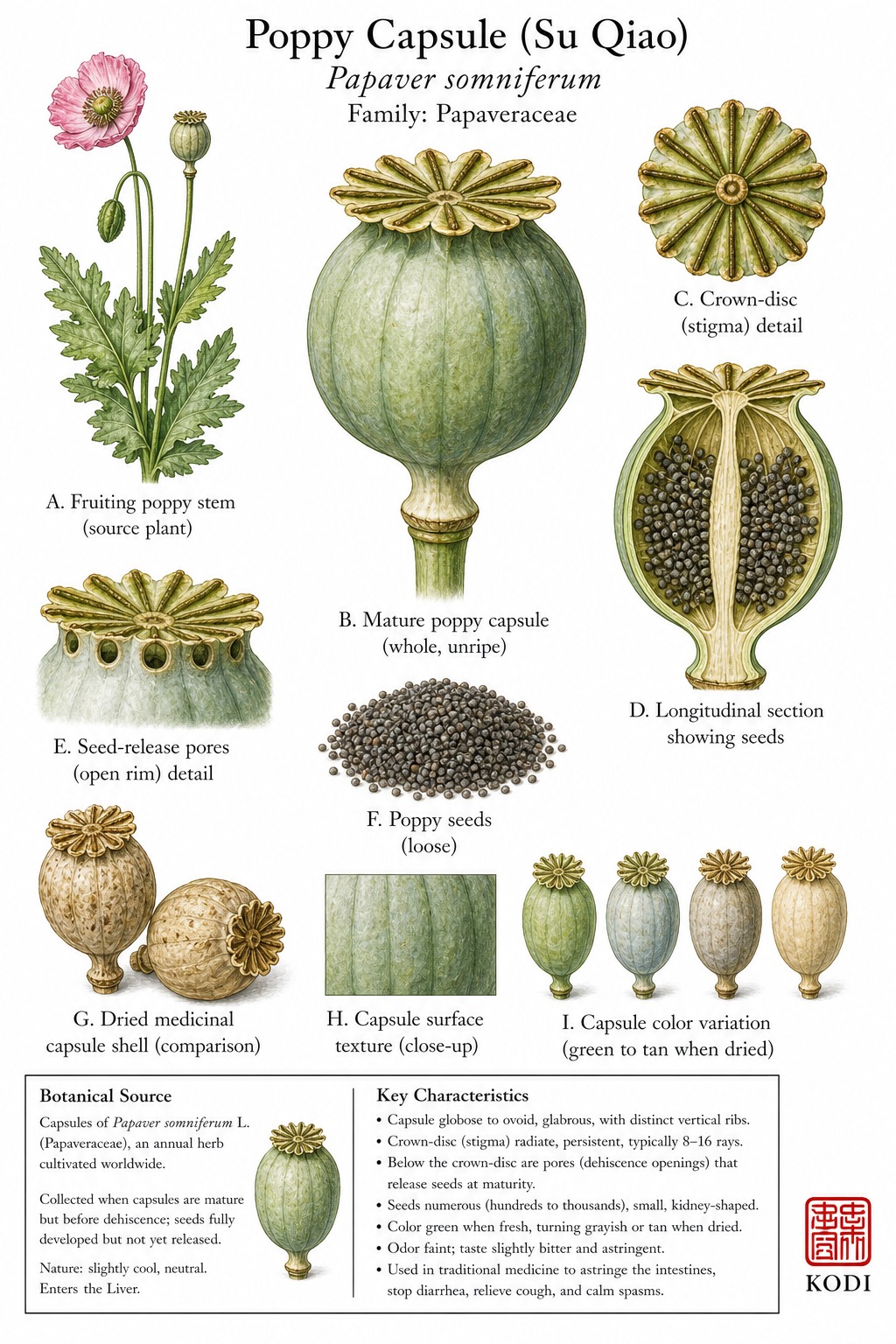
Known in TCM as Ying Su Qiao (罂粟壳), this sour and astringent, neutral herb enters the Lung, Large Intestine, and Kidney. Traditionally, it astringes the Lung and stops chronic cough, especially when the cough has become prolonged, weak, and difficult to control, most often applied for cough, diarrhea, and dysentery. Modern research has identified Morphine among its active constituents.
Also Known As
Latin: Capsula Papaveris | Pinyin: Ying Su Qiao | Chinese: 罂粟壳
TCM Properties
- Taste
- sour, astringent
- Temperature
- neutral
- Channels
- Lung, Large Intestine, Kidney
Traditional Use
Primary Actions
- Astringes the Lung and stops chronic cough, especially when the cough has become prolonged, weak, and difficult to control.
- Astringes the intestines and stops chronic diarrhea or dysentery when prolonged leakage has exhausted the bowel's ability to contain.
- Relieves pain in stubborn chronic patterns where leakage and spasm coexist, particularly abdominal pain associated with long-standing diarrhea.
Secondary Actions
- IDENTITY NOTE: the imported pinyin dropped the opening syllable. Standard reference naming is Ying Su Qiao or Ying Su Ke, not plain Su Qiao by itself.
- This record is the whole-capsule, source-material lane. The sibling `poppy-capsule-2` record is kept as the drier trade-husk form of the same restricted drug tradition.
Classic Formulas
- Zhen Ren Yang Zang Tang, where poppy capsule helps bind the intestines in chronic diarrhea and dysentery from deficiency and prolonged leakage.
- Jiu Xian San, where poppy capsule is used to astringe the Lung in chronic cough and consumption-type cough patterns.
Classical References
- Traditional Chinese herbology places poppy capsule among the strongly astringing herbs that stop chronic cough and chronic diarrhea.
- Its use is classically reserved for long-standing leakage, not for early acute disease.
Modern Research
Active Compounds
- Morphine
- Codeine
- Papaverine
- Other opium alkaloid residues in the dried capsule wall
Studied Effects
- Pharmacokinetic work on Papaver somniferum demonstrated transplacental transfer of codeine and its metabolites, which reinforces the strong pregnancy caution for the poppy-capsule drug tradition (PMID 36007718).
- Human pharmacokinetic work on morphine and codeine after administration of a traditional formula containing Papaveris Pericarpium confirms that clinically relevant opiate alkaloid exposure occurs even in herbal-medicine contexts (PMID 29148050).
- Analytical quality-control work identified codeine, morphine, and papaverine in Pericarpium papaveris, underscoring why this herb is controlled and potentially addictive (PMID 15739501).
PubMed References
- Pharmacokinetics and transplacental transfer of codeine and codeine metabolites from Papaver somniferum L. (2022)
- The Pharmacokinetics of Morphine and Codeine in Human Plasma and Urine after Oral Administration of Qiangli Pipa Syrup. (2018)
- [Determination of alkaloids in Pericarpium papaveris (Yingsuqiao) by high performance capillary electrophoresis]. (1997)
Safety & Interactions
Contraindications
- Pregnancy
- Children except under tightly supervised specialist use
- Early-stage cough, diarrhea, or dysentery with unresolved pathogen
- History of substance misuse or opioid sensitivity
Cautions
- This is a controlled narcotic-adjacent medicinal containing opium alkaloids and should never be treated as a casual self-care herb.
- Its strong astringing action can trap pathogens if used before the disease has been properly vented.
Drug Interactions
- Opioids or other sedating medications ... possible additive sedation and respiratory suppression risk
- Antidiarrheals or antitussives ... possible additive constipating or cough-suppressing effects
Conditions
Frequently Asked Questions
What is Whole Poppy Capsule used for?
Whole Poppy Capsule is traditionally used to Astringes the Lung and stops chronic cough, especially when the cough has become prolonged, weak, and difficult to control., Astringes the intestines and stops chronic diarrhea or dysentery when prolonged leakage has exhausted the bowel's ability to contain., Relieves pain in stubborn chronic patterns where leakage and spasm coexist, particularly abdominal pain associated with long-standing diarrhea.. Research has investigated its effects on: Pharmacokinetic work on Papaver somniferum demonstrated transplacental transfer of codeine and its metabolites, which reinforces the strong pregnancy caution for the poppy-capsule drug tradition (PMID 36007718).; Human pharmacokinetic work on morphine and codeine after administration of a traditional formula containing Papaveris Pericarpium confirms that clinically relevant opiate alkaloid exposure occurs even in herbal-medicine contexts (PMID 29148050)..
What are other names for Whole Poppy Capsule?
Whole Poppy Capsule is also known as Su Qiao, Whole opium poppy capsule. In TCM: 罂粟壳 (Ying Su Qiao); Capsula Papaveris.
Is Whole Poppy Capsule safe during pregnancy?
Whole Poppy Capsule is not recommended during pregnancy.
What are the contraindications for Whole Poppy Capsule?
Whole Poppy Capsule should not be used in: Pregnancy; Children except under tightly supervised specialist use; Early-stage cough, diarrhea, or dysentery with unresolved pathogen; History of substance misuse or opioid sensitivity. Consult a qualified healthcare provider before use.
Does Whole Poppy Capsule interact with any medications?
Whole Poppy Capsule may interact with: Opioids or other sedating medications ... possible additive sedation and respiratory suppression risk; Antidiarrheals or antitussives ... possible additive constipating or cough-suppressing effects. Always inform your healthcare provider of any herbal supplements you are taking.