Pomegranate Rind
- Chinese
- 石榴皮
- Pinyin
- Shi Liu Pi
- Latin
- Pericarpium Granati
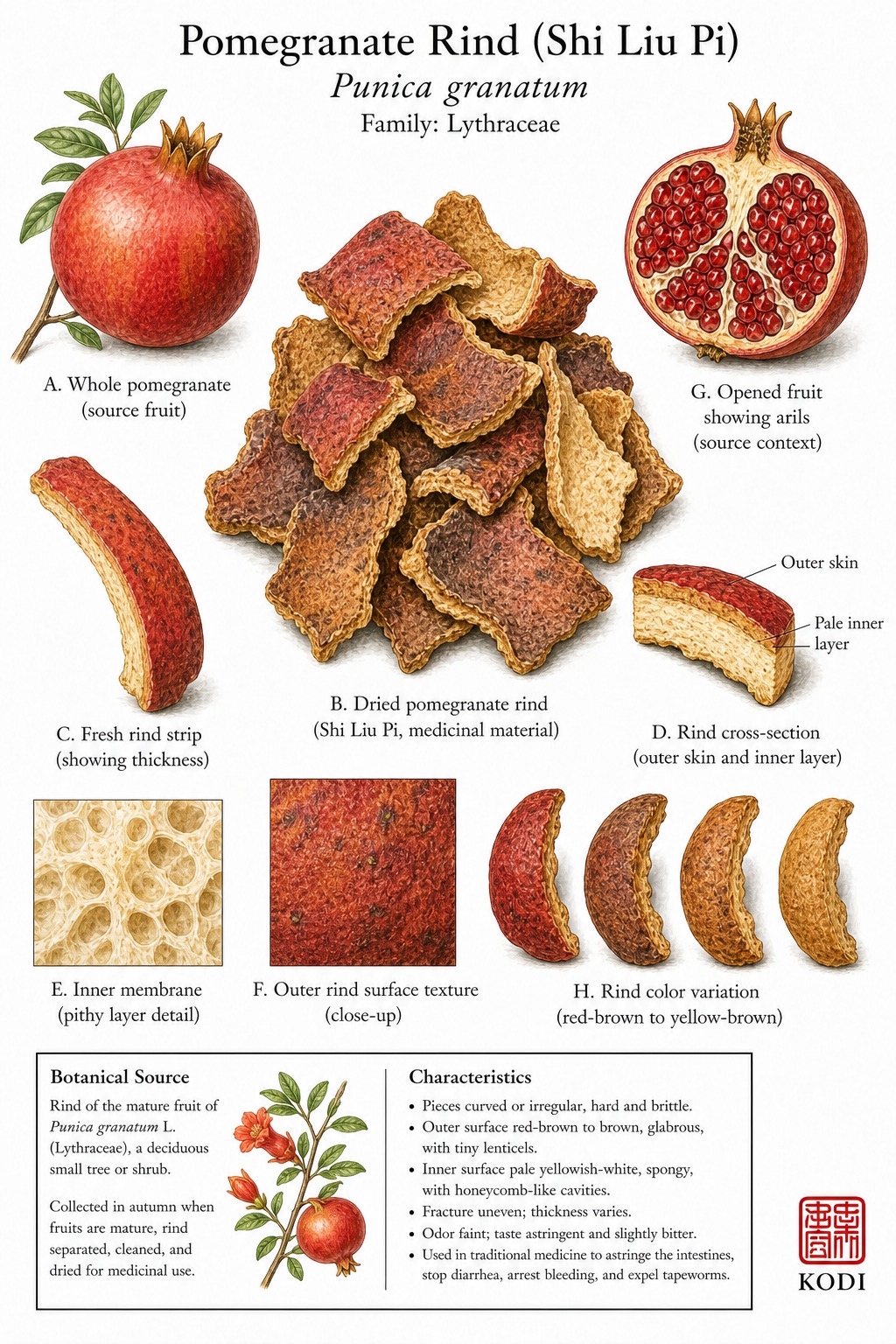
Known in TCM as Shi Liu Pi (石榴皮), this sour and astringent, warm herb enters the Large Intestine and Kidney. Traditionally, it astringes the intestines and stops chronic diarrhea or dysentery, especially when the bowel has become slack after prolonged illness, most often applied for diarrhea, dysentery, and intestinal parasites. Modern research has identified Punicalagins among its active constituents.
Part used: Peel
Also Known As
Latin: Pericarpium Granati | Pinyin: Shi Liu Pi | Chinese: 石榴皮
TCM Properties
- Taste
- sour, astringent
- Temperature
- warm
- Channels
- Large Intestine, Kidney
Traditional Use
Primary Actions
- Astringes the intestines and stops chronic diarrhea or dysentery, especially when the bowel has become slack after prolonged illness.
- Kills intestinal parasites, particularly when chronic digestive weakness and worm infestation overlap.
- Secures leakage below, so classical use extends to leukorrhea and other chronic discharge patterns.
Secondary Actions
- Shi Liu Pi is much stronger and more astringent than the whole fruit Shi Liu.
- Its warm-sour binding action is best for lingering leakage rather than for the early stage of an acute pathogen that still needs to be expelled.
Classical References
- Traditional herbology describes Shi Liu Pi as sour, astringent, and warm, entering the intestines to stop chronic diarrhea and dysentery.
- Older sources also emphasize its anti-parasitic action and its use for chronic vaginal discharge.
Modern Research
Active Compounds
- Punicalagins and related ellagitannins
- Phenolic acids and flavonoids
- Antimicrobial and anti-parasitic peel polyphenols
Studied Effects
- A comprehensive review described the health benefits and nutraceutical potential of pomegranate peel, including antioxidant, anti-inflammatory, and antimicrobial activity (PMID 34923641).
- Another review focused specifically on pomegranate peel phytochemistry, pharmacologic properties, extraction methods, and applications, reinforcing that the rind is the most medicinally concentrated part of the fruit (PMID 37810640).
- Experimental work found anticryptosporidial effects from pomegranate peel water extract in infected mice, which fits the traditional anti-dysenteric and anti-parasitic lane unusually well (PMID 31263326).
- A therapeutic study on giardiasis also supported anti-parasitic activity of pomegranate peel extract, further aligning modern evidence with classical use (PMID 34208266).
PubMed References
- Ongoing and potential novel trends of pomegranate fruit peel; a comprehensive review of its health benefits and future perspectives as nutraceutical. (2022)
- Pomegranate Peel Phytochemistry, Pharmacological Properties, Methods of Extraction, and Its Application: A Comprehensive Review. (2023)
- Anticryptosporidial effect of pomegranate peels water extract in experimentally infected mice with special reference to some biochemical parameters and antioxidant activity. (2019)
- Pomegranate Peel Extract Is a Potential Alternative Therapeutic for Giardiasis. (2021)
Safety & Interactions
Contraindications
- Early-stage diarrhea or dysentery when the pathogen still needs to be vented
- Constipation from dryness without chronic leakage
Cautions
- Because Shi Liu Pi is strongly binding, it should not be used reflexively for acute bowel infection before the pattern is clear.
Conditions
- Diarrhea Traditional ★★★★☆ JSON
- Dysentery Traditional ★★★★☆ JSON
- Intestinal Parasites Traditional ★★★☆☆ JSON
- Leukorrhea Traditional ★★☆☆☆ JSON
Frequently Asked Questions
What is Pomegranate Rind used for?
Pomegranate Rind is traditionally used to Astringes the intestines and stops chronic diarrhea or dysentery, especially when the bowel has become slack after prolonged illness., Kills intestinal parasites, particularly when chronic digestive weakness and worm infestation overlap., Secures leakage below, so classical use extends to leukorrhea and other chronic discharge patterns.. Research has investigated its effects on: A comprehensive review described the health benefits and nutraceutical potential of pomegranate peel, including antioxidant, anti-inflammatory, and antimicrobial activity (PMID 34923641).; Another review focused specifically on pomegranate peel phytochemistry, pharmacologic properties, extraction methods, and applications, reinforcing that the rind is the most medicinally concentrated part of the fruit (PMID 37810640)..
What are other names for Pomegranate Rind?
Pomegranate Rind is also known as Pomegranate peel, Granati pericarp. In TCM: 石榴皮 (Shi Liu Pi); Pericarpium Granati.
Is Pomegranate Rind safe during pregnancy?
The safety of Pomegranate Rind during pregnancy has not been established. Consult a qualified healthcare provider before use.
What are the contraindications for Pomegranate Rind?
Pomegranate Rind should not be used in: Early-stage diarrhea or dysentery when the pathogen still needs to be vented; Constipation from dryness without chronic leakage. Consult a qualified healthcare provider before use.