Polyporus Sclerotium
- Chinese
- 猪苓
- Pinyin
- Zhu Ling
- Latin
- Polyporus umbellatus
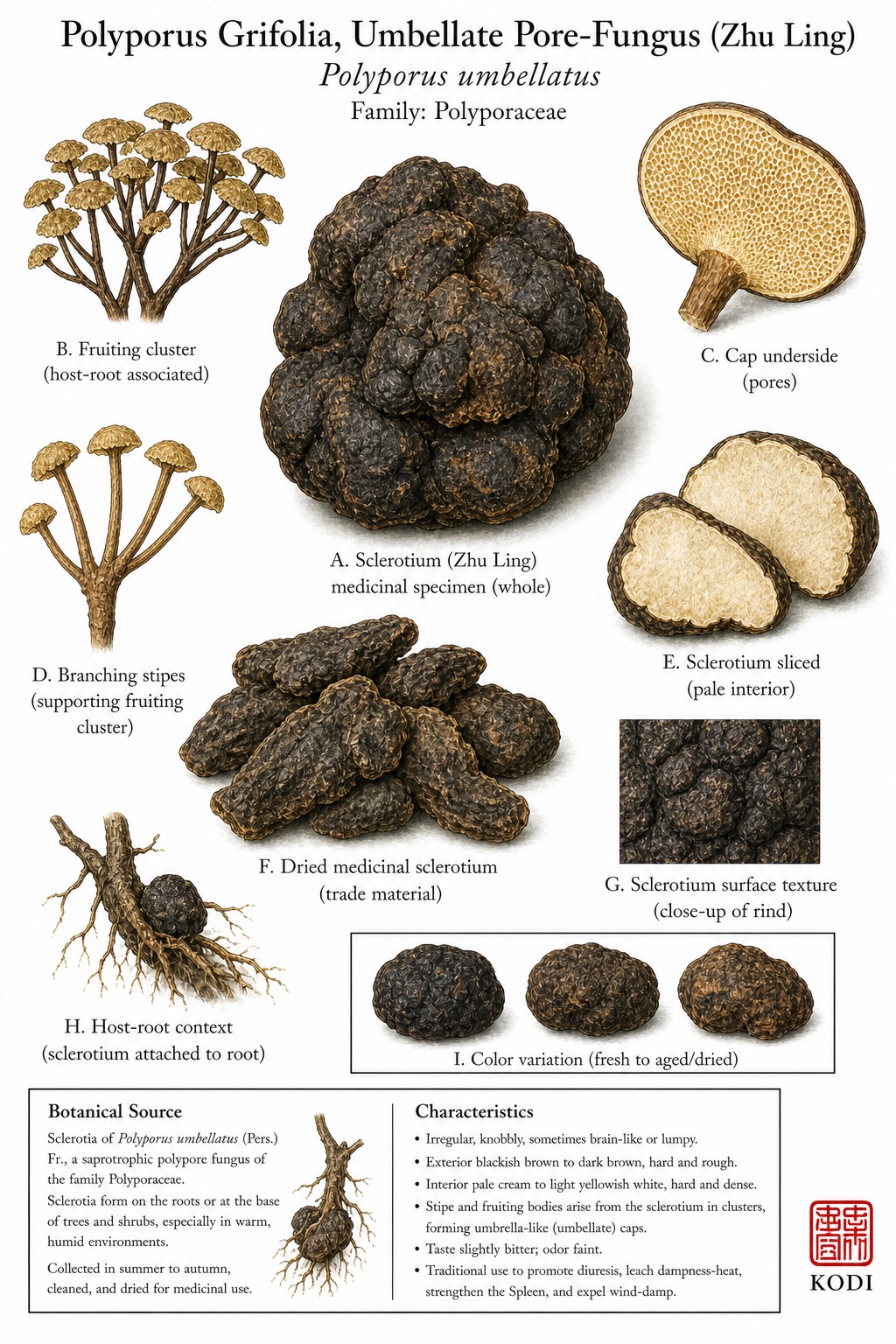
Known in TCM as Zhu Ling (猪苓), this sweet and bland, neutral herb enters the Kidney and Bladder. Traditionally, it promotes urination and drains dampness, especially for edema, scanty urine, urinary difficulty, and damp retention that has begun to impair fluid movement, most often applied for edema, urinary tract infection, and diarrhea. Modern research has identified Polyporus among its active constituents.
Part used: Fruiting body (fungus)
Also Known As
Latin: Polyporus umbellatus | Pinyin: Zhu Ling | Chinese: 猪苓
TCM Properties
- Taste
- sweet, bland
- Temperature
- neutral
- Channels
- Kidney, Bladder
Traditional Use
Primary Actions
- Promotes urination and drains dampness, especially for edema, scanty urine, urinary difficulty, and damp retention that has begun to impair fluid movement.
- Clears damp-heat from the lower burner without strongly injuring Yin, which is why Zhu Ling is central in urinary patterns with burning, fever, thirst, or dark painful urination.
- Leaches out retained water from the intestines when fluid obstruction contributes to diarrhea rather than simple food stagnation or Spleen deficiency.
Secondary Actions
- IDENTITY NOTE: the medicinal is the underground sclerotium of Polyporus umbellatus, not a generic edible mushroom cluster and not maitake.
- Zhu Ling overlaps with Fu Ling as a damp-draining fungus, but it is more directly urination-promoting and does not carry Fu Ling's stronger Spleen-supporting or spirit-calming emphasis.
Classic Formulas
- Zhu Ling Tang, where Zhu Ling is a chief herb for damp-heat urinary difficulty with thirst and irritability.
- Wu Ling San, where Zhu Ling helps unblock water pathways and resolve edema, urinary inhibition, and fluid retention.
Classical References
- Traditional materia medica consistently describe Zhu Ling as sweet, bland, and neutral, entering the Kidney and Bladder to induce urination and drain dampness.
- Its classic use is strongest when water accumulation and urinary obstruction are prominent.
Modern Research
Active Compounds
- Polyporus polysaccharides
- Ergostane-type sterols and ecdysteroids
- Fungal triterpenoid and sclerotial bioactive fractions
Studied Effects
- A comprehensive review summarized the traditional uses, phytochemistry, pharmacology, pharmacokinetics, and quality control of Polyporus umbellatus, supporting Zhu Ling's modern research base beyond simple diuresis (PMID 23811047).
- A focused review of Polyporus polysaccharides summarized extraction methods, structures, modifications, and bioactivities, highlighting anti-inflammatory, immune, and renal research interest (PMID 34419536).
- Experimental work reported renoprotective effects of polysaccharides from Polyporus umbellatus sclerotia against renal fibrosis, which aligns well with the herb's longstanding urinary and kidney-associated use (PMID 30832835).
PubMed References
- Traditional uses, phytochemistry, pharmacology, pharmacokinetics and quality control of Polyporus umbellatus (Pers.) Fries: a review. (2013)
- Polysaccharides from Polyporus umbellatus: A review on their extraction, modification, structure, and bioactivities. (2021)
- Renoprotective effect and mechanism of polysaccharide from Polyporus umbellatus sclerotia on renal fibrosis. (2019)
Safety & Interactions
Contraindications
- Marked Yin deficiency or fluid depletion without damp retention
Cautions
- Because Zhu Ling promotes urination without tonifying, prolonged use in already dry or depleted patients can worsen fluid loss.
Conditions
Frequently Asked Questions
What is Polyporus Sclerotium used for?
Polyporus Sclerotium is traditionally used to Promotes urination and drains dampness, especially for edema, scanty urine, urinary difficulty, and damp retention that has begun to impair fluid movement., Clears damp-heat from the lower burner without strongly injuring Yin, which is why Zhu Ling is central in urinary patterns with burning, fever, thirst, or dark painful urination., Leaches out retained water from the intestines when fluid obstruction contributes to diarrhea rather than simple food stagnation or Spleen deficiency.. Research has investigated its effects on: A comprehensive review summarized the traditional uses, phytochemistry, pharmacology, pharmacokinetics, and quality control of Polyporus umbellatus, supporting Zhu Ling's modern research base beyond simple diuresis (PMID 23811047).; A focused review of Polyporus polysaccharides summarized extraction methods, structures, modifications, and bioactivities, highlighting anti-inflammatory, immune, and renal research interest (PMID 34419536)..
What are other names for Polyporus Sclerotium?
Polyporus Sclerotium is also known as Polyporus, Umbrella polypore sclerotium. In TCM: 猪苓 (Zhu Ling); Polyporus umbellatus.
Is Polyporus Sclerotium safe during pregnancy?
The safety of Polyporus Sclerotium during pregnancy has not been established. Consult a qualified healthcare provider before use.
What are the contraindications for Polyporus Sclerotium?
Polyporus Sclerotium should not be used in: Marked Yin deficiency or fluid depletion without damp retention. Consult a qualified healthcare provider before use.