Pokeberry Root
- Chinese
- 商陆
- Pinyin
- Shang Lu
- Latin
- Radix Phytolaccae
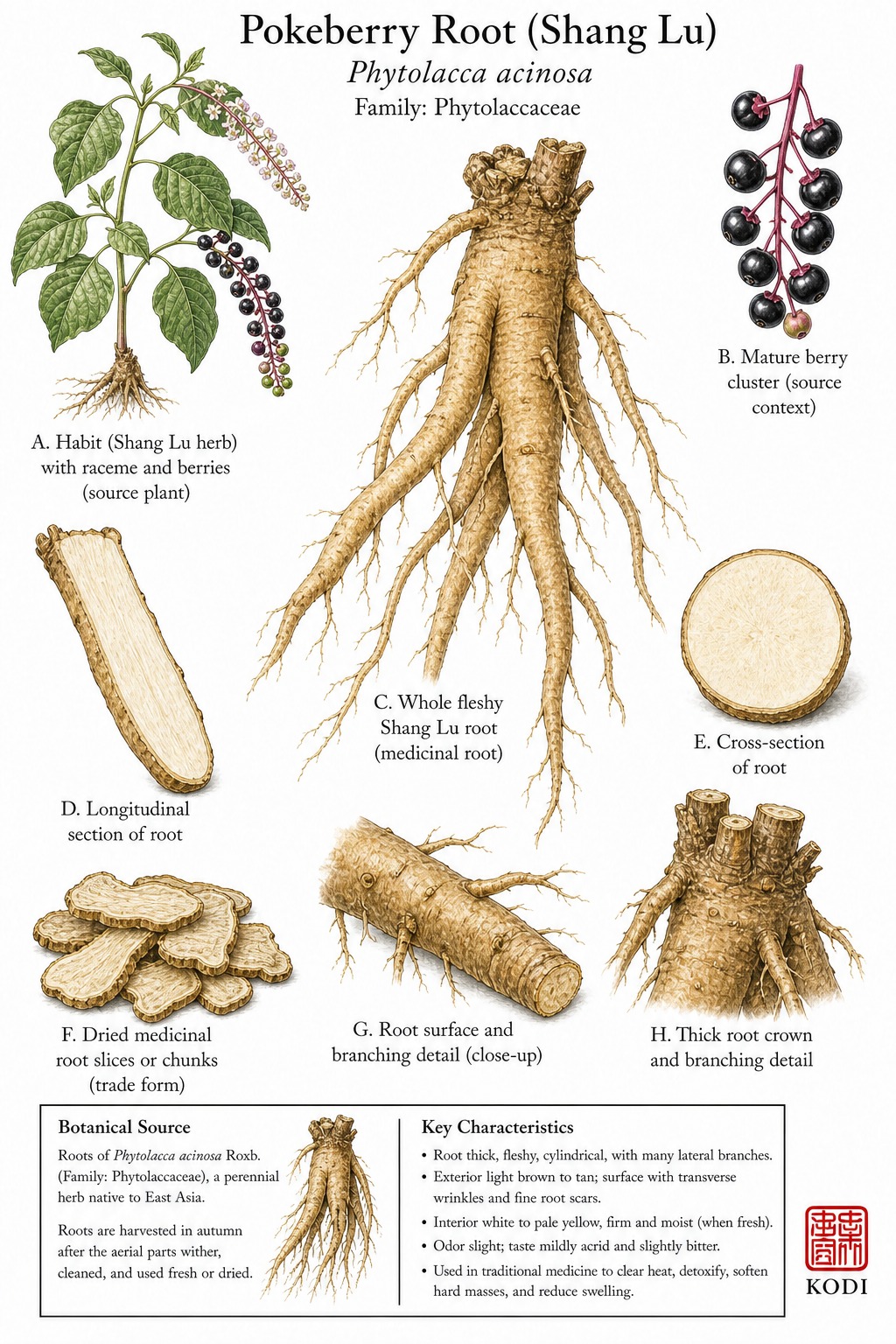
Known in TCM as Shang Lu (商陆), this bitter and pungent, cold herb enters the Lung, Spleen, Kidney, and Large Intestine. Traditionally, it drastically expels water and reduces swelling in severe edema, ascites, or fluid accumulation that requires forceful downward draining, most often applied for edema, constipation, and abscess. Modern research has identified Triterpenoid among its active constituents.
Part used: Root
Also Known As
Latin: Radix Phytolaccae | Pinyin: Shang Lu | Chinese: 商陆
TCM Properties
- Taste
- bitter, pungent
- Temperature
- cold
- Channels
- Lung, Spleen, Kidney, Large Intestine
Traditional Use
Primary Actions
- Drastically expels water and reduces swelling in severe edema, ascites, or fluid accumulation that requires forceful downward draining.
- Promotes urination and purges accumulation downward, making it part of the harsh expellant class rather than the gentle damp-draining class.
- Used externally to resolve toxicity and reduce swelling for abscesses, sores, and breast inflammation.
Secondary Actions
- Shang Lu is a toxic herb and is far stronger and riskier than everyday diuretics such as Fu Ling or Ze Xie.
- Processed forms, especially vinegar-treated material, are traditionally used to reduce toxicity.
Classical References
- Traditional sources consistently describe Shang Lu as bitter, cold, descending, and toxic, with strong action on severe water accumulation.
- Its external use for swellings and abscesses is secondary to its better-known harsh internal water-expelling role.
Modern Research
Active Compounds
- Triterpenoid saponins
- Esculentic acid
- Phytolaccagenin and related aglycones
Studied Effects
- A 2025 comprehensive review summarized the ethnomedicine, phytochemistry, pharmacology, and toxicology of Phytolacca acinosa, reflecting strong current interest in Shang Lu as a multipurpose but risky medicinal (PMID 39978645).
- Recent Chinese review literature specifically focused on chemical constituents, pharmacologic effects, toxicity, and heavy-metal enrichment in Phytolacca plants, reinforcing that toxicity assessment is central to this drug's identity (PMID 39307773).
- Esculentic acid from Phytolacca showed protective effects against endotoxic shock in mice, supporting anti-inflammatory research interest in root constituents (PMID 25242384).
- New work also documented hepatotoxicity mediated by phytolaccagenin through ferroptosis and related signaling pathways, which strongly supports keeping Shang Lu in the high-risk safety tier (PMID 39892312).
PubMed References
- From folklore to pharmacology: A comprehensive review of Phytolacca acinosa Roxb. A multipurpose medicinal herb. (2025)
- [Researc h progress on chemical constituents, pharmacological effects, toxicity,and heavy metal enrichment characteristics of Phytolacca plants]. (2024)
- Protective effects of esculentic acid against endotoxic shock in Kunming mice. (2014)
- Hepatotoxicity of Phytolacca acinosa Roxb mediated by phytolaccagenin via ferroptosis/PPAR/P53/arachidonic acid metabolism. (2025)
Safety & Interactions
Contraindications
- Pregnancy
- Frailty, depletion, or absence of severe water accumulation
- Mild edema that could be managed with gentler medicinals
Cautions
- Shang Lu is toxic and can cause severe gastrointestinal irritation and systemic poisoning if misused.
- Correct processing does not make it casual or food-like. This is a professional-use herb.
Conditions
Frequently Asked Questions
What is Pokeberry Root used for?
Pokeberry Root is traditionally used to Drastically expels water and reduces swelling in severe edema, ascites, or fluid accumulation that requires forceful downward draining., Promotes urination and purges accumulation downward, making it part of the harsh expellant class rather than the gentle damp-draining class., Used externally to resolve toxicity and reduce swelling for abscesses, sores, and breast inflammation.. Research has investigated its effects on: A 2025 comprehensive review summarized the ethnomedicine, phytochemistry, pharmacology, and toxicology of Phytolacca acinosa, reflecting strong current interest in Shang Lu as a multipurpose but risky medicinal (PMID 39978645).; Recent Chinese review literature specifically focused on chemical constituents, pharmacologic effects, toxicity, and heavy-metal enrichment in Phytolacca plants, reinforcing that toxicity assessment is central to this drug's identity (PMID 39307773)..
What are other names for Pokeberry Root?
Pokeberry Root is also known as Poke root, Phytolacca root. In TCM: 商陆 (Shang Lu); Radix Phytolaccae.
Is Pokeberry Root safe during pregnancy?
Pokeberry Root is not recommended during pregnancy.
What are the contraindications for Pokeberry Root?
Pokeberry Root should not be used in: Pregnancy; Frailty, depletion, or absence of severe water accumulation; Mild edema that could be managed with gentler medicinals. Consult a qualified healthcare provider before use.