Pith of Common Rush
- Chinese
- 灯心草
- Pinyin
- Deng Xin Cao
- Latin
- Medulla Junci
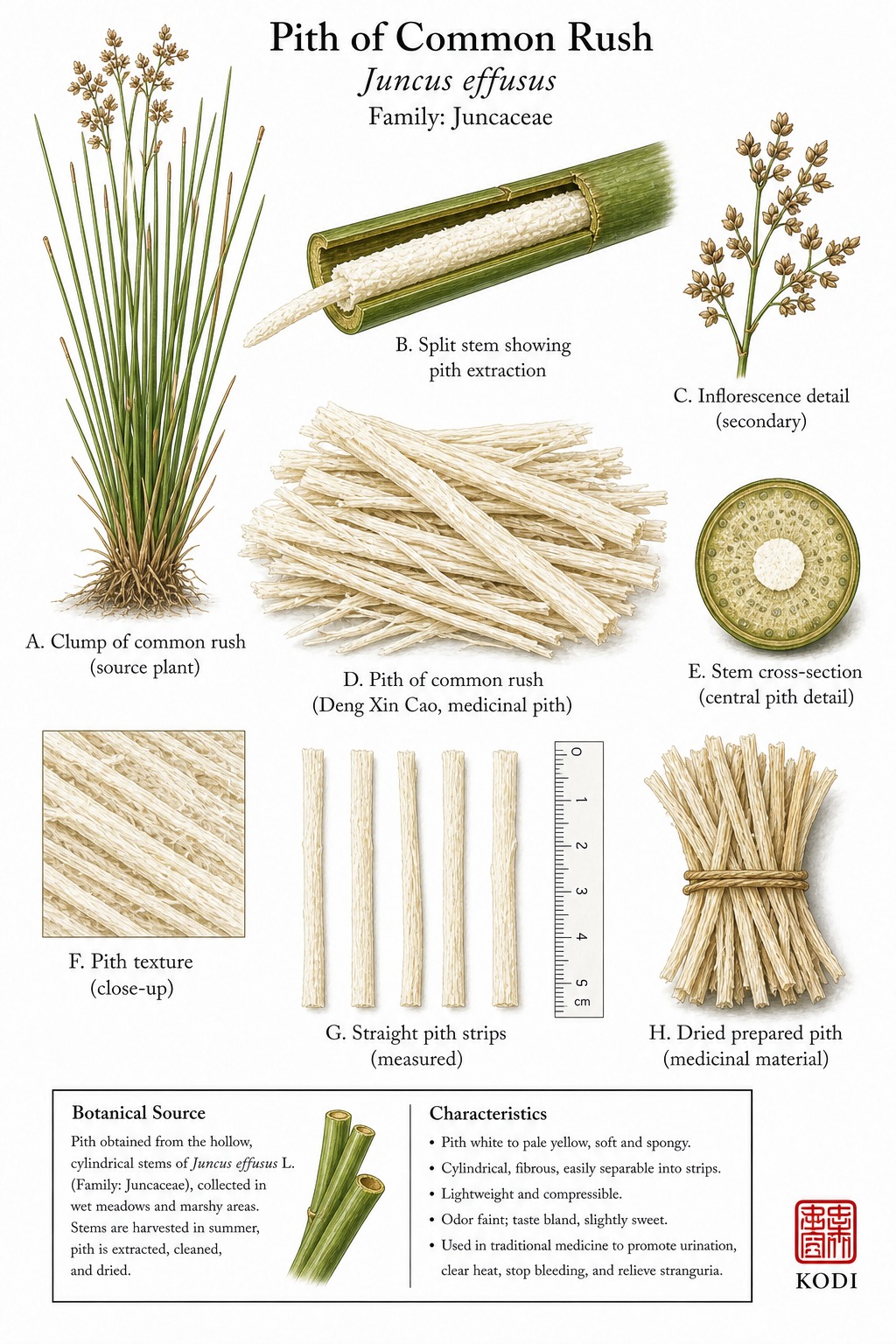
Known in TCM as Deng Xin Cao (灯心草), this sweet and bland, slightly cold herb enters the Heart, Lung, and Small Intestine. Traditionally, it clears Heart heat gently and relieves irritability, especially in children or mild patterns with restless sleep and nighttime crying, most often applied for insomnia, urinary tract infection, and oral ulcers. Modern research has identified Phenanthrenes among its active constituents.
Part used: Pith
Also Known As
Latin: Medulla Junci | Pinyin: Deng Xin Cao | Chinese: 灯心草
TCM Properties
- Taste
- sweet, bland
- Temperature
- slightly cold
- Channels
- Heart, Lung, Small Intestine
Traditional Use
Primary Actions
- Clears Heart heat gently and relieves irritability, especially in children or mild patterns with restless sleep and nighttime crying.
- Promotes urination and guides heat downward through the Small Intestine for scanty painful dark urine with internal heat.
- Can be used for mouth sores or tongue-tip ulceration when Heart fire flares upward.
Secondary Actions
- Deng Xin Cao is lighter and gentler than stronger damp-heat draining medicinals, which is why it is often selected when the patient is delicate or pediatric.
- Charred forms appear in older literature for cooling blood and stopping bleeding, but the main modern use remains gentle Heart-heat drainage.
Classical References
- Traditional herbology describes Deng Xin Cao as sweet, bland, and slightly cold, entering the Heart, Lung, and Small Intestine.
- Its classic job is to direct Heart heat downward through urination while calming irritability.
Modern Research
Active Compounds
- Phenanthrenes from Juncus effusus
- Water-soluble anti-inflammatory extract fractions
- Flavonoid and phenolic constituents
Studied Effects
- Juncus effusus extract showed anti-inflammatory effects in LPS-stimulated macrophages and edema models, which supports the herb's traditional heat-clearing role (PMID 25885933).
- A 2022 study reported anti-inflammatory and protective effects of Juncus effusus water extract on oral keratinocytes, which is especially relevant to the traditional mouth-sore indication (PMID 35028318).
- Phenanthrenes isolated from Juncus effusus showed estrogenic and anti-neutrophilic inflammatory activity, deepening the mechanistic literature on this mild but active herb (PMID 34498976).
PubMed References
- Anti-inflammatory effects of Juncus effusus extract (JEE) on LPS-stimulated RAW 264.7 cells and edema models. (2016)
- Anti-Inflammatory and Protective Effects of Juncus effusus L. Water Extract on Oral Keratinocytes. (2022)
- Estrogenic and anti-neutrophilic inflammatory phenanthrenes from Juncus effusus L. (2022)
Safety & Interactions
Contraindications
- Urinary frequency or leakage from deficiency-cold without heat
Cautions
- This herb is mild, but it is still best matched to heat-type urinary or irritability patterns rather than to cold deficiency.
Conditions
- Insomnia Traditional ★★☆☆☆ JSON
- Urinary Tract Infection Traditional ★★☆☆☆ JSON
- Oral Ulcers Traditional ★★★☆☆ JSON
- Mouth Sores Traditional ★★★☆☆ JSON
Frequently Asked Questions
What is Pith of Common Rush used for?
Pith of Common Rush is traditionally used to Clears Heart heat gently and relieves irritability, especially in children or mild patterns with restless sleep and nighttime crying., Promotes urination and guides heat downward through the Small Intestine for scanty painful dark urine with internal heat., Can be used for mouth sores or tongue-tip ulceration when Heart fire flares upward.. Research has investigated its effects on: Juncus effusus extract showed anti-inflammatory effects in LPS-stimulated macrophages and edema models, which supports the herb's traditional heat-clearing role (PMID 25885933).; A 2022 study reported anti-inflammatory and protective effects of Juncus effusus water extract on oral keratinocytes, which is especially relevant to the traditional mouth-sore indication (PMID 35028318)..
What are other names for Pith of Common Rush?
Pith of Common Rush is also known as Rush pith, Juncus pith. In TCM: 灯心草 (Deng Xin Cao); Medulla Junci.
Is Pith of Common Rush safe during pregnancy?
The safety of Pith of Common Rush during pregnancy has not been established. Consult a qualified healthcare provider before use.
What are the contraindications for Pith of Common Rush?
Pith of Common Rush should not be used in: Urinary frequency or leakage from deficiency-cold without heat. Consult a qualified healthcare provider before use.