Pipewort Flower
- Chinese
- 谷精草
- Pinyin
- Gu Jing Cao
- Latin
- Flos Eriocauli
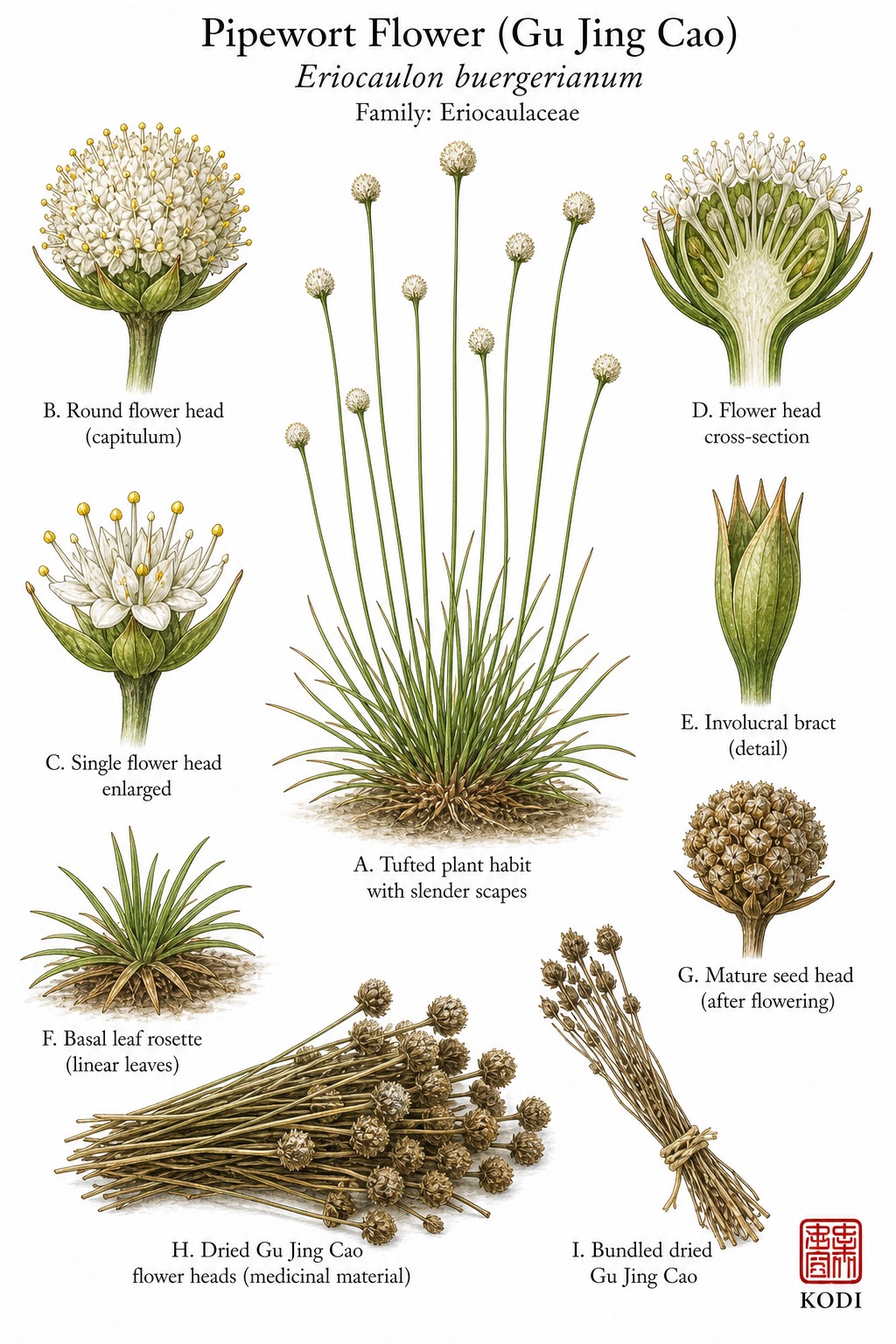
Known in TCM as Gu Jing Cao (谷精草), this acrid and sweet, neutral herb enters the Liver and Lung. Traditionally, it dispels wind-heat from the head and face, especially when red swollen painful eyes follow an exterior wind-heat pattern, most often applied for conjunctivitis, blurred vision, and headache. Modern research has identified Hispidulin among its active constituents.
Part used: Flower
Also Known As
Latin: Flos Eriocauli | Pinyin: Gu Jing Cao | Chinese: 谷精草
TCM Properties
- Taste
- acrid, sweet
- Temperature
- neutral
- Channels
- Liver, Lung
Traditional Use
Primary Actions
- Dispels wind-heat from the head and face, especially when red swollen painful eyes follow an exterior wind-heat pattern.
- Clears Liver-related eye heat and improves vision in cases of blurred sight, photophobia, or superficial visual obstruction.
- Also used for headache linked to wind-heat rising upward.
Secondary Actions
- Some materia medica describe Gu Jing Cao as slightly cool and Liver-Stomach entering, while others call it neutral and Liver-Lung entering. The clinical eye-focused action profile is the main point of consistency.
- Its traditional identity is strongly ophthalmic.
Classical References
- Classical use emphasizes eye redness, eye pain, superficial visual obstruction, and headache from wind-heat or Liver heat.
- Traditional physicians often compared its eye-brightening action favorably with other light upward-moving flower herbs.
Modern Research
Active Compounds
- Hispidulin and related flavonoids
- Eriocaulon phenolics and anti-inflammatory constituents
- Market-identified species-specific phytochemical markers
Studied Effects
- Morphological and chemical market analysis has been used to distinguish Eriocauli Flos sold in Taiwan, supporting identity control for this often-confused eye herb (PMID 28987371).
- Eriocaulon buergerianum extract protected PC12 cells and zebrafish neurons against 6-hydroxydopamine injury, showing neuroprotective experimental activity beyond the classical eye indications (PMID 21527031).
- A network-pharmacology study explored the potential role of hispidulin from Eriocauli Flos in diabetic retinopathy treatment, aligning modern interest with the herb's longstanding ophthalmic reputation (PMID 35590353).
PubMed References
- Morphological and chemical analyses of Eriocauli Flos sold in Taiwan markets. (2017)
- Eriocaulon buergerianum extract protects PC12 cells and neurons in zebrafish against 6-hydroxydopamine-induced damage. (2011)
- The potential effects and mechanisms of hispidulin in the treatment of diabetic retinopathy based on network pharmacology. (2022)
Safety & Interactions
Contraindications
- Eye symptoms caused mainly by blood deficiency or Yin deficiency without wind-heat
Cautions
- Persistent eye pain or sudden vision change should be medically evaluated rather than self-treated.
Conditions
- Conjunctivitis Traditional ★★★★☆ JSON
- Blurred Vision Traditional ★★★☆☆ JSON
- Headache Traditional ★★☆☆☆ JSON
Frequently Asked Questions
What is Pipewort Flower used for?
Pipewort Flower is traditionally used to Dispels wind-heat from the head and face, especially when red swollen painful eyes follow an exterior wind-heat pattern., Clears Liver-related eye heat and improves vision in cases of blurred sight, photophobia, or superficial visual obstruction., Also used for headache linked to wind-heat rising upward.. Research has investigated its effects on: Morphological and chemical market analysis has been used to distinguish Eriocauli Flos sold in Taiwan, supporting identity control for this often-confused eye herb (PMID 28987371).; Eriocaulon buergerianum extract protected PC12 cells and zebrafish neurons against 6-hydroxydopamine injury, showing neuroprotective experimental activity beyond the classical eye indications (PMID 21527031)..
What are other names for Pipewort Flower?
Pipewort Flower is also known as Eriocauli Flos. In TCM: 谷精草 (Gu Jing Cao); Flos Eriocauli.
Is Pipewort Flower safe during pregnancy?
The safety of Pipewort Flower during pregnancy has not been established. Consult a qualified healthcare provider before use.
What are the contraindications for Pipewort Flower?
Pipewort Flower should not be used in: Eye symptoms caused mainly by blood deficiency or Yin deficiency without wind-heat. Consult a qualified healthcare provider before use.