Pipe Fish
- Chinese
- 海龙
- Pinyin
- Hai Long
- Latin
- Syngnathus
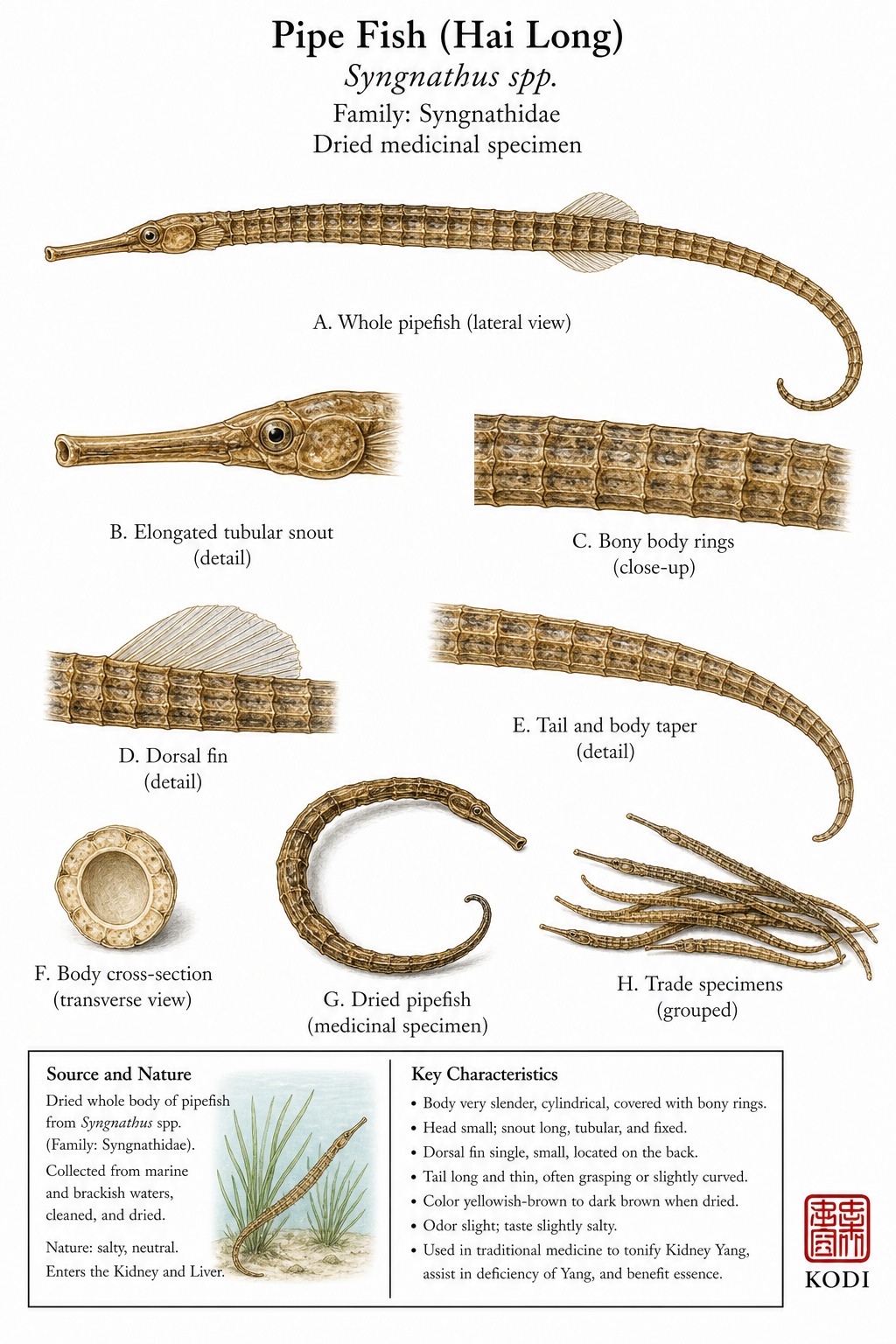
Known in TCM as Hai Long (海龙), this sweet and salty, warm herb enters the Kidney. Traditionally, it warms the Kidney and strengthens Yang for impotence, infertility, diminished libido, and weakness tied to Kidney Yang deficiency, most often applied for impotence, infertility, and low back pain. Modern research has identified Marine among its active constituents.
Also Known As
Latin: Syngnathus | Pinyin: Hai Long | Chinese: 海龙
TCM Properties
- Taste
- sweet, salty
- Temperature
- warm
- Channels
- Kidney
Traditional Use
Primary Actions
- Warms the Kidney and strengthens Yang for impotence, infertility, diminished libido, and weakness tied to Kidney Yang deficiency.
- Assists the channels and sinews when deficiency causes weakness of the low back and reduced physical vigor.
- Reduces swelling and disperses nodules, giving Hai Long a second traditional lane beyond reproductive and Yang-tonic use.
Secondary Actions
- Hai Long is closely related to Hai Ma, the sea horse, but many materia medica sources describe it as somewhat stronger in warming Kidney Yang and dispersing nodules.
- This is a marine animal medicinal, so authenticity and sustainable sourcing are persistent real-world issues.
Classical References
- Traditional sources describe Hai Long as sweet, salty, and warm, entering the Kidney to tonify Yang and support virility.
- It is one of the few Yang-tonic animal medicinals that also carries a clear swelling-and-nodule reducing indication.
Modern Research
Active Compounds
- Marine protein and peptide fractions studied from Syngnathus species
- Mineral and collagenous animal-tissue components
- Species-authentication markers used in quality-control work
Studied Effects
- A multiplex PCR study focused on authentic identification of medicinal pipefish and exclusion of common adulterants, which is directly relevant because Hai Long products are often sold under broad common names (PMID 28129724).
- Laboratory work isolated a new protein from Syngnathus acus with antitumor activity, suggesting marine bioactive potential even though clinical TCM evidence remains sparse (PMID 22363219).
- Compared with plant herbs, the indexed literature is much thinner and leans toward species authentication and exploratory marine pharmacology rather than robust clinical trials.
PubMed References
Safety & Interactions
Contraindications
- Yin deficiency with heat signs
- Pregnancy
Cautions
- Because Hai Long is an animal medicinal traded under broad names, authenticity and conservation concerns are substantial.
- Use of reproductive or Yang-tonic animal products should stay professionally guided rather than self-prescribed.
Conditions
- Impotence Traditional ★★★★☆ JSON
- Infertility Traditional ★★★☆☆ JSON
- Low Back Pain Traditional ★★☆☆☆ JSON
- Thyroid Nodule Traditional ★☆☆☆☆ JSON
Frequently Asked Questions
What is Pipe Fish used for?
Pipe Fish is traditionally used to Warms the Kidney and strengthens Yang for impotence, infertility, diminished libido, and weakness tied to Kidney Yang deficiency., Assists the channels and sinews when deficiency causes weakness of the low back and reduced physical vigor., Reduces swelling and disperses nodules, giving Hai Long a second traditional lane beyond reproductive and Yang-tonic use.. Research has investigated its effects on: A multiplex PCR study focused on authentic identification of medicinal pipefish and exclusion of common adulterants, which is directly relevant because Hai Long products are often sold under broad common names (PMID 28129724).; Laboratory work isolated a new protein from Syngnathus acus with antitumor activity, suggesting marine bioactive potential even though clinical TCM evidence remains sparse (PMID 22363219)..
What are other names for Pipe Fish?
Pipe Fish is also known as Pipefish, Syngnathus acus. In TCM: 海龙 (Hai Long); Syngnathus.
Is Pipe Fish safe during pregnancy?
Pipe Fish is not recommended during pregnancy.
What are the contraindications for Pipe Fish?
Pipe Fish should not be used in: Yin deficiency with heat signs; Pregnancy. Consult a qualified healthcare provider before use.