Fermented Pinellia
- Chinese
- 半夏曲
- Pinyin
- Ban Xia Qu
- Latin
- Massa Fermentata Rhizomae Pinelliae
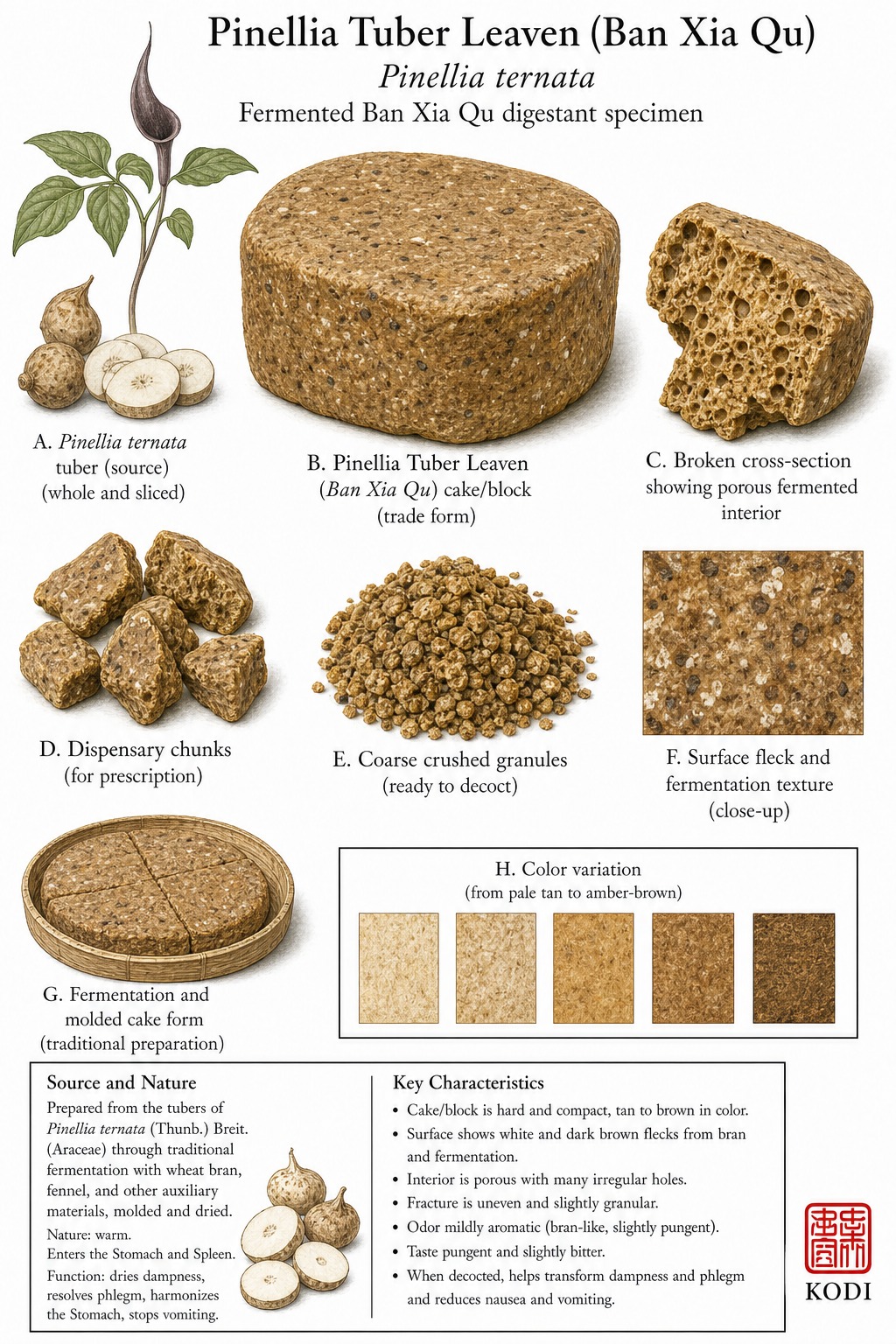
Known in TCM as Ban Xia Qu (半夏曲), this bitter and pungent, neutral herb enters the Lung, Spleen, and Large Intestine. Traditionally, it transforms phlegm and relieves cough when damp-phlegm obstructs the Lung and middle burner, most often applied for productive cough, cough, and indigestion. Modern research has identified Fermentation-modified among its active constituents.
Part used: Fermented mass
Also Known As
Latin: Massa Fermentata Rhizomae Pinelliae | Pinyin: Ban Xia Qu | Chinese: 半夏曲
TCM Properties
- Taste
- bitter, pungent
- Temperature
- neutral
- Channels
- Lung, Spleen, Large Intestine
Traditional Use
Primary Actions
- Transforms phlegm and relieves cough when damp-phlegm obstructs the Lung and middle burner.
- Promotes digestion and reduces food stagnation, especially when phlegm, dampness, and stagnant food combine with focal distension, belching, poor appetite, or nausea.
- Harmonizes the Stomach and redirects rebellious Qi downward, giving it a practical role in mixed phlegm-food accumulation patterns.
Secondary Actions
- Ban Xia Qu is not identical to raw Ban Xia or to the common processed forms Jiang Ban Xia and Fa Ban Xia. The fermentation step gives it a stronger digestion-oriented lane.
- Its classic niche sits between phlegm-transforming and food-reducing medicinals.
Classic Formulas
- Zhi Shi Xiao Pi Wan, where Ban Xia Qu helps transform phlegm and food accumulation in focal epigastric distension.
- Digestive-phlegm formulas may use Ban Xia Qu when dampness and food stagnation trap the middle burner together.
Classical References
- Traditional dictionaries describe Ban Xia Qu as bitter, pungent, and neutral, entering the Lung, Spleen, and Large Intestine.
- Its classic actions are to transform phlegm, stop cough, aid digestion, and widen the middle.
Modern Research
Active Compounds
- Fermentation-modified Pinellia ternata constituents
- Processed pinellia protein and polysaccharide fractions
- Ginger and flour co-processing metabolites associated with reduced irritation
Studied Effects
- A review of fermented traditional Chinese medicines specifically included fermented Pinellia and summarized how fermentation changes chemistry and traditional function (PMID 23627162).
- A comprehensive 2023 review of Pinellia ternata covered pharmacology, toxicity, and quality control across the broader Ban Xia medicinal tradition (PMID 38058630).
- Processing-method research continues to emphasize that proper treatment of Pinellia is crucial for reducing toxicity, which is directly relevant to Ban Xia Qu as a fermented processed form (PMID 36087845).
PubMed References
- [Review of traditional Chinese medicine processed by fermentation]. (2012)
- A review of the research progress on Pinellia ternata (Thunb.) Breit.: Botany, traditional uses, phytochemistry, pharmacology, toxicity and quality control. (2023)
- A review of traditional and current processing methods used to decrease the toxicity of the rhizome of Pinellia ternata in traditional Chinese medicine. (2022)
Safety & Interactions
Contraindications
- Dry cough from Yin deficiency without damp-phlegm
- Bleeding, heat, or fluid depletion patterns where drying phlegm transformation is inappropriate
Cautions
- Even though processed and fermented, this remains part of the Pinellia ternata drug family, where correct preparation matters for safety.
- Use should rely on qualified sourcing because adulteration or poor processing can materially change tolerability.
Conditions
- Productive Cough Traditional ★★★☆☆ JSON
- Cough Traditional ★★☆☆☆ JSON
- Indigestion Traditional ★★★☆☆ JSON
- Poor Appetite Traditional ★★☆☆☆ JSON
- Abdominal Distension Traditional ★★☆☆☆ JSON
Frequently Asked Questions
What is Fermented Pinellia used for?
Fermented Pinellia is traditionally used to Transforms phlegm and relieves cough when damp-phlegm obstructs the Lung and middle burner., Promotes digestion and reduces food stagnation, especially when phlegm, dampness, and stagnant food combine with focal distension, belching, poor appetite, or nausea., Harmonizes the Stomach and redirects rebellious Qi downward, giving it a practical role in mixed phlegm-food accumulation patterns.. Research has investigated its effects on: A review of fermented traditional Chinese medicines specifically included fermented Pinellia and summarized how fermentation changes chemistry and traditional function (PMID 23627162).; A comprehensive 2023 review of Pinellia ternata covered pharmacology, toxicity, and quality control across the broader Ban Xia medicinal tradition (PMID 38058630)..
What are other names for Fermented Pinellia?
Fermented Pinellia is also known as Pinellia Rhizome Fermented Mass, Pinellia tuber leaven. In TCM: 半夏曲 (Ban Xia Qu); Massa Fermentata Rhizomae Pinelliae.
Is Fermented Pinellia safe during pregnancy?
The safety of Fermented Pinellia during pregnancy has not been established. Consult a qualified healthcare provider before use.
What are the contraindications for Fermented Pinellia?
Fermented Pinellia should not be used in: Dry cough from Yin deficiency without damp-phlegm; Bleeding, heat, or fluid depletion patterns where drying phlegm transformation is inappropriate. Consult a qualified healthcare provider before use.