Pig Kidney
- Chinese
- 猪肾
- Pinyin
- Zhu Shen
- Latin
- Ren Porci
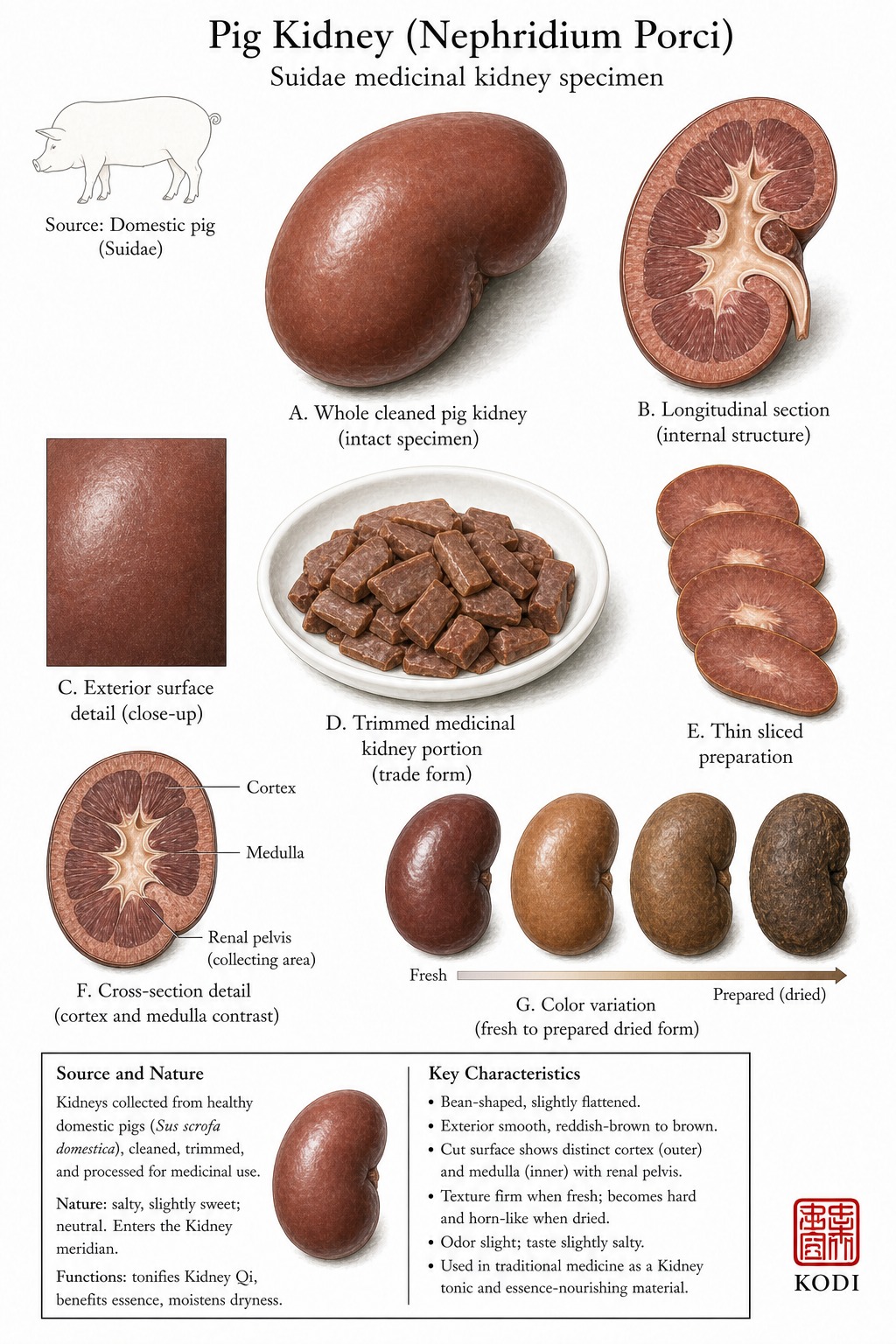
Known in TCM as Zhu Shen (猪肾), this salty, neutral herb enters the Kidney. Traditionally, it tonifies the Kidney in the food-medicine tradition, especially for weakness of the low back and knees associated with Kidney deficiency, most often applied for low back pain, frequent urination, and impotence.
Also Known As
Latin: Ren Porci | Pinyin: Zhu Shen | Chinese: 猪肾
TCM Properties
- Taste
- salty
- Temperature
- neutral
- Channels
- Kidney
Traditional Use
Primary Actions
- Tonifies the Kidney in the food-medicine tradition, especially for weakness of the low back and knees associated with Kidney deficiency.
- Supports Kidney Qi and Kidney Yang patterns marked by frequent urination, soreness, diminished reproductive strength, or fatigue after chronic depletion.
- Appears in diet-therapy style use for infertility or impotence when the therapeutic strategy is to supplement like with like.
Secondary Actions
- This is a classic organotherapy-style medicinal food entry rather than a high-intensity botanical drug.
- Traditional use depends heavily on broader pattern differentiation and preparation method, not on isolated use of the organ alone.
Classical References
- Traditional Chinese dietary therapy often uses animal kidneys to supplement Kidney deficiency presentations by correspondence of organ to organ.
- The record belongs more to the food-medicine borderland than to the major formal decoction tradition.
Modern Research
Studied Effects
- No herb-specific PubMed-indexed pharmacology literature was located for pig kidney as a defined TCM medicinal. Current use remains primarily traditional and diet-therapy based.
Safety & Interactions
Contraindications
- Damp-heat or excess heat patterns where warm supplementation is not indicated
Cautions
- As an animal organ food, sourcing, hygiene, and cooking safety matter more than they do for many dried herbs.
- Classical use is supportive and pattern-based, not a substitute for evaluation of infertility, urinary symptoms, or back pain from structural disease.
Conditions
- Low Back Pain Traditional ★★☆☆☆ JSON
- Frequent Urination Traditional ★★☆☆☆ JSON
- Impotence Traditional ★★☆☆☆ JSON
- Infertility Traditional ★☆☆☆☆ JSON
Frequently Asked Questions
What is Pig Kidney used for?
Pig Kidney is traditionally used to Tonifies the Kidney in the food-medicine tradition, especially for weakness of the low back and knees associated with Kidney deficiency., Supports Kidney Qi and Kidney Yang patterns marked by frequent urination, soreness, diminished reproductive strength, or fatigue after chronic depletion., Appears in diet-therapy style use for infertility or impotence when the therapeutic strategy is to supplement like with like.. Research has investigated its effects on: No herb-specific PubMed-indexed pharmacology literature was located for pig kidney as a defined TCM medicinal. Current use remains primarily traditional and diet-therapy based..
What are other names for Pig Kidney?
Pig Kidney is also known as Pork kidney. In TCM: 猪肾 (Zhu Shen); Ren Porci.
Is Pig Kidney safe during pregnancy?
The safety of Pig Kidney during pregnancy has not been established. Consult a qualified healthcare provider before use.
What are the contraindications for Pig Kidney?
Pig Kidney should not be used in: Damp-heat or excess heat patterns where warm supplementation is not indicated. Consult a qualified healthcare provider before use.