Phellodendron Bark
- Chinese
- 黄柏
- Pinyin
- Huang Bai
- Latin
- Cortex Phellodendri
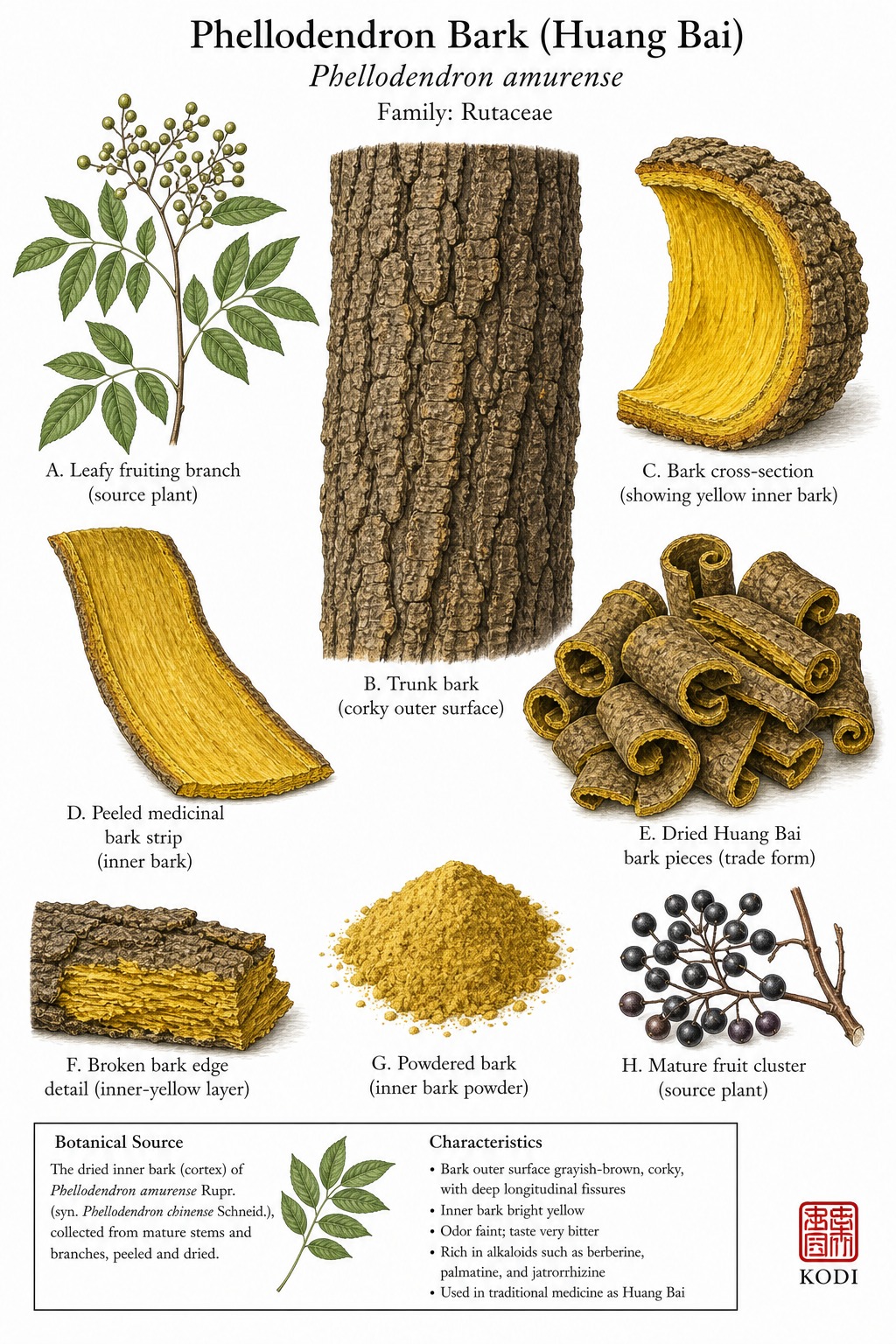
Known in TCM as Huang Bai (黄柏), this bitter, cold herb enters the Kidney, Bladder, and Large Intestine. Traditionally, it clears damp-heat from the lower burner - used for painful dark urination, leukorrhea, dysenteric diarrhea, jaundice, swollen painful lower limbs, and genital damp-heat where bitterness and coldness are needed to dry and drain downward, most often applied for urinary tract infection, diarrhea, and dysentery. Modern research has identified Berberine among its active constituents.
Part used: Bark
Also Known As
Latin: Cortex Phellodendri | Pinyin: Huang Bai | Chinese: 黄柏
TCM Properties
- Taste
- bitter
- Temperature
- cold
- Channels
- Kidney, Bladder, Large Intestine
Traditional Use
Primary Actions
- Clears damp-heat from the lower burner - used for painful dark urination, leukorrhea, dysenteric diarrhea, jaundice, swollen painful lower limbs, and genital damp-heat where bitterness and coldness are needed to dry and drain downward.
- Drains deficiency fire from Kidney Yin deficiency - an important herb for tidal fever, bone steaming, night sweats, seminal emission, and lower-burner heat signs in formulas such as Zhi Bai Di Huang Wan.
- Resolves fire toxin and damp skin lesions - applied internally or externally for eczema, sores, hot toxic swellings, and damp-heat eruptions with redness, itching, oozing, or foul discharge.
- Directs heat downward from the intestines and bladder - especially useful when damp-heat causes tenesmus, foul diarrhea, or lower-abdominal burning that requires a strong descending bitter-cold approach.
Secondary Actions
- This record is therapeutically the same medicinal as bark-of-amur-corktree, reflecting an English naming split in the import rather than a separate herb.
- Its strong drying nature means it is often balanced with Yin-nourishing or Spleen-supporting herbs when deficiency and excess coexist.
Classic Formulas
- Er Miao San (二妙散) - the classic two-herb combination of Huang Bai and Cang Zhu for damp-heat pouring downward with red swollen legs, genital itching, and lower-burner inflammation.
- Bai Tou Weng Tang (白头翁汤) - from Shang Han Lun, where Huang Bai assists in treating toxic-heat dysentery with tenesmus, blood, and severe intestinal inflammation.
- Zhi Bai Di Huang Wan (知柏地黄丸) - the well-known extension of Liu Wei Di Huang Wan that adds Huang Bai and Zhi Mu to drain deficiency fire from Kidney-Liver Yin deficiency.
Classical References
- IDENTITY NOTE: This record is therapeutically identical to bark-of-amur-corktree.json. The duplicate reflects an English naming split rather than a distinct medicinal drug.
- Traditional materia medica established Huang Bai as a bitter-cold lower-burner herb for damp-heat, dysentery, jaundice, skin disease, and deficiency fire patterns.
- Both Phellodendron amurense and Phellodendron chinense are used in the Cortex Phellodendri drug tradition, but the clinical action profile in Chinese medicine remains the same Huang Bai lane.
Modern Research
Active Compounds
- Berberine - the best-known protoberberine alkaloid in Huang Bai bark, associated with antimicrobial and anti-inflammatory activity
- Palmatine - an isoquinoline alkaloid linked with anti-inflammatory and metabolic effects
- Jatrorrhizine - a protoberberine alkaloid studied for antimicrobial and gastrointestinal relevance
- Phellodendrine - an alkaloid associated with immunomodulatory and anti-inflammatory activity
- Obacunone and obaculactone - limonoids highlighted in review literature for dermatologic and anti-atopic potential
Studied Effects
- Comprehensive review literature describes broad anti-inflammatory, antibacterial, antiviral, antitumor, antigout, neuroprotective, and anti-atopic activities across Phellodendri Cortex extracts and compounds (PMID 31057654).
- Human tissue and cell work found that Phellodendron amurense extract reduced inflammatory mediators, matrix degradation, and MAPK signaling in osteoarthritic cartilage and chondrocytes (PMID 21182922).
- Recent experimental work reported nephroprotective effects of Phellodendron amurense polysaccharides through PI3K, GSK-3β, Nrf2, TGF-β, Smad, and gut-microbiota pathways in diabetic nephropathy models (PMID 41518482).
- Species-comparison work also confirms that the Cortex Phellodendri drug is sourced from both Phellodendron chinense and Phellodendron amurense, supporting this record's generic English naming (PMID 20354951).
PubMed References
- Phellodendri Cortex: A Phytochemical, Pharmacological, and Pharmacokinetic Review (2019)
- Effect of Phellodendron amurense in protecting human osteoarthritic cartilage and chondrocytes (2011)
- Phellodendron amurense Rupr. Polysaccharides protects against diabetic nephropathy via alteration of PI3K/GSK-3β/Nrf2/TGF-β/Smad signaling pathway and gut microbiota (2024)
- Chemical and biological differentiation of Cortex Phellodendri Chinensis and Cortex Phellodendri Amurensis (2010)
Safety & Interactions
Contraindications
- Spleen and Stomach deficiency-cold, especially with chronic diarrhea
- Absence of damp-heat, deficiency fire, or toxic heat signs
Cautions
- Its bitter-cold drying action can injure the middle burner and worsen poor appetite, abdominal cold, or chronic loose stools if used too long.
- Because berberine-containing bark preparations may require extra caution in peripartum, neonatal, or hemolytic-risk settings, use should remain professionally guided rather than casual self-medication.
- MSK page not found - drug interaction data not available from Memorial Sloan Kettering integrative medicine database.
Conditions
Frequently Asked Questions
What is Phellodendron Bark used for?
Phellodendron Bark is traditionally used to Clears damp-heat from the lower burner - used for painful dark urination, leukorrhea, dysenteric diarrhea, jaundice, swollen painful lower limbs, and genital damp-heat where bitterness and coldness are needed to dry and drain downward., Drains deficiency fire from Kidney Yin deficiency - an important herb for tidal fever, bone steaming, night sweats, seminal emission, and lower-burner heat signs in formulas such as Zhi Bai Di Huang Wan., Resolves fire toxin and damp skin lesions - applied internally or externally for eczema, sores, hot toxic swellings, and damp-heat eruptions with redness, itching, oozing, or foul discharge., Directs heat downward from the intestines and bladder - especially useful when damp-heat causes tenesmus, foul diarrhea, or lower-abdominal burning that requires a strong descending bitter-cold approach.. Research has investigated its effects on: Comprehensive review literature describes broad anti-inflammatory, antibacterial, antiviral, antitumor, antigout, neuroprotective, and anti-atopic activities across Phellodendri Cortex extracts and compounds (PMID 31057654).; Human tissue and cell work found that Phellodendron amurense extract reduced inflammatory mediators, matrix degradation, and MAPK signaling in osteoarthritic cartilage and chondrocytes (PMID 21182922)..
What are other names for Phellodendron Bark?
Phellodendron Bark is also known as Phellodendri, Amur corktree bark. In TCM: 黄柏 (Huang Bai); Cortex Phellodendri.
Is Phellodendron Bark safe during pregnancy?
The safety of Phellodendron Bark during pregnancy has not been established. Consult a qualified healthcare provider before use.
What are the contraindications for Phellodendron Bark?
Phellodendron Bark should not be used in: Spleen and Stomach deficiency-cold, especially with chronic diarrhea; Absence of damp-heat, deficiency fire, or toxic heat signs. Consult a qualified healthcare provider before use.