White Morning Glory Seed
- Chinese
- 白丑
- Pinyin
- Bai Chou
- Latin
- Semen Pharbitidis
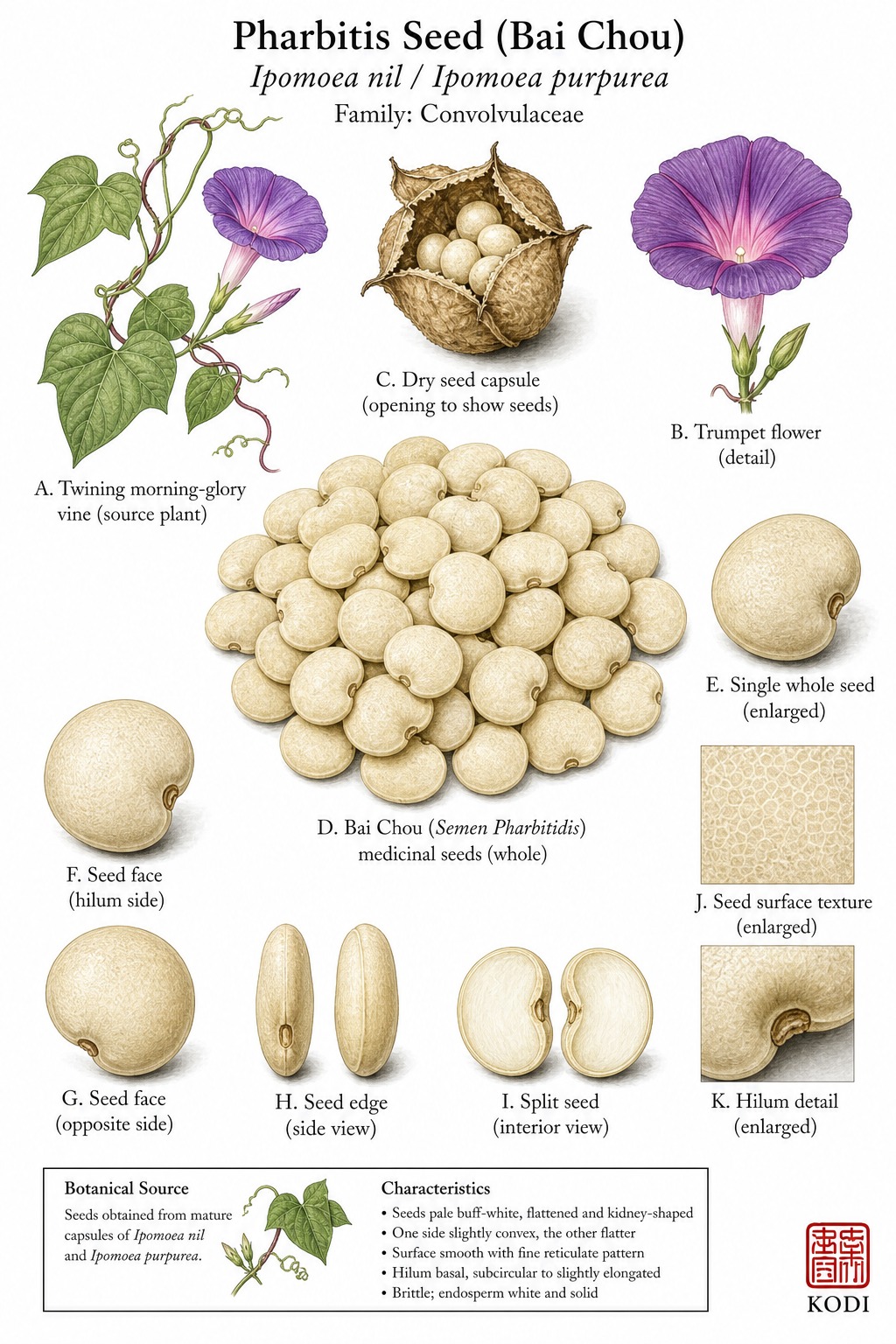
Known in TCM as Bai Chou (白丑), this bitter and acrid, cold herb enters the Lung, Kidney, and Large Intestine. Traditionally, it drives out retained water by forceful downward purgation - used for edema, ascites, swollen face, and abdominal fullness when excess water and accumulation require a strong exit through stool and urine, most often applied for edema, constipation, and wheezing. Modern research has identified Pharbitin among its active constituents.
Part used: Seed
Also Known As
Latin: Semen Pharbitidis | Pinyin: Bai Chou | Chinese: 白丑
TCM Properties
- Taste
- bitter, acrid
- Temperature
- cold
- Channels
- Lung, Kidney, Large Intestine
Traditional Use
Primary Actions
- Drives out retained water by forceful downward purgation - used for edema, ascites, swollen face, and abdominal fullness when excess water and accumulation require a strong exit through stool and urine.
- Unblocks the bowels and reduces accumulation - applied to excess-type constipation, food stagnation, and obstructed abdominal distension rather than to weak or deficient constipation.
- Drains phlegm and retained fluid from the Lung - classical use extends to cough, wheezing, and dyspnea when phlegm-fluid obstruction combines with swelling or bowel blockage.
- Kills parasites and relieves abdominal pain - used in worm accumulation patterns, especially when parasites coexist with distension or constipation.
Secondary Actions
- This Bai Chou record represents the pale or whitish seed form of Qian Niu Zi rather than a separate medicinal species.
- Traditional processing, especially frying, is used to temper harshness, but Bai Chou remains a strong downward-draining herb rather than a routine laxative.
Classic Formulas
- Mu Xiang Bing Lang Wan (木香槟榔丸) - a classic accumulation-breaking formula in which Qian Niu Zi helps purge intestinal excess contributing to constipation, tenesmus, and abdominal oppression.
- Zhou Che Wan (舟车丸) - a drastic water-expelling formula for severe ascites and edema in relatively strong patients, where Qian Niu Zi opens a downward route for fluid elimination.
- Combinations with Ting Li Zi or Sang Bai Pi - classical and later-practice pairings for cough and wheezing from phlegm-fluid retention with facial swelling or difficult breathing.
Classical References
- Traditional materia medica classifies Qian Niu Zi as bitter, cold, slightly toxic, and strongly downward-draining, with emphasis on edema, constipation, phlegm-fluid, and parasites.
- The modern review literature explicitly notes that Pharbitidis Semen is also known as Bai Chou or Hei Chou, confirming that these sibling records represent naming and appearance variants of the same crude drug.
- Older teaching repeatedly warns that this is an attack herb suited to excess repletion patterns and small supervised doses, not a tonic or everyday bowel aid.
Modern Research
Active Compounds
- Pharbitin - the resin glycoside complex regarded as the seed's classic purgative fraction
- Pharbitic acid - a glycosidic acid fraction derived from pharbitin in mechanistic studies
- Phar-genin - an aglycone fraction implicated in intestinal motility effects
- Resin glycosides, phenylpropanoids, and fatty acids - broader compound classes described in review literature
- Phenolic acids - part of the seed's minor phytochemical profile and processing studies
Studied Effects
- A modern review summarized laxative, anti-inflammatory, antioxidant, neuroprotective, antitumor, and toxicity findings for Pharbitidis Semen while stressing that the exact active and toxic principles are still not fully resolved (PMID 37178984).
- Mechanistic work showed that pharbitin increased colon tonus through acetylcholine receptors while decreasing ileal tension in mice, offering a direct experimental basis for the herb's purgative reputation (PMID 35317794).
- A processing study found that fried morning glory seed retained laxative action while showing less subchronic liver, kidney, and colon toxicity than the raw seed (PMID 31883474).
- A rat toxicology study linked long-term exposure to metabolic and renal injury signals, reinforcing the classical warning against prolonged unsupervised use (PMID 20435118).
PubMed References
- Pharbitidis Semen: A review of botany, traditional uses, phytochemistry, pharmacology, and toxicology (2023)
- Different effects on the tonus of colon and ileum isolated from mouse by resin glycoside (pharbitin) of Pharbitidis Semen (2022)
- Morning glory seed keeps laxative effect while retains less subchronic toxicity after being fried (2020)
- Toxicology effects of morning glory seed in rat: a metabonomic method for profiling of urine metabolic changes (2010)
Safety & Interactions
Contraindications
- Pregnancy
- Frailty or marked deficiency
- Dehydration or chronic loose stools
- Absence of excess water accumulation, bowel obstruction pattern, or parasite burden
Cautions
- Bai Chou is a harsh downward-draining seed and can cause severe diarrhea, abdominal cramping, dehydration, and toxicity if misused.
- Processing reduces but does not remove risk, so only properly prepared medicinal material should be used under qualified supervision.
- Commercial ornamental morning glory seed packets are not interchangeable with medicinally prepared Pharbitidis Semen.
Conditions
- Edema Traditional ★★★★☆ JSON
- Constipation Traditional ★★★★☆ JSON
- Wheezing Traditional ★★★☆☆ JSON
- Phlegm Accumulation Traditional ★★★☆☆ JSON
- Intestinal Parasites Traditional ★★★☆☆ JSON
Frequently Asked Questions
What is White Morning Glory Seed used for?
White Morning Glory Seed is traditionally used to Drives out retained water by forceful downward purgation - used for edema, ascites, swollen face, and abdominal fullness when excess water and accumulation require a strong exit through stool and urine., Unblocks the bowels and reduces accumulation - applied to excess-type constipation, food stagnation, and obstructed abdominal distension rather than to weak or deficient constipation., Drains phlegm and retained fluid from the Lung - classical use extends to cough, wheezing, and dyspnea when phlegm-fluid obstruction combines with swelling or bowel blockage., Kills parasites and relieves abdominal pain - used in worm accumulation patterns, especially when parasites coexist with distension or constipation.. Research has investigated its effects on: A modern review summarized laxative, anti-inflammatory, antioxidant, neuroprotective, antitumor, and toxicity findings for Pharbitidis Semen while stressing that the exact active and toxic principles are still not fully resolved (PMID 37178984).; Mechanistic work showed that pharbitin increased colon tonus through acetylcholine receptors while decreasing ileal tension in mice, offering a direct experimental basis for the herb's purgative reputation (PMID 35317794)..
What are other names for White Morning Glory Seed?
White Morning Glory Seed is also known as White Qian Niu Zi, Pharbitidis. In TCM: 白丑 (Bai Chou); Semen Pharbitidis.
Is White Morning Glory Seed safe during pregnancy?
White Morning Glory Seed is not recommended during pregnancy.
What are the contraindications for White Morning Glory Seed?
White Morning Glory Seed should not be used in: Pregnancy; Frailty or marked deficiency; Dehydration or chronic loose stools; Absence of excess water accumulation, bowel obstruction pattern, or parasite burden. Consult a qualified healthcare provider before use.