Snow Pear Peel
- Chinese
- 雪梨皮
- Pinyin
- Xue Li Pi
- Latin
- Exocarpium Pyrus
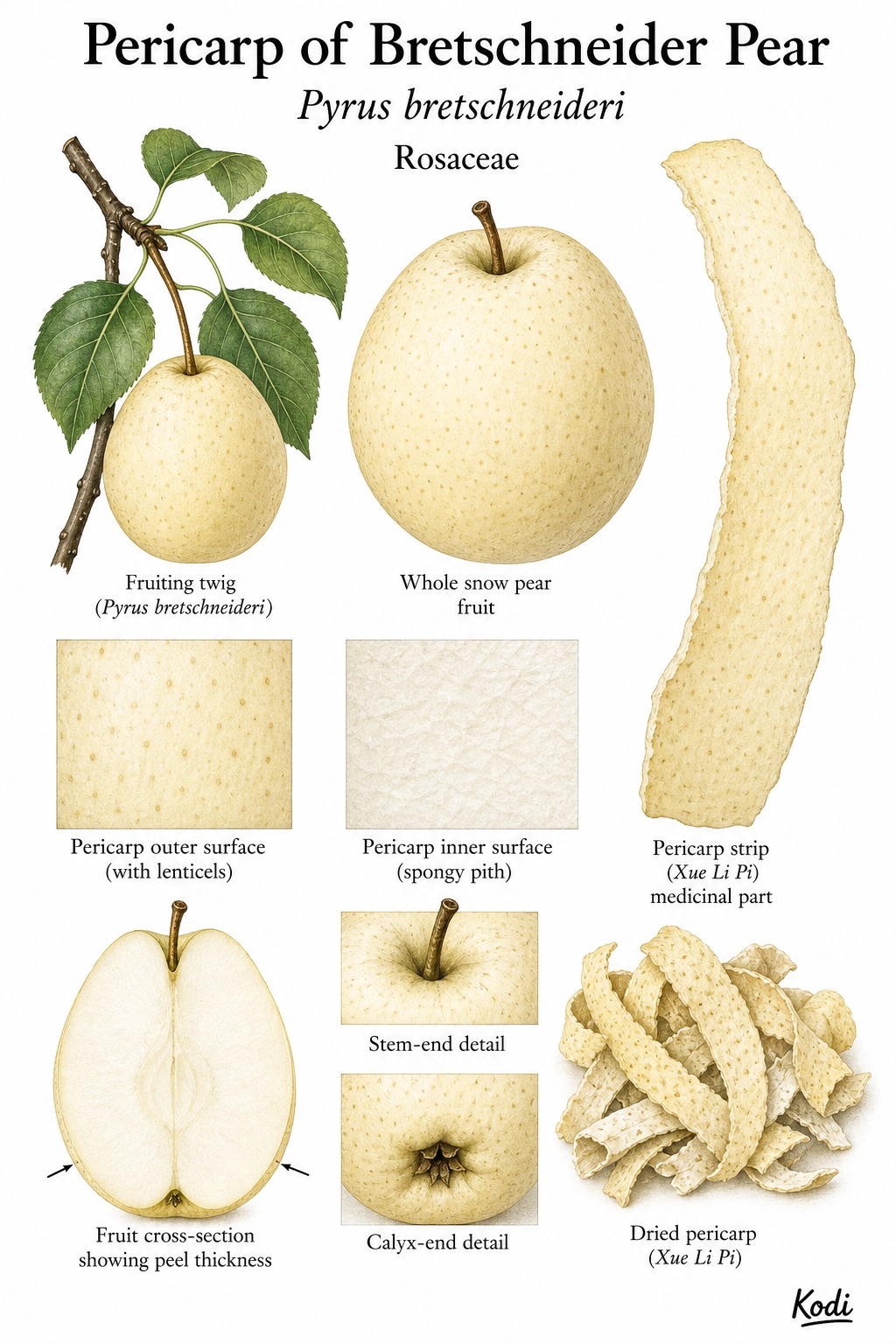
Known in TCM as Xue Li Pi (雪梨皮), this sweet and slightly sour, cool herb enters the Lung and Stomach. Traditionally, it moistens the Lung and eases dry cough - especially useful for dry, tickling, or warm-dryness cough with throat irritation and scant fluids, most often applied for dry cough, sore throat, and cough. Modern research has identified Arbutin among its active constituents.
Part used: Outer peel
Also Known As
Latin: Exocarpium Pyrus | Pinyin: Xue Li Pi | Chinese: 雪梨皮
TCM Properties
- Taste
- sweet, slightly sour
- Temperature
- cool
- Channels
- Lung, Stomach
Traditional Use
Primary Actions
- Moistens the Lung and eases dry cough - especially useful for dry, tickling, or warm-dryness cough with throat irritation and scant fluids.
- Generates fluids and cools thirst - used in food-medicine style care for thirst, dry mouth, and warm illness that has consumed fluids.
- Soothes the throat and upper digestive tract - a gentle cooling peel for dry sore throat, hoarseness, and mild heat affecting the Lung and Stomach together.
- Supports heat-relieving pear preparations - Xue Li Pi is the peel most closely associated with snow-pear syrups, stews, and decoctions for respiratory dryness.
Secondary Actions
- This record overlaps strongly with generic Li Pi, but the naming emphasis points more specifically to the snow pear tradition used in cooling cough foods and drinks.
- It is a light adjunctive medicinal rather than a harsh heat-clearing drug, making it more common in soothing mixtures than in attack-style prescriptions.
Classic Formulas
- Sang Xing Tang (桑杏汤) - the classic later-formula reference point for pear peel in warm-dry cough, where the peel helps restore Lung fluids.
- Snow-pear decoctions with Chuan Bei Mu or Sha Shen - later-practice and food-therapy combinations for dry cough, throat irritation, and post-febrile dryness.
- Stewed snow pear preparations (炖雪梨) - a traditional culinary-medicinal approach that reflects Xue Li Pi's role as a gentle cooling adjunct for the chest and throat.
Classical References
- Xue Li Pi belongs to the same pear-peel medicinal lane as Li Pi, but the snow-pear naming points toward later food-therapy practice focused on dryness and throat comfort.
- Traditional usage centers on cooling and moistening rather than on draining or drying, which is why snow pear preparations remain common household remedies in Chinese medicine culture.
- Its practical role is strongest in warm-dry cough, thirst, and sore throat rather than in deep deficiency or cold patterns.
Modern Research
Active Compounds
- Arbutin - a signature pear phenolic identified across reviews and cultivar studies
- Chlorogenic acid - a dominant polyphenol linked with antioxidant and anti-inflammatory effects
- Ursolic acid and oleanolic acid - triterpenes enriched in peel fractions
- Rutin and epicatechin - flavonoids that contribute to the peel's antioxidant profile
- Peel polyphenol complexes - collectively associated with lung-protective and anti-inflammatory activity
Studied Effects
- Pear review literature describes peel as the most concentrated source of active compounds and summarizes anti-inflammatory, respiratory-supportive, and antioxidant relevance across Pyrus species (PMID 34470625).
- A cultivar comparison study found substantially higher phenolic, flavonoid, and triterpene levels in peel than in flesh, along with stronger anti-inflammatory activity (PMID 24444971).
- Experimental work on Pyrus ussuriensis fractions demonstrated reduced inflammatory and oxidative-stress signaling, which fits the traditional snow-pear use for hot, irritated respiratory patterns (PMID 36655082).
PubMed References
- A review of pears (Pyrus spp.), ancient functional food for modern times (2021)
- Chemical composition and antioxidant and anti-inflammatory potential of peels and flesh from 10 different pear varieties (Pyrus spp.) (2014)
- Pyrus ussuriensis Maxim 70% ethanol eluted fraction ameliorates inflammation and oxidative stress in LPS-induced inflammation in vitro and in vivo (2023)
Safety & Interactions
Contraindications
- Cold-pattern cough without heat or dryness
- Very weak digestion with chronic cold loose stools if taken in heavily chilled preparations
Cautions
- Traditional use is mostly culinary or decoction based, so supplement-style concentrated extracts should not be assumed to have the same dosing tradition.
- Sweet cooling snow-pear preparations are gentle for most users but may be too cooling in excess for cold, damp digestive constitutions.
Conditions
Frequently Asked Questions
What is Snow Pear Peel used for?
Snow Pear Peel is traditionally used to Moistens the Lung and eases dry cough - especially useful for dry, tickling, or warm-dryness cough with throat irritation and scant fluids., Generates fluids and cools thirst - used in food-medicine style care for thirst, dry mouth, and warm illness that has consumed fluids., Soothes the throat and upper digestive tract - a gentle cooling peel for dry sore throat, hoarseness, and mild heat affecting the Lung and Stomach together., Supports heat-relieving pear preparations - Xue Li Pi is the peel most closely associated with snow-pear syrups, stews, and decoctions for respiratory dryness.. Research has investigated its effects on: Pear review literature describes peel as the most concentrated source of active compounds and summarizes anti-inflammatory, respiratory-supportive, and antioxidant relevance across Pyrus species (PMID 34470625).; A cultivar comparison study found substantially higher phenolic, flavonoid, and triterpene levels in peel than in flesh, along with stronger anti-inflammatory activity (PMID 24444971)..
What are other names for Snow Pear Peel?
Snow Pear Peel is also known as Snow pear skin, Pyrus. In TCM: 雪梨皮 (Xue Li Pi); Exocarpium Pyrus.
Is Snow Pear Peel safe during pregnancy?
The safety of Snow Pear Peel during pregnancy has not been established. Consult a qualified healthcare provider before use.
What are the contraindications for Snow Pear Peel?
Snow Pear Peel should not be used in: Cold-pattern cough without heat or dryness; Very weak digestion with chronic cold loose stools if taken in heavily chilled preparations. Consult a qualified healthcare provider before use.