Pear Peel
- Chinese
- 梨皮
- Pinyin
- Li Pi
- Latin
- Pericarpium Pyri
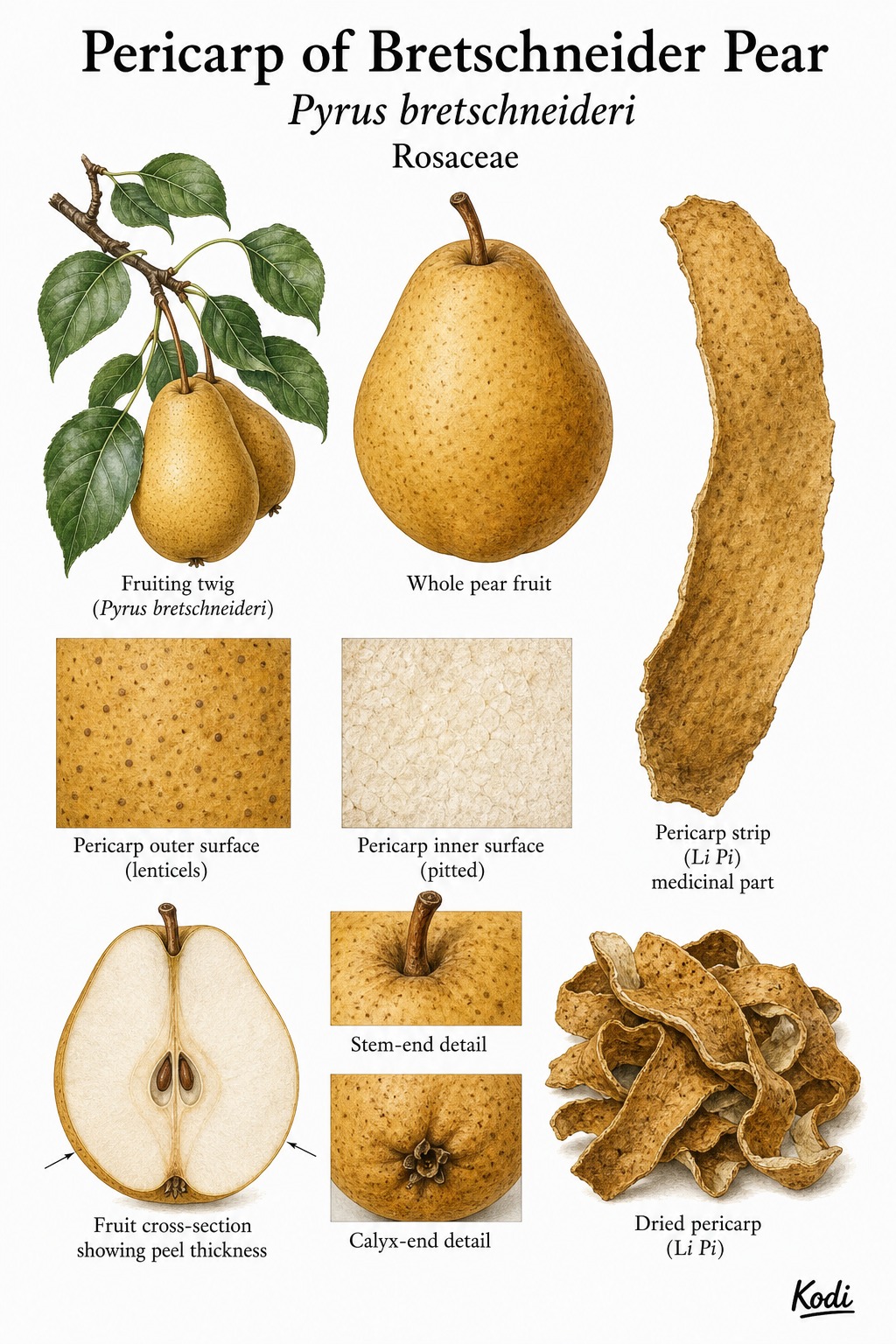
Known in TCM as Li Pi (梨皮), this sweet and astringent, cool herb enters the Lung and Stomach. Traditionally, it moistens the Lung and relieves dryness cough - a gentle food-grade herb for dry cough, scratchy throat, and hoarse irritative cough when warmth and dryness have injured fluids, most often applied for dry cough, sore throat, and cough. Modern research has identified Arbutin among its active constituents.
Part used: Peel
Also Known As
Latin: Pericarpium Pyri | Pinyin: Li Pi | Chinese: 梨皮
TCM Properties
- Taste
- sweet, astringent
- Temperature
- cool
- Channels
- Lung, Stomach
Traditional Use
Primary Actions
- Moistens the Lung and relieves dryness cough - a gentle food-grade herb for dry cough, scratchy throat, and hoarse irritative cough when warmth and dryness have injured fluids.
- Generates fluids and relieves thirst - used for dry mouth, thirst, and lingering fluid depletion after summer-heat or febrile illness.
- Gently clears upper-burner heat - helps cool mild irritability, dry heat in the chest, and warm-dryness patterns without the harshness of stronger bitter-cold medicinals.
- Supports recovery from dryness affecting both Lung and Stomach - especially when cough, thirst, and a dry throat appear together.
Secondary Actions
- Li Pi is better known in food-therapy and warm-dryness modification than as a stand-alone heavy classical drug.
- Compared with whole pear flesh or pear syrup, the peel is regarded as lighter and more upward-directing toward the Lung.
Classic Formulas
- Sang Xing Tang (桑杏汤) - a later dryness-treating formula in which Li Pi nourishes fluids and moistens the Lung alongside Sang Ye and Sha Shen for warm-dry cough.
- Fresh pear-peel decoctions or juices (鲜梨皮煎) - traditional food-therapy style use for summer-heat thirst, dry throat, and mild cough after fluid injury.
- Regional combinations with Chuan Bei Mu, Sha Shen, or Gan Cao - later-practice pairings for autumn dryness and irritative cough rather than one universally dominant early formula.
Classical References
- Traditional herb and food-therapy sources describe Li Pi as a cool, sweet peel that moistens the Lung, clears mild heat, and promotes body fluids.
- The herb's reputation is strongest in later practical medicine and dietary therapy, which explains why it appears more often as a modifying ingredient than as the star of a famous early formula.
- Classical usage especially emphasizes dry cough, thirst, and sore throat arising from warmth or dryness rather than from cold-phlegm patterns.
Modern Research
Active Compounds
- Arbutin - a phenolic marker repeatedly highlighted in pear chemistry reviews
- Chlorogenic acid - a major polyphenol associated with antioxidant and anti-inflammatory effects
- Ursolic acid and oleanolic acid - triterpenes enriched in the peel compared with the flesh
- Epicatechin and rutin - flavonoid compounds contributing to antioxidant activity
- Mixed peel polyphenols and triterpenes - the broad fraction most consistently associated with the peel's bioactivity
Studied Effects
- A broad review of pears found that beneficial compounds are concentrated in the peel and summarized anti-inflammatory, respiratory-protective, cardioprotective, and detoxification-related effects across pear species (PMID 34470625).
- A comparative study of ten pear cultivars found that peel contained about 6 to 20 times more measured chemical components than flesh and showed stronger antioxidant and anti-inflammatory activity (PMID 24444971).
- Pyrus ussuriensis peel-rich fractions reduced inflammatory and oxidative-stress signaling in experimental models, supporting the traditional use of pear peel for heat and irritation patterns (PMID 36655082).
PubMed References
- A review of pears (Pyrus spp.), ancient functional food for modern times (2021)
- Chemical composition and antioxidant and anti-inflammatory potential of peels and flesh from 10 different pear varieties (Pyrus spp.) (2014)
- Pyrus ussuriensis Maxim 70% ethanol eluted fraction ameliorates inflammation and oxidative stress in LPS-induced inflammation in vitro and in vivo (2023)
Safety & Interactions
Contraindications
- Cold-phlegm cough without dryness or heat
- Marked Spleen deficiency-cold with loose stool if used in large cooling amounts
Cautions
- Li Pi is traditionally gentle and food-grade, but concentrated extracts or commercial supplements are not equivalent to ordinary decoction or culinary use.
- Very cooling pear-peel preparations may aggravate weak digestion in patients who already run cold and loose.
Conditions
Frequently Asked Questions
What is Pear Peel used for?
Pear Peel is traditionally used to Moistens the Lung and relieves dryness cough - a gentle food-grade herb for dry cough, scratchy throat, and hoarse irritative cough when warmth and dryness have injured fluids., Generates fluids and relieves thirst - used for dry mouth, thirst, and lingering fluid depletion after summer-heat or febrile illness., Gently clears upper-burner heat - helps cool mild irritability, dry heat in the chest, and warm-dryness patterns without the harshness of stronger bitter-cold medicinals., Supports recovery from dryness affecting both Lung and Stomach - especially when cough, thirst, and a dry throat appear together.. Research has investigated its effects on: A broad review of pears found that beneficial compounds are concentrated in the peel and summarized anti-inflammatory, respiratory-protective, cardioprotective, and detoxification-related effects across pear species (PMID 34470625).; A comparative study of ten pear cultivars found that peel contained about 6 to 20 times more measured chemical components than flesh and showed stronger antioxidant and anti-inflammatory activity (PMID 24444971)..
What are other names for Pear Peel?
Pear Peel is also known as Li Zi Pi, Pear skin. In TCM: 梨皮 (Li Pi); Pericarpium Pyri.
Is Pear Peel safe during pregnancy?
The safety of Pear Peel during pregnancy has not been established. Consult a qualified healthcare provider before use.
What are the contraindications for Pear Peel?
Pear Peel should not be used in: Cold-phlegm cough without dryness or heat; Marked Spleen deficiency-cold with loose stool if used in large cooling amounts. Consult a qualified healthcare provider before use.