Pearl
- Chinese
- 珍珠
- Pinyin
- Zhen Zhu
- Latin
- Margarita
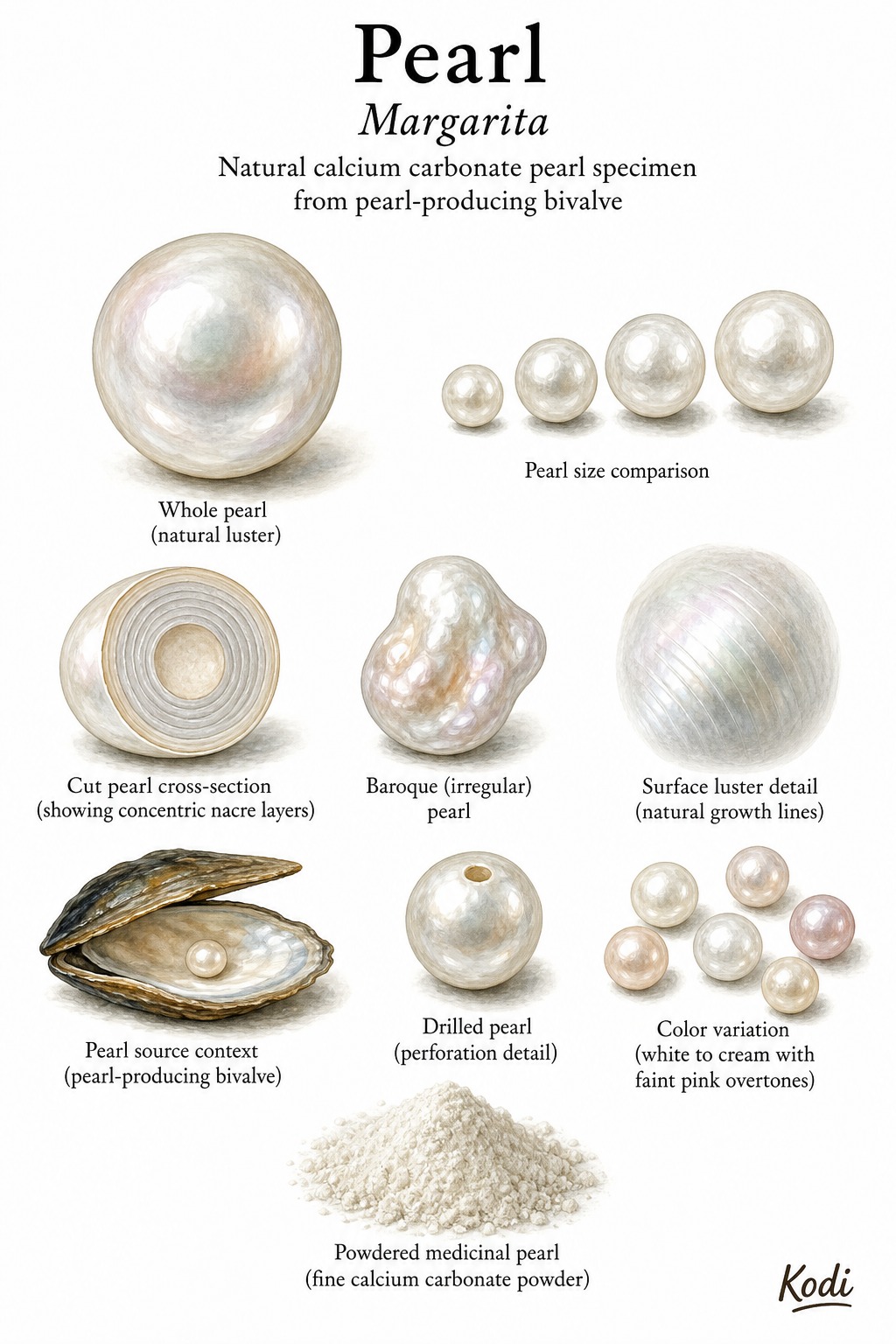
Known in TCM as Zhen Zhu (珍珠), this sweet and salty, cold herb enters the Heart and Liver. Traditionally, it calms the Spirit and anchors the Heart; treats both Excess-type Shen disturbance (tremors, seizures, childhood convulsions) and Deficiency-type Shen disturbance (insomnia, palpitations, being easily frightened), most often applied for insomnia, epilepsy, and blurred vision. Modern research has identified Calcium among its active constituents.
Part used: Pearl
Also Known As
Latin: Margarita | Pinyin: Zhen Zhu | Chinese: 珍珠
TCM Properties
- Taste
- sweet, salty
- Temperature
- cold
- Channels
- Heart, Liver
Traditional Use
Primary Actions
- Calms the Spirit and anchors the Heart; treats both Excess-type Shen disturbance (tremors, seizures, childhood convulsions) and Deficiency-type Shen disturbance (insomnia, palpitations, being easily frightened)
- Clears Liver Fire and removes superficial visual obstruction, brightening the eyes
- Promotes tissue regeneration; applied topically for non-healing skin ulcers, often combined with Bing Pian and Ru Xiang
Secondary Actions
- More strongly Heart-calming than Zhen Zhu Mu (Mother of Pearl/Nacre), which more effectively calms the Liver
Classical References
- Documented in later Chinese materia medica as a precious calming substance for both Excess Wind-type and Deficiency-type Spirit disturbance
Modern Research
Active Compounds
- Calcium carbonate (aragonite)
- Conchiolin protein matrix
- Trace amino acids
Studied Effects
- Pearl powder stimulates fibroblast proliferation, migration, and collagen deposition, accelerating wound healing in vitro and in vivo
- Nanoscale pearl powder formulations show the highest wound-healing efficiency among tested particle sizes
- Traditional use for aphthous, gastric, and duodenal ulcers is consistent with documented tissue-regenerative activity
PubMed References
Safety & Interactions
Cautions
- Must be finely powdered (levigated) before use
- Source from quality-controlled suppliers given general heavy-metal contamination risk documented across mineral and shell Chinese medicinals
- Spleen-Stomach Deficiency Cold
Conditions
- Insomnia Traditional ★★★☆☆ JSON
- Epilepsy Traditional ★★☆☆☆ JSON
- Blurred Vision Traditional ★★☆☆☆ JSON
- Gastric Ulcer Traditional ★☆☆☆☆ JSON
Frequently Asked Questions
What is Pearl used for?
Pearl is traditionally used to Calms the Spirit and anchors the Heart; treats both Excess-type Shen disturbance (tremors, seizures, childhood convulsions) and Deficiency-type Shen disturbance (insomnia, palpitations, being easily frightened), Clears Liver Fire and removes superficial visual obstruction, brightening the eyes, Promotes tissue regeneration; applied topically for non-healing skin ulcers, often combined with Bing Pian and Ru Xiang. Research has investigated its effects on: Pearl powder stimulates fibroblast proliferation, migration, and collagen deposition, accelerating wound healing in vitro and in vivo; Nanoscale pearl powder formulations show the highest wound-healing efficiency among tested particle sizes.
What are other names for Pearl?
Pearl is also known as Pteria martensii pearl, Freshwater Pearl. In TCM: 珍珠 (Zhen Zhu); Margarita.
Is Pearl safe during pregnancy?
The safety of Pearl during pregnancy has not been established. Consult a qualified healthcare provider before use.