Manyinflorescenced Sweetvetch Root
- Chinese
- 红芪
- Pinyin
- Hong Qi
- Latin
- Radix Hedysari
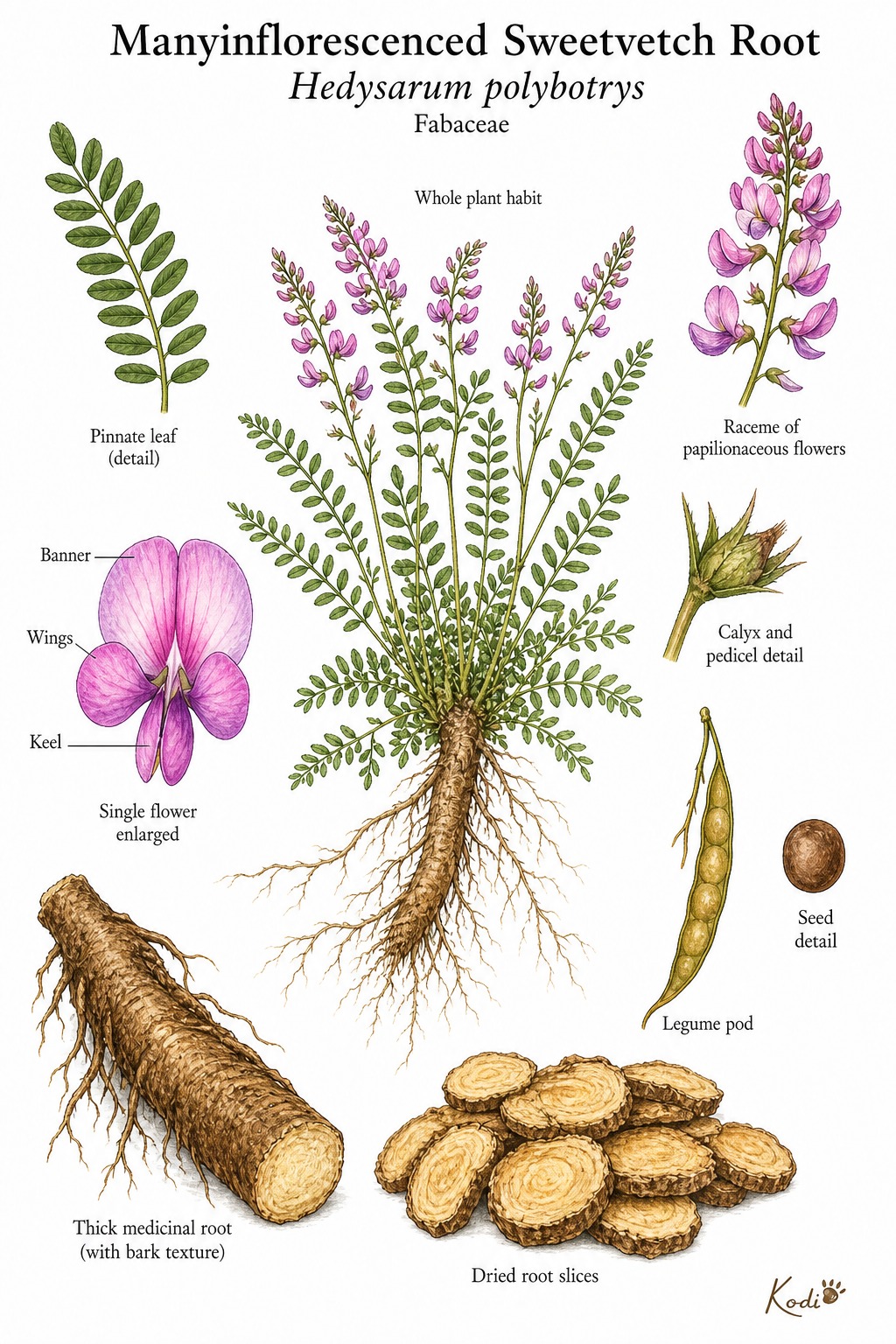
Known in TCM as Hong Qi (红芪), this sweet, slightly warm herb enters the Spleen and Lung. Traditionally, it tonifies Spleen and Lung Qi and strengthens Wei (defensive) Qi against external pathogens, similar in function to Huang Qi (Astragalus) but generally regarded as milder, most often applied for immune deficiency, edema, and fatigue. Modern research has identified Polysaccharides among its active constituents.
Part used: Root
Also Known As
Latin: Radix Hedysari | Pinyin: Hong Qi | Chinese: 红芪
TCM Properties
- Taste
- sweet
- Temperature
- slightly warm
- Channels
- Spleen, Lung
Traditional Use
Primary Actions
- Tonifies Spleen and Lung Qi and strengthens Wei (defensive) Qi against external pathogens, similar in function to Huang Qi (Astragalus) but generally regarded as milder
- Promotes urination and reduces edema from Qi deficiency
- Supports the discharge of pus and generation of new flesh in non-healing sores
Secondary Actions
- Used regionally, especially in Gansu province, as a documented substitute for Huang Qi, though the Chinese Pharmacopoeia lists it as a distinct medicinal material with a different chemical profile
Classical References
- Listed separately from Huang Qi in the Chinese Pharmacopoeia despite frequent substitution due to the similarity of their trade names
Modern Research
Active Compounds
- Polysaccharides
- Flavonoids
- Astragaloside-related saponins
Studied Effects
- Immunomodulatory activity demonstrated in macrophage and splenocyte models
- Investigated for restorative effects in leucopenia models
- Comparative studies show overlapping but generally weaker immunomodulatory potency than Huang Qi
PubMed References
Safety & Interactions
Cautions
- Excess Heat patterns or Yin deficiency with Heat signs
- Do not assume full interchangeability with Huang Qi in formula substitution without practitioner guidance
Conditions
- Immune Deficiency Research ★★☆☆☆ JSON
- Edema Traditional ★★☆☆☆ JSON
- Fatigue Traditional ★★☆☆☆ JSON
- Common Cold Traditional ★☆☆☆☆ JSON
Frequently Asked Questions
What is Manyinflorescenced Sweetvetch Root used for?
Manyinflorescenced Sweetvetch Root is traditionally used to Tonifies Spleen and Lung Qi and strengthens Wei (defensive) Qi against external pathogens, similar in function to Huang Qi (Astragalus) but generally regarded as milder, Promotes urination and reduces edema from Qi deficiency, Supports the discharge of pus and generation of new flesh in non-healing sores. Research has investigated its effects on: Immunomodulatory activity demonstrated in macrophage and splenocyte models; Investigated for restorative effects in leucopenia models.
What are other names for Manyinflorescenced Sweetvetch Root?
Manyinflorescenced Sweetvetch Root is also known as Hedysarum polybotrys, Multiflower Sweetvetch Root, Red Astragalus. In TCM: 红芪 (Hong Qi); Radix Hedysari.
Is Manyinflorescenced Sweetvetch Root safe during pregnancy?
Manyinflorescenced Sweetvetch Root is generally considered safe during pregnancy in normal amounts. Therapeutic or concentrated doses should be discussed with a qualified healthcare provider before use.