Loquat Leaf
- Chinese
- 枇杷叶
- Pinyin
- Pi Pa Ye
- Latin
- Folium Eriobotryae
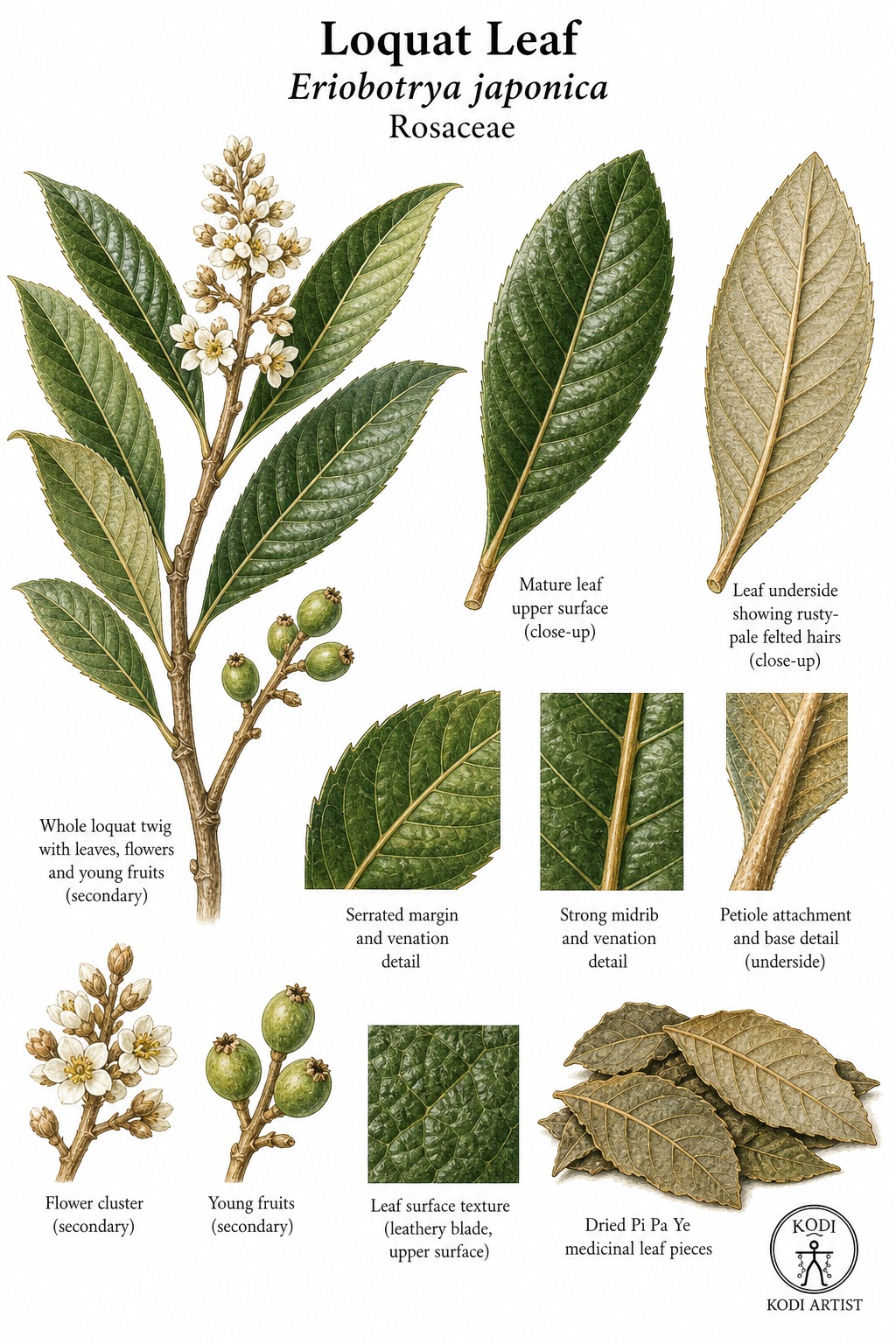
Known in TCM as Pi Pa Ye (枇杷叶), this bitter, cool herb enters the Lung and Stomach. Traditionally, it transforms Phlegm and clears Lung Heat; treats cough with yellow, sticky phlegm from Lung Heat, most often applied for cough, productive cough, and nausea. Modern research has identified Ursolic among its active constituents.
Part used: Leaf
Also Known As
Latin: Folium Eriobotryae | Pinyin: Pi Pa Ye | Chinese: 枇杷叶
TCM Properties
- Taste
- bitter
- Temperature
- cool
- Channels
- Lung, Stomach
Traditional Use
Primary Actions
- Transforms Phlegm and clears Lung Heat; treats cough with yellow, sticky phlegm from Lung Heat
- Harmonizes the Stomach and redirects rebellious Qi downward; relieves nausea, vomiting, and hiccup from Stomach Heat
Secondary Actions
- Prepared as honey-fried Pi Pa Ye for dry, unproductive cough with weak Lung Yin
Classic Formulas
- Pi Pa Ye Gao (Loquat Leaf Syrup)
Classical References
- Ben Cao Gang Mu (Li Shizhen, 1578) records Pi Pa Ye for clearing Lung Heat and redirecting rebellious Stomach Qi
- Ben Cao Jing Ji Zhu (Tao Hongjing, c. 500 CE) describes early use for cough and vomiting
Modern Research
Active Compounds
- Ursolic acid
- Oleanolic acid
- Corosolic acid
- Maslinic acid
- Quercetin and kaempferol glycosides
Studied Effects
- Triterpene acids reduce airway inflammation and oxidative stress in cigarette-smoke-induced COPD models via AMPK/Nrf2 and NF-κB pathways
- Antitussive activity concentrated in triterpenoid-rich extracts; expectorant activity concentrated in flavonoid-rich extracts
- Antioxidant and anti-inflammatory activity from polyphenolic constituents
PubMed References
Safety & Interactions
Cautions
- Leaf must be brushed free of irritating hairs before decoction; unprocessed fuzz can irritate the throat and cause cough
- Cold-Cough from external Wind-Cold without Heat signs
Conditions
- Cough Traditional ★★★☆☆ JSON
- Productive Cough Traditional ★★★☆☆ JSON
- Nausea Traditional ★★☆☆☆ JSON
- Acid Reflux Traditional ★☆☆☆☆ JSON
Frequently Asked Questions
What is Loquat Leaf used for?
Loquat Leaf is traditionally used to Transforms Phlegm and clears Lung Heat; treats cough with yellow, sticky phlegm from Lung Heat, Harmonizes the Stomach and redirects rebellious Qi downward; relieves nausea, vomiting, and hiccup from Stomach Heat. Research has investigated its effects on: Triterpene acids reduce airway inflammation and oxidative stress in cigarette-smoke-induced COPD models via AMPK/Nrf2 and NF-κB pathways; Antitussive activity concentrated in triterpenoid-rich extracts; expectorant activity concentrated in flavonoid-rich extracts.
What are other names for Loquat Leaf?
Loquat Leaf is also known as Eriobotrya japonica, Eriobotrya. In TCM: 枇杷叶 (Pi Pa Ye); Folium Eriobotryae.
Is Loquat Leaf safe during pregnancy?
Loquat Leaf is generally considered safe during pregnancy in normal amounts. Therapeutic or concentrated doses should be discussed with a qualified healthcare provider before use.