Selfheal Fruit Spike
- Chinese
- 夏枯草
- Pinyin
- Xia Ku Cao
- Latin
- Spica Prunellae
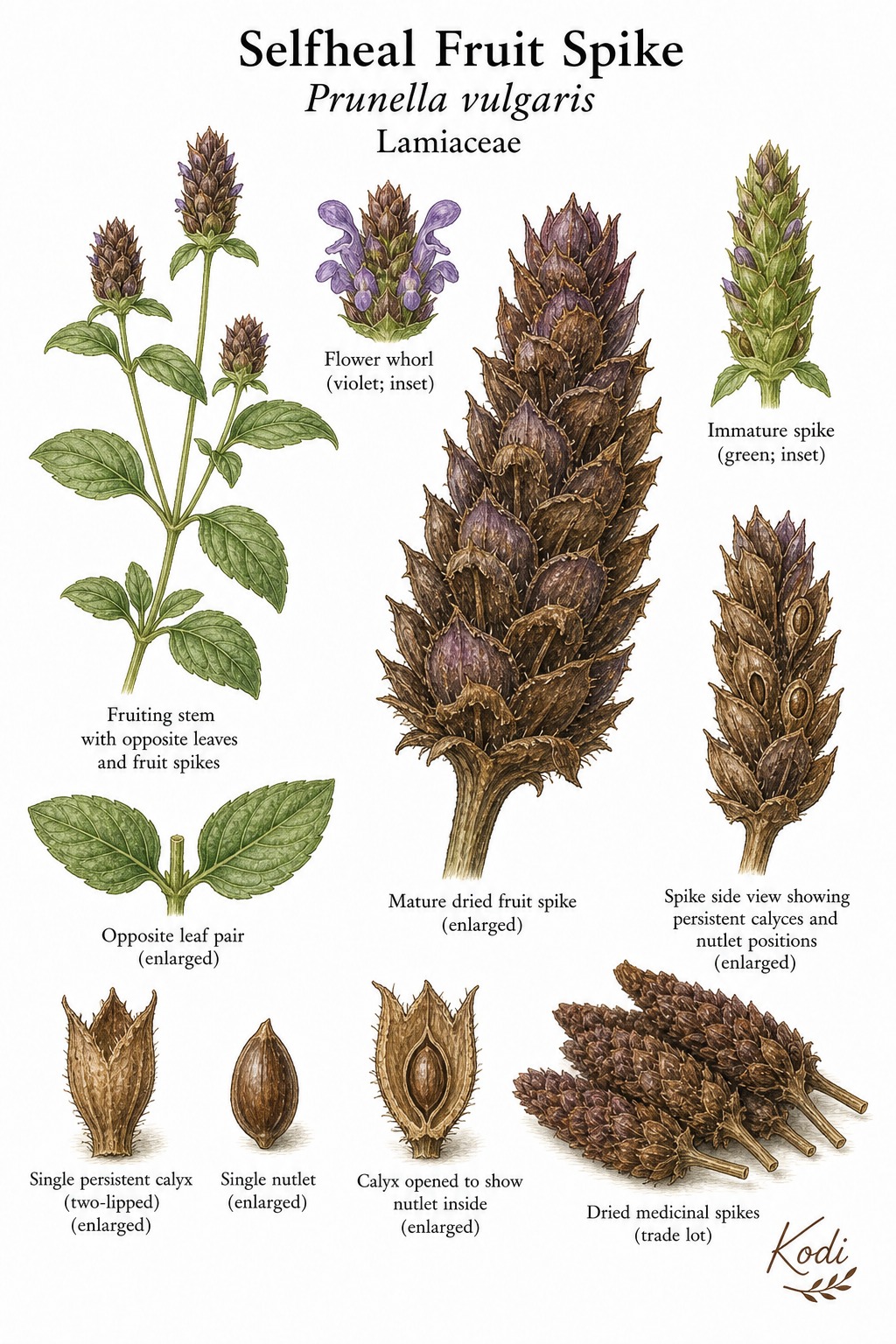
Known in TCM as Xia Ku Cao (夏枯草), this bitter and pungent, cold herb enters the Liver and Gallbladder. Traditionally, it clears Liver fire and brightens the eyes - Xia Ku Cao is a key herb for red, swollen, painful eyes, headache, and dizziness from ascending Liver fire, most often applied for conjunctivitis, headache, and thyroid nodule. Modern research has identified Rosmarinic among its active constituents.
Part used: Spike
Also Known As
Latin: Spica Prunellae | Pinyin: Xia Ku Cao | Chinese: 夏枯草
TCM Properties
- Taste
- bitter, pungent
- Temperature
- cold
- Channels
- Liver, Gallbladder
Traditional Use
Primary Actions
- Clears Liver fire and brightens the eyes - Xia Ku Cao is a key herb for red, swollen, painful eyes, headache, and dizziness from ascending Liver fire.
- Dissipates nodules and reduces swelling - it is classically used for scrofula, goiter, thyroid nodules, breast lumps, and other hard masses linked to phlegm-fire.
- Drains constrained heat and resolves toxicity - traditional use extends to sore throat, hot swellings, and breast carbuncle patterns.
Secondary Actions
- Xia Ku Cao is widely consumed as a cooling summer tea in southern China, but medicinal doses for nodules and Liver fire are not the same as casual beverage use.
- Among cooling eye herbs, it is especially valued when upward fire and palpable nodulation appear together.
Classic Formulas
- Eye-clearing pairings with Ju Hua and Jue Ming Zi - traditional formula lineages use Xia Ku Cao when red eyes and headache reflect rising Liver fire.
- Nodule-dissolving lineages pair Xia Ku Cao with Hai Zao and Kun Bu for scrofula, goiter, and phlegm-fire masses.
- Single-herb and simple tea preparations are also traditional for summer heat with red eyes and irritability.
Classical References
- TCM healing-herb and TCM Wiki materia medica sources describe Xia Ku Cao as bitter, pungent, and cold, entering the Liver and Gallbladder to clear fire and dissipate swelling.
- Shen Nong Ben Cao Jing is cited as the earliest major classical source for Xia Ku Cao and emphasizes its use for scrofula, sores, and constrained heat.
Modern Research
Active Compounds
- Rosmarinic acid - a key quality-control and anti-inflammatory phenolic compound
- Ursolic and oleanolic acids - triterpenes associated with anti-inflammatory and antiproliferative research
- Flavonoids such as rutin and quercetin derivatives - antioxidant constituents frequently discussed in reviews
- Polysaccharides and phenylpropanoids - additional fractions contributing to immunologic and metabolic study interest
Studied Effects
- A 2022 review summarized ethnopharmacology, phytochemistry, quality control, and pharmacologic research on Prunella vulgaris, highlighting anti-inflammatory, antioxidant, and nodule-related use contexts (PMID 35814234).
- A 2023 updated overview reviewed botanical, chemical, extraction, and biological-activity data for Prunella vulgaris, reinforcing broad preclinical interest in anti-inflammatory and antimicrobial effects (PMID 37631021).
- A 2019 comprehensive review described anti-microbial, anti-cancer, and anti-inflammatory activities for Prunella vulgaris while noting that clinical evidence remains limited (PMID 30864498).
PubMed References
- Prunella vulgaris L. - A Review of its Ethnopharmacology, Phytochemistry, Quality Control and Pharmacological Effects. (2022)
- Prunella vulgaris L.: An Updated Overview of Botany, Chemical Composition, Extraction Methods, and Biological Activities. (2023)
- Prunella vulgaris: A Comprehensive Review of Chemical Constituents, Pharmacological Effects and Clinical Applications. (2019)
Safety & Interactions
Contraindications
- Cold deficiency with loose stool and no sign of heat or Liver-fire ascent
Cautions
- Because Xia Ku Cao is distinctly cold, long-term or high-dose use can burden weak digestion when there is no true heat pattern.
- Research is strongest in preclinical and review literature; clinical dosing for nodules or thyroid conditions still requires professional supervision.
- MSK page not found - drug interaction data not available from Memorial Sloan Kettering integrative medicine database
Conditions
- Conjunctivitis Traditional ★★★★☆ JSON
- Headache Traditional ★★★☆☆ JSON
- Thyroid Nodule Traditional ★★★☆☆ JSON
- Hypertension Traditional ★★☆☆☆ JSON
Frequently Asked Questions
What is Selfheal Fruit Spike used for?
Selfheal Fruit Spike is traditionally used to Clears Liver fire and brightens the eyes - Xia Ku Cao is a key herb for red, swollen, painful eyes, headache, and dizziness from ascending Liver fire., Dissipates nodules and reduces swelling - it is classically used for scrofula, goiter, thyroid nodules, breast lumps, and other hard masses linked to phlegm-fire., Drains constrained heat and resolves toxicity - traditional use extends to sore throat, hot swellings, and breast carbuncle patterns.. Research has investigated its effects on: A 2022 review summarized ethnopharmacology, phytochemistry, quality control, and pharmacologic research on Prunella vulgaris, highlighting anti-inflammatory, antioxidant, and nodule-related use contexts (PMID 35814234).; A 2023 updated overview reviewed botanical, chemical, extraction, and biological-activity data for Prunella vulgaris, reinforcing broad preclinical interest in anti-inflammatory and antimicrobial effects (PMID 37631021)..
What are other names for Selfheal Fruit Spike?
Selfheal Fruit Spike is also known as Prunella. In TCM: 夏枯草 (Xia Ku Cao); Spica Prunellae.
Is Selfheal Fruit Spike safe during pregnancy?
The safety of Selfheal Fruit Spike during pregnancy has not been established. Consult a qualified healthcare provider before use.
What are the contraindications for Selfheal Fruit Spike?
Selfheal Fruit Spike should not be used in: Cold deficiency with loose stool and no sign of heat or Liver-fire ascent. Consult a qualified healthcare provider before use.