Puncturevine Fruit
- Chinese
- 刺蒺藜
- Pinyin
- Ci Ji Li
- Latin
- Fructus Tribuli
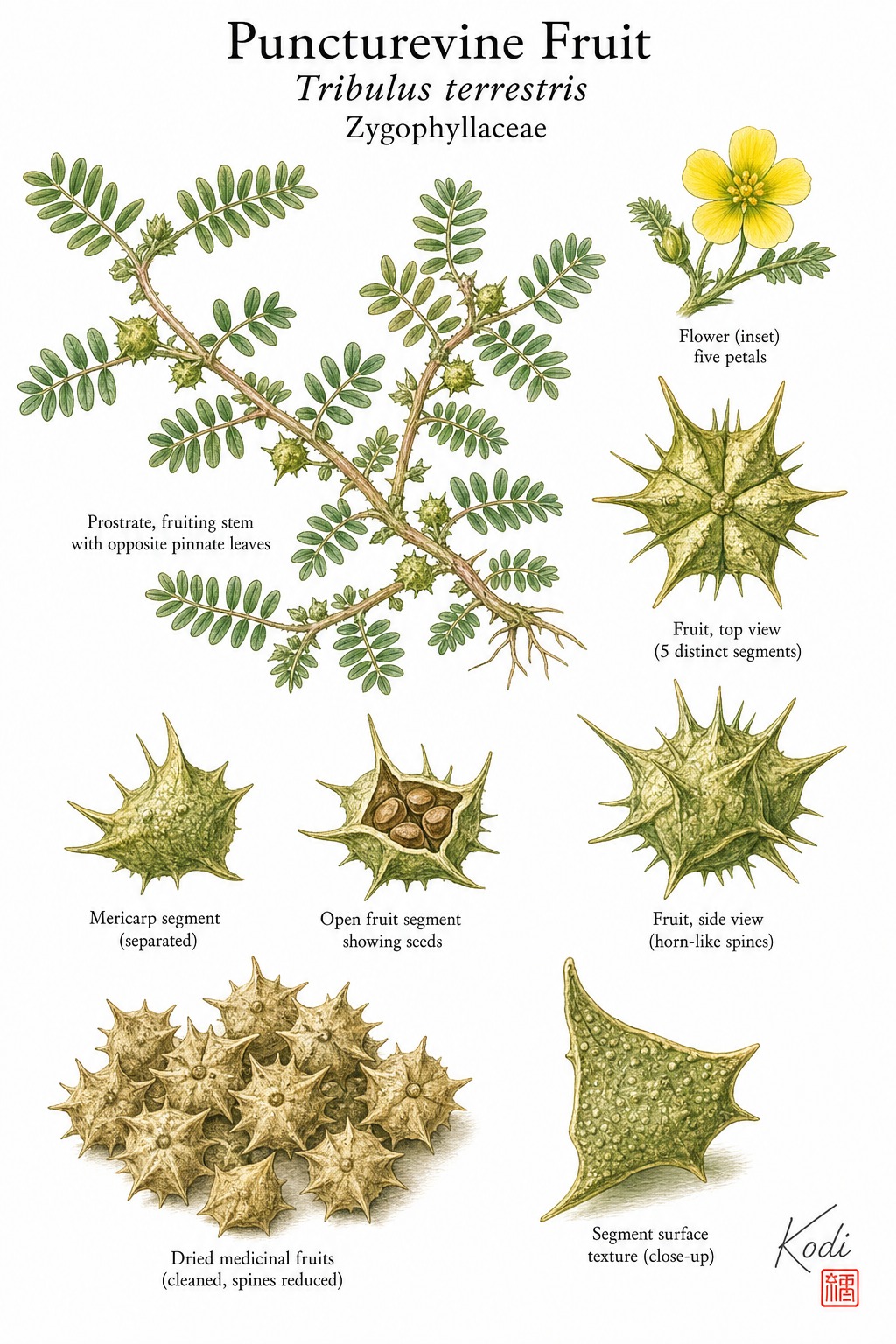
Known in TCM as Ci Ji Li (刺蒺藜), this pungent and bitter and salty, slightly warm herb enters the Liver. Traditionally, it pacifies the Liver and subdues rising yang - Ci Ji Li is widely used for headache, dizziness, irritability, and upward-rushing Liver activity, most often applied for headache, dizziness, and blurred vision. Modern research has identified Protodioscin among its active constituents.
Part used: Fruit
Also Known As
Latin: Fructus Tribuli | Pinyin: Ci Ji Li | Chinese: 刺蒺藜
TCM Properties
- Taste
- pungent, bitter, salty
- Temperature
- slightly warm
- Channels
- Liver
Traditional Use
Primary Actions
- Pacifies the Liver and subdues rising yang - Ci Ji Li is widely used for headache, dizziness, irritability, and upward-rushing Liver activity.
- Soothes Liver qi and relieves constraint - it appears when emotional stagnation creates chest or rib-side discomfort, breast distention, or pressure headaches.
- Dispels wind and brightens the eyes - traditional use includes red, painful, itchy, or visually obscured eyes linked to Liver channel disturbance.
- Stops itching - it is commonly added for urticaria, pruritic eruptions, and skin disorders where wind is considered the main pathogen.
Secondary Actions
- This record uses the thorny-fruit name Ci Ji Li, helping distinguish Tribulus fruit from Sha Yuan Ji Li, which is a different seed herb with a tonifying profile.
- Processing usually removes the hard spines and may include stir-baking, which reduces roughness and improves practical dispensing.
Classic Formulas
- Liver-constraint formulas pair Ci Ji Li with Chai Hu or Xiang Fu for headache, breast distention, and emotional stagnation.
- Eye-focused formulas combine it with Ju Hua or Jue Ming Zi when Liver heat, wind, or rising yang affects vision.
- Skin and itching formulas pair it with Fang Feng, Chan Tui, or other wind-dispelling herbs for urticaria and diffuse pruritus.
Classical References
- Me and Qi presents Ji Li as a Liver-focused herb that calms yang, soothes constraint, brightens the eyes, and relieves itching.
- Traditional herbology repeatedly warns not to confuse Tribulus fruit with Sha Yuan Ji Li, whose action is tonic and securing rather than dispersing and Liver-soothing.
Modern Research
Active Compounds
- Protodioscin and related steroidal saponins - the best-known constituents in Tribulus supplement research
- Tribulosin and other saponin fractions - compounds discussed in vascular and metabolic studies
- Flavonoids - antioxidant constituents reported in Tribulus phytochemistry
- Beta-carboline alkaloids - minor constituents relevant to some safety discussions
Studied Effects
- A 2014 systematic review examined Tribulus terrestris and the roots of its putative aphrodisiac and performance-enhancing reputation, finding the evidence mixed and often weak in humans (PMID 24559105).
- A 2020 cell study reported protective effects of Tribulus terrestris against oxidative-stress injury through PI3K/Akt-Nrf2 signaling, illustrating the herb's largely preclinical modern literature (PMID 32774685).
- A 2016 clinical study explored Tribulus extract in women with diabetes and reported effects on serum glucose and lipids, reflecting ongoing metabolic interest but limited high-quality clinical depth (PMID 27840471).
PubMed References
- A systematic review on the herbal extract Tribulus terrestris and the roots of its putative aphrodisiac and performance enhancing effect. (2014)
- Tribulus terrestris Ameliorates Oxidative Stress-Induced ARPE-19 Cell Injury through the PI3K/Akt-Nrf2 Signaling Pathway. (2020)
- Efficacy of Tribulus Terrestris Extract on the Serum Glucose and Lipids of Women with Diabetes Mellitus. (2016)
Safety & Interactions
Contraindications
- Pregnancy
- Use without supervision in hormone-sensitive or prostate-related conditions
- Marked deficiency patterns without clear Liver wind, Liver yang, or qi stagnation features
Cautions
- MSK reports gastrointestinal irritation as well as case reports of severe liver, kidney, neurologic toxicities, and priapism with Tribulus use.
- Commercial sports and libido supplements are not equivalent to traditional processed decoction fruit and may deliver much higher exposures.
- Due to potential hormonal activity, prostate-cancer patients are advised by MSK to consult their physicians before using Tribulus.
Drug Interactions
- Diuretics - Tribulus may increase diuretic effects
- Antihypertensive drugs - Tribulus may have additive blood-pressure-lowering effects
- Antidiabetics - Tribulus may have additive blood-sugar-lowering effects
- Clopidogrel - an herbal formula containing Tribulus has been associated with stent thrombosis
Conditions
- Headache Traditional ★★★★☆ JSON
- Dizziness Traditional ★★★☆☆ JSON
- Blurred Vision Traditional ★★★☆☆ JSON
- Urticaria Traditional ★★★★☆ JSON
- Liver Yang Rising Traditional ★★★☆☆ JSON
Frequently Asked Questions
What is Puncturevine Fruit used for?
Puncturevine Fruit is traditionally used to Pacifies the Liver and subdues rising yang - Ci Ji Li is widely used for headache, dizziness, irritability, and upward-rushing Liver activity., Soothes Liver qi and relieves constraint - it appears when emotional stagnation creates chest or rib-side discomfort, breast distention, or pressure headaches., Dispels wind and brightens the eyes - traditional use includes red, painful, itchy, or visually obscured eyes linked to Liver channel disturbance., Stops itching - it is commonly added for urticaria, pruritic eruptions, and skin disorders where wind is considered the main pathogen.. Research has investigated its effects on: A 2014 systematic review examined Tribulus terrestris and the roots of its putative aphrodisiac and performance-enhancing reputation, finding the evidence mixed and often weak in humans (PMID 24559105).; A 2020 cell study reported protective effects of Tribulus terrestris against oxidative-stress injury through PI3K/Akt-Nrf2 signaling, illustrating the herb's largely preclinical modern literature (PMID 32774685)..
What are other names for Puncturevine Fruit?
Puncturevine Fruit is also known as Tribuli. In TCM: 刺蒺藜 (Ci Ji Li); Fructus Tribuli.
Is Puncturevine Fruit safe during pregnancy?
Puncturevine Fruit is not recommended during pregnancy.
What are the contraindications for Puncturevine Fruit?
Puncturevine Fruit should not be used in: Pregnancy; Use without supervision in hormone-sensitive or prostate-related conditions; Marked deficiency patterns without clear Liver wind, Liver yang, or qi stagnation features. Consult a qualified healthcare provider before use.
Does Puncturevine Fruit interact with any medications?
Puncturevine Fruit may interact with: Diuretics - Tribulus may increase diuretic effects; Antihypertensive drugs - Tribulus may have additive blood-pressure-lowering effects; Antidiabetics - Tribulus may have additive blood-sugar-lowering effects; Clopidogrel - an herbal formula containing Tribulus has been associated with stent thrombosis. Always inform your healthcare provider of any herbal supplements you are taking.