Chinese Raspberry Fruit
- Chinese
- 覆盆子
- Pinyin
- Fu Pen Zi
- Latin
- Fructus Rubi
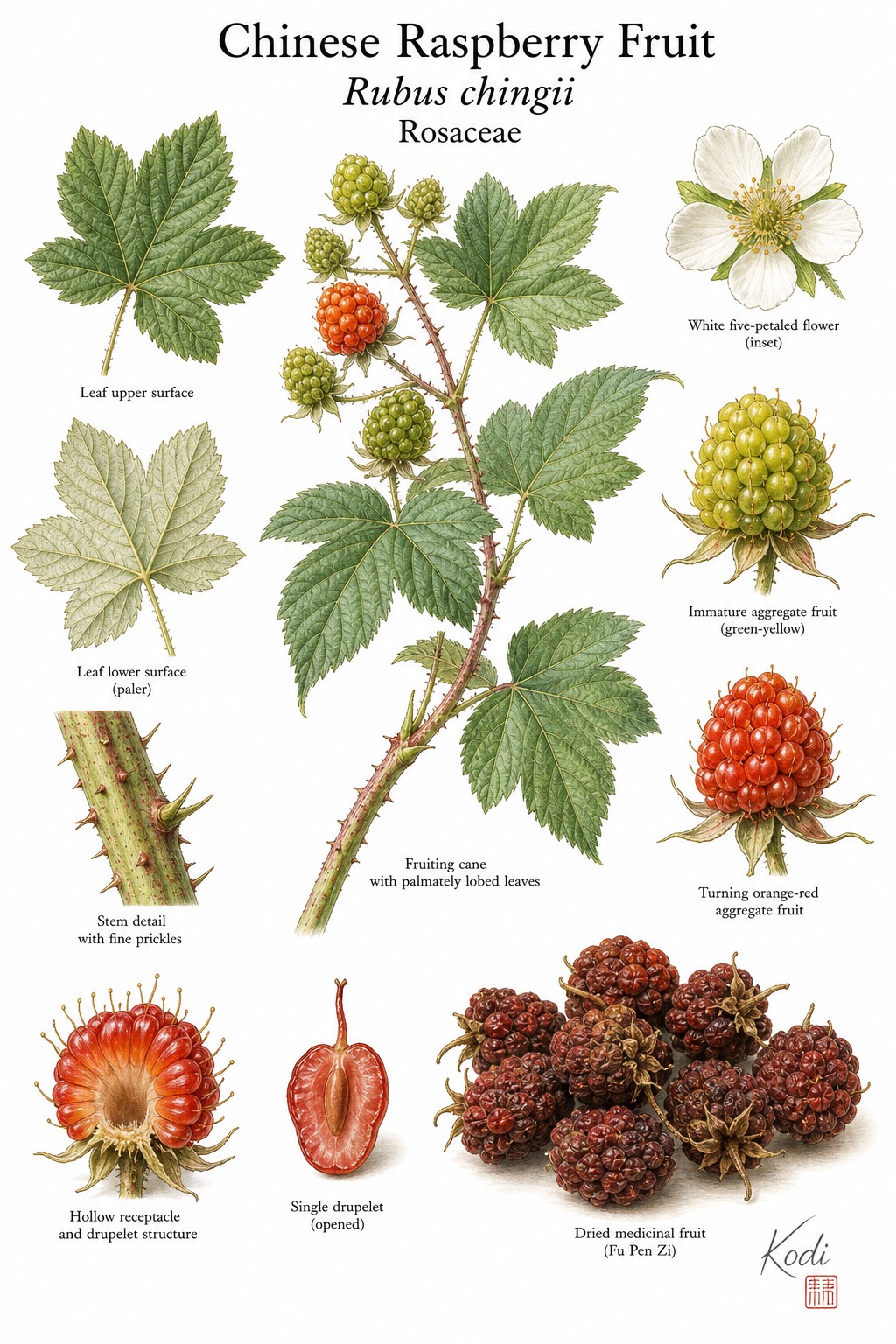
Known in TCM as Fu Pen Zi (覆盆子), this sweet and sour, slightly warm herb enters the Liver, Kidney, and Bladder. Traditionally, it secures essence and reduces urination - Fu Pen Zi is a core herb for enuresis, urinary frequency, nocturia, and leakage patterns from weak Kidney qi, most often applied for frequent urination, infertility, and erectile dysfunction. Modern research has identified Polysaccharides among its active constituents.
Part used: Fruit
Also Known As
Latin: Fructus Rubi | Pinyin: Fu Pen Zi | Chinese: 覆盆子
TCM Properties
- Taste
- sweet, sour
- Temperature
- slightly warm
- Channels
- Liver, Kidney, Bladder
Traditional Use
Primary Actions
- Secures essence and reduces urination - Fu Pen Zi is a core herb for enuresis, urinary frequency, nocturia, and leakage patterns from weak Kidney qi.
- Tonifies the Kidney and supports reproductive vitality - it is used for infertility, impotence, low sperm quality, and premature ejaculation when deficiency and leakage coexist.
- Benefits the Liver and brightens the eyes - traditional use extends to blurred or dim vision from Liver-Kidney insufficiency.
- Supports long-course constitutional restoration - because it both tonifies and astringes, it is valuable when the treatment goal is to nourish while preventing further loss.
Secondary Actions
- Fu Pen Zi is gentler than purely restraining herbs such as Jin Ying Zi because it both nourishes and secures rather than only binding leakage.
- Its famous name story refers to 'overturning the chamber pot,' a traditional way of saying it can reduce chronic urinary frequency.
Classic Formulas
- Wu Zi Yan Zong Wan - classic fertility and Kidney-essence formula in which Fu Pen Zi helps secure the essence while other seeds deepen nourishment.
- Kidney leakage formulas pair Fu Pen Zi with Tu Si Zi, Sang Piao Xiao, or Qian Shi for enuresis, spermatorrhea, and nocturia.
- Vision-support formulas combine Fu Pen Zi with Gou Qi Zi and other Liver-Kidney tonics when chronic deficiency affects the eyes.
Classical References
- Me and Qi presents Fu Pen Zi as a sweet-sour, slightly warm fruit that enters the Liver, Kidney, and Bladder to tonify and astringe at the same time.
- Classical literature links its essence-preserving and eye-brightening functions to the shared root of Liver blood and Kidney essence.
Modern Research
Active Compounds
- Polysaccharides - major modern research fractions in Rubus chingii fruit
- Flavonoids and anthocyanin-related pigments - antioxidant constituents studied in fruit extracts
- Triterpenoids and diterpenes - broader phytochemical classes reported in Rubus chingii reviews
- Ellagic acid and related phenolics - compounds contributing to antioxidant and anti-inflammatory interest
Studied Effects
- A 2025 review summarized preparation methods, structural characterization, and health benefits of polysaccharides from Rubus chingii Hu, reflecting current research emphasis on Fu Pen Zi's macromolecular fractions (PMID 40417219).
- A 2017 study used active-tracking extraction to isolate antioxidant and antiproliferative ingredients from Rubus chingii fruits, illustrating the fruit's functional-food research profile (PMID 30108878).
- A 2023 study described a novel polysaccharide from unripe Rubus chingii fruit and reported amelioration of colonic inflammation and oxidative stress in experimental work (PMID 37094397).
PubMed References
- Preparation, structural characterization and health benefits of polysaccharides from Rubus chingii Hu: a review. (2025)
- Extraction of antioxidant and antiproliferative ingredients from fruits of Rubus chingii Hu by active tracking guidance. (2017)
- A novel polysaccharide from Rubus chingii Hu unripe fruits: Extraction optimization, structural characterization and amelioration of colonic inflammation and oxidative stress. (2023)
Safety & Interactions
Contraindications
- Difficult or painful urination due to damp-heat rather than deficiency leakage
- Yin deficiency with pronounced heat signs
- Excess conditions without true Kidney deficiency
Cautions
- Because Fu Pen Zi is astringent, it can trap pathogens or damp-heat if used when leakage is not rooted in deficiency.
- Rubus substitutions are common in commerce, so quality sourcing matters.
- MSK page not found - drug interaction data not available from Memorial Sloan Kettering integrative medicine database
Conditions
- Frequent Urination Traditional ★★★★☆ JSON
- Infertility Traditional ★★★★☆ JSON
- Erectile Dysfunction Traditional ★★★☆☆ JSON
- Blurred Vision Traditional ★★★☆☆ JSON
- Kidney Deficiency Traditional ★★★☆☆ JSON
Frequently Asked Questions
What is Chinese Raspberry Fruit used for?
Chinese Raspberry Fruit is traditionally used to Secures essence and reduces urination - Fu Pen Zi is a core herb for enuresis, urinary frequency, nocturia, and leakage patterns from weak Kidney qi., Tonifies the Kidney and supports reproductive vitality - it is used for infertility, impotence, low sperm quality, and premature ejaculation when deficiency and leakage coexist., Benefits the Liver and brightens the eyes - traditional use extends to blurred or dim vision from Liver-Kidney insufficiency., Supports long-course constitutional restoration - because it both tonifies and astringes, it is valuable when the treatment goal is to nourish while preventing further loss.. Research has investigated its effects on: A 2025 review summarized preparation methods, structural characterization, and health benefits of polysaccharides from Rubus chingii Hu, reflecting current research emphasis on Fu Pen Zi's macromolecular fractions (PMID 40417219).; A 2017 study used active-tracking extraction to isolate antioxidant and antiproliferative ingredients from Rubus chingii fruits, illustrating the fruit's functional-food research profile (PMID 30108878)..
What are other names for Chinese Raspberry Fruit?
Chinese Raspberry Fruit is also known as Rubi. In TCM: 覆盆子 (Fu Pen Zi); Fructus Rubi.
Is Chinese Raspberry Fruit safe during pregnancy?
The safety of Chinese Raspberry Fruit during pregnancy has not been established. Consult a qualified healthcare provider before use.
What are the contraindications for Chinese Raspberry Fruit?
Chinese Raspberry Fruit should not be used in: Difficult or painful urination due to damp-heat rather than deficiency leakage; Yin deficiency with pronounced heat signs; Excess conditions without true Kidney deficiency. Consult a qualified healthcare provider before use.