Psoralea Fruit
- Chinese
- 补骨脂
- Pinyin
- Bu Gu Zhi
- Latin
- Fructus Psoraleae
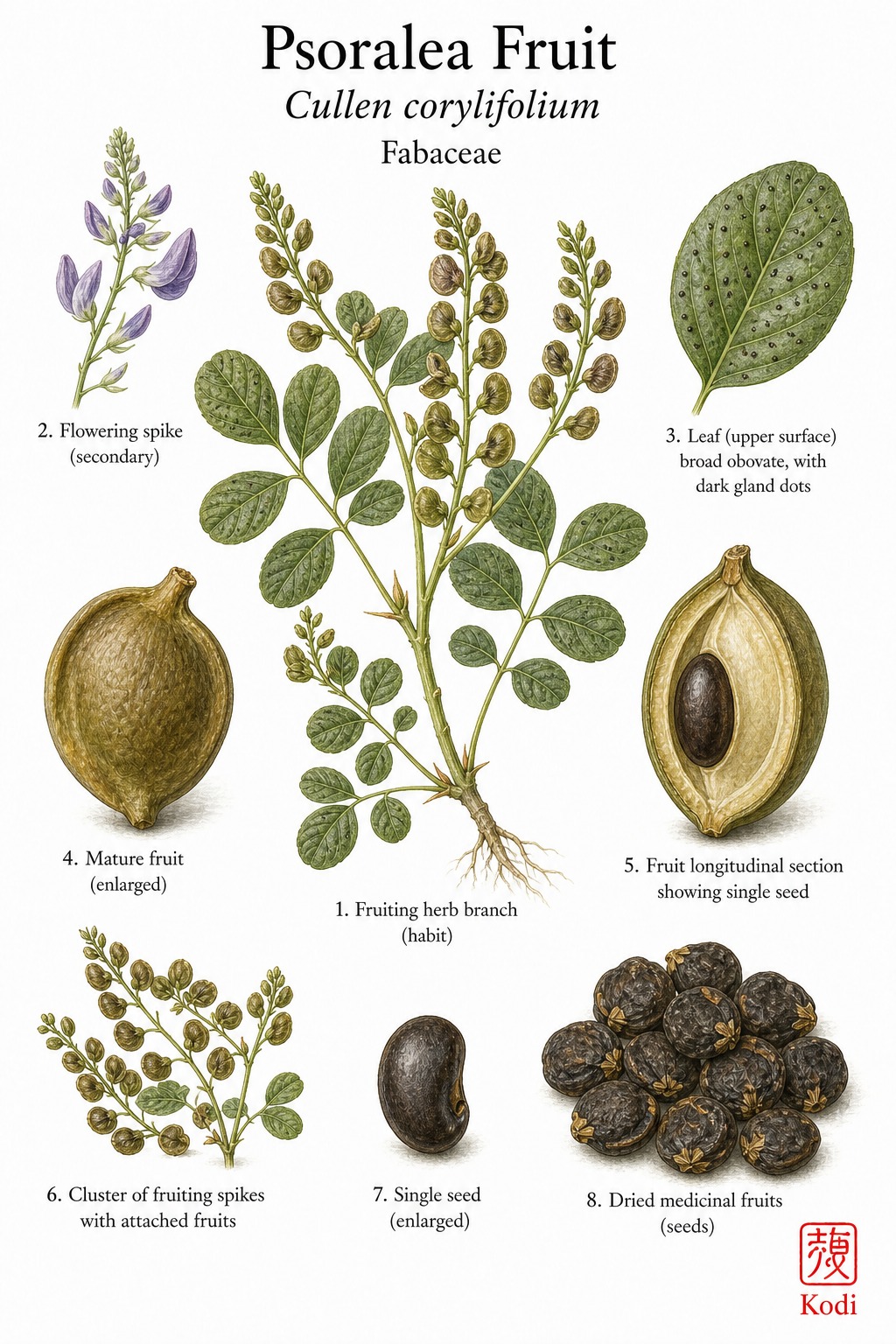
Known in TCM as Bu Gu Zhi (补骨脂), this sweet and bitter and astringent, warm herb enters the Kidney, Spleen, and Lung. Traditionally, it warms the Kidney and tonifies yang - Bu Gu Zhi is used for cold low back, weak knees, impotence, infertility, and depleted Kidney fire, most often applied for kidney yang deficiency, frequent urination, and diarrhea. Modern research has identified Psoralen among its active constituents.
Part used: Fruit
Also Known As
Latin: Fructus Psoraleae | Pinyin: Bu Gu Zhi | Chinese: 补骨脂
TCM Properties
- Taste
- sweet, bitter, astringent
- Temperature
- warm
- Channels
- Kidney, Spleen, Lung
Traditional Use
Primary Actions
- Warms the Kidney and tonifies yang - Bu Gu Zhi is used for cold low back, weak knees, impotence, infertility, and depleted Kidney fire.
- Secures essence and reduces urination - it is a standard herb for frequent urination, enuresis, spermatorrhea, and lower-burner leakage rooted in Kidney deficiency.
- Warms the Spleen and stops dawn diarrhea - it is especially valued when early-morning loose stool reflects chronic Spleen-Kidney yang deficiency.
- Helps the Kidney grasp qi - it is added to formulas for chronic wheezing or dyspnea when lower-source weakness prevents proper grasp of breath.
Secondary Actions
- Traditional and modern practice also uses Bu Gu Zhi externally, especially in vitiligo-focused preparations because of its photosensitizing psoralen compounds.
- It is a strong warm-astringent herb rather than a gentle tonic, so it works best when cold, leakage, and lower-burner weakness are all clearly present.
Classic Formulas
- Si Shen Wan - classic dawn-diarrhea formula using Bu Gu Zhi to warm the Spleen and Kidney and secure chronic early-morning stool.
- Qing E Wan - lower-back and Kidney-yang formula pairing Bu Gu Zhi with Du Zhong and other supportive ingredients for lumbar weakness.
- Kidney grasping-qi lineages pair Bu Gu Zhi with Ren Shen, Hu Tao Rou, or Chen Xiang for chronic wheezing from lower-source deficiency.
Classical References
- TCMWiki records Bu Gu Zhi as sweet, bitter, astringent, and warm, entering the Kidney, Spleen, and Lung to warm yang, secure leakage, stop diarrhea, and relieve dyspnea.
- Traditional materia medica repeatedly distinguishes its hot, drying, astringing nature from the gentler balanced Kidney tonics such as Tu Si Zi.
Modern Research
Active Compounds
- Psoralen and isopsoralen - hallmark furocoumarins responsible for much of the herb's research and safety profile
- Bakuchiol - a notable meroterpene frequently discussed in Psoralea pharmacology
- Bavachin and bavachalcone - flavonoid-type constituents studied in bone and inflammatory models
- Seed polysaccharides - emerging fractions in modern osteoporosis and immune research
Studied Effects
- A 2018 review summarized the ethnobotanical, biological, and chemical aspects of Psoralea corylifolia, providing the main broad overview of Bu Gu Zhi research (PMID 29243333).
- A 2025 study reported that polysaccharides from Psoralea corylifolia seeds suppressed osteoclastogenesis and alleviated osteoporosis in preclinical work, reinforcing continued bone-health interest (PMID 40403806).
- A 2019 rat study found that long-term exposure to psoralen and isopsoralen induced hepatotoxicity and altered serum metabolites, underscoring one of the herb's key safety concerns (PMID 31684074).
PubMed References
- Psoralea corylifolia L: Ethnobotanical, biological, and chemical aspects: A review. (2018)
- Polysaccharides from Psoralea corylifolia seeds suppress osteoclastogenesis and alleviate osteoporosis. (2025)
- Long-Term Exposure of Psoralen and Isopsoralen Induced Hepatotoxicity and Serum Metabolites Profiles Changes in Female Rats. (2019)
Safety & Interactions
Contraindications
- Yin deficiency with heat or deficiency fire
- Constipation from fluid depletion or excessive internal heat
- Active liver disease without qualified supervision
Cautions
- Psoralen-rich Bu Gu Zhi can be hepatotoxic, especially in concentrated products, prolonged use, or poorly supervised dosing.
- The herb is photosensitizing and may increase skin sensitivity to ultraviolet exposure, particularly in topical or extract form.
- MSK page not found - drug interaction data not available from Memorial Sloan Kettering integrative medicine database
Conditions
- Kidney Yang Deficiency Traditional ★★★★☆ JSON
- Frequent Urination Traditional ★★★★☆ JSON
- Diarrhea Traditional ★★★★☆ JSON
- Impotence Traditional ★★★★☆ JSON
- Wheezing Traditional ★★★☆☆ JSON
Frequently Asked Questions
What is Psoralea Fruit used for?
Psoralea Fruit is traditionally used to Warms the Kidney and tonifies yang - Bu Gu Zhi is used for cold low back, weak knees, impotence, infertility, and depleted Kidney fire., Secures essence and reduces urination - it is a standard herb for frequent urination, enuresis, spermatorrhea, and lower-burner leakage rooted in Kidney deficiency., Warms the Spleen and stops dawn diarrhea - it is especially valued when early-morning loose stool reflects chronic Spleen-Kidney yang deficiency., Helps the Kidney grasp qi - it is added to formulas for chronic wheezing or dyspnea when lower-source weakness prevents proper grasp of breath.. Research has investigated its effects on: A 2018 review summarized the ethnobotanical, biological, and chemical aspects of Psoralea corylifolia, providing the main broad overview of Bu Gu Zhi research (PMID 29243333).; A 2025 study reported that polysaccharides from Psoralea corylifolia seeds suppressed osteoclastogenesis and alleviated osteoporosis in preclinical work, reinforcing continued bone-health interest (PMID 40403806)..
What are other names for Psoralea Fruit?
Psoralea Fruit is also known as Psoralea. In TCM: 补骨脂 (Bu Gu Zhi); Fructus Psoraleae.
Is Psoralea Fruit safe during pregnancy?
The safety of Psoralea Fruit during pregnancy has not been established. Consult a qualified healthcare provider before use.
What are the contraindications for Psoralea Fruit?
Psoralea Fruit should not be used in: Yin deficiency with heat or deficiency fire; Constipation from fluid depletion or excessive internal heat; Active liver disease without qualified supervision. Consult a qualified healthcare provider before use.