Glossy Privet Fruit
- Chinese
- 女贞子
- Pinyin
- Nu Zhen Zi
- Latin
- Fructus Ligustri Lucidi
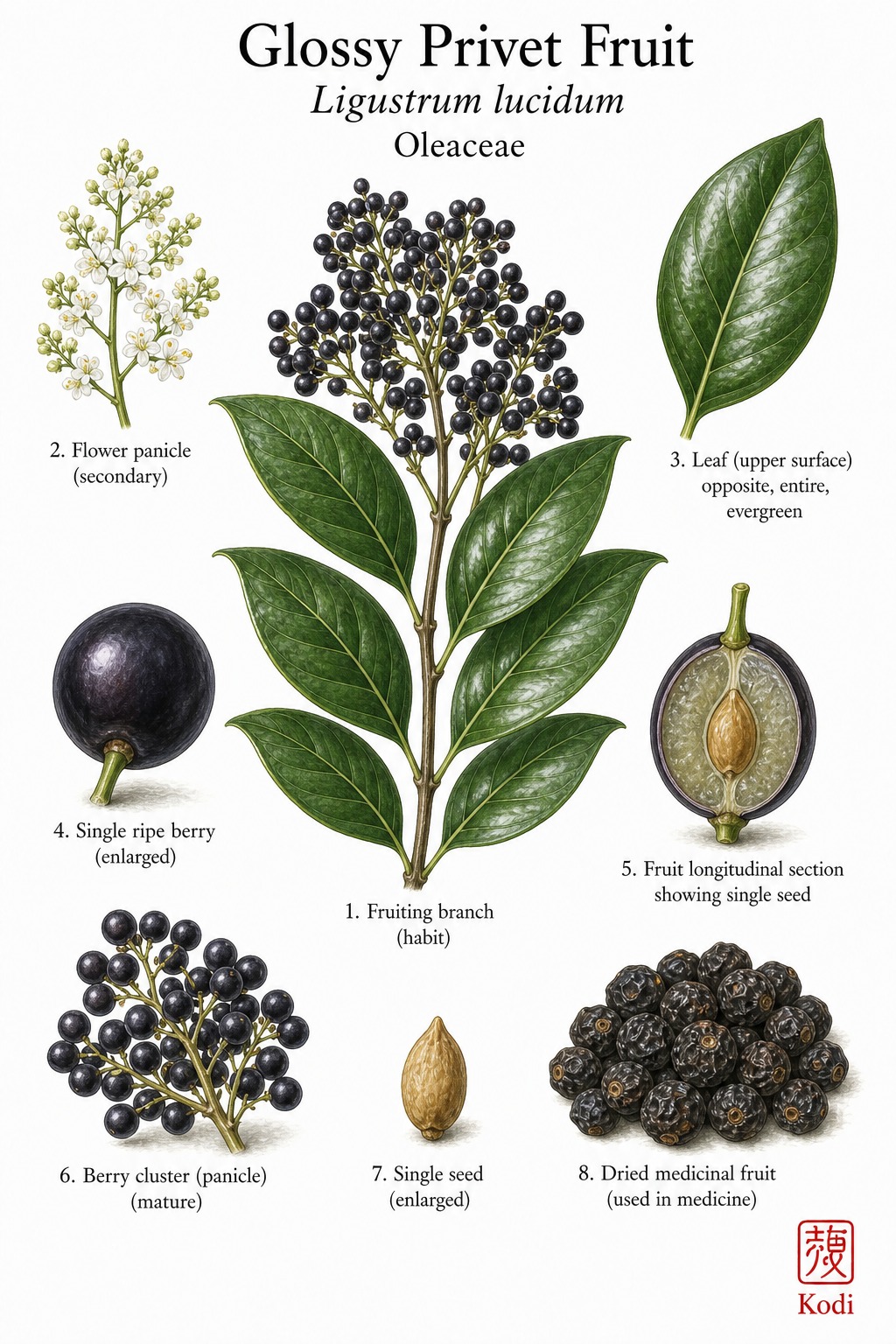
Known in TCM as Nu Zhen Zi (女贞子), this sweet and bitter, cool herb enters the Liver and Kidney. Traditionally, it nourishes Liver and Kidney yin - Nu Zhen Zi is a classic gentle tonic for dizziness, weak low back and knees, tinnitus, and constitutional depletion, most often applied for yin deficiency, blurred vision, and tinnitus. Modern research has identified Specnuezhenide among its active constituents.
Part used: Fruit
Also Known As
Latin: Fructus Ligustri Lucidi | Pinyin: Nu Zhen Zi | Chinese: 女贞子
TCM Properties
- Taste
- sweet, bitter
- Temperature
- cool
- Channels
- Liver, Kidney
Traditional Use
Primary Actions
- Nourishes Liver and Kidney yin - Nu Zhen Zi is a classic gentle tonic for dizziness, weak low back and knees, tinnitus, and constitutional depletion.
- Benefits the eyes - it is often chosen for gradual visual decline, dry eyes, and blurred vision when the Liver and Kidney fail to nourish the sense organs.
- Supports hair and essence - traditional use includes premature graying, hair thinning, and signs of aging linked to Kidney deficiency.
- Clears deficiency heat without being harsh - it is valued when depletion carries dryness, irritability, or heat signs but the patient still needs a tonic approach.
Secondary Actions
- Nu Zhen Zi is milder and less cloying than many richer yin tonics, so it is frequently used for long-course support or combined with stronger herbs rather than used as a dramatic stand-alone tonic.
- Its most famous traditional partner is Han Lian Cao in Er Zhi Wan, a pairing that balances yin nourishment with blood-cooling support.
Classic Formulas
- Er Zhi Wan - the classic Nu Zhen Zi and Han Lian Cao combination for Liver-Kidney yin deficiency, tinnitus, hair changes, and menopausal depletion.
- Qi Ju Di Huang Wan lineages may add or pair Nu Zhen Zi when eye symptoms and yin deficiency are both prominent.
- Long-course constitutional formulas often combine Nu Zhen Zi with Gou Qi Zi, Sang Ji Sheng, or Shu Di Huang for vision, bones, and aging support.
Classical References
- Me and Qi describes Nu Zhen Zi as one of the standard herbs for Liver and Kidney yin deficiency, especially when diminished eyesight, dizziness, and dry deficiency signs dominate.
- Traditional materia medica consistently praises its ability to supplement without the heavy greasy burden of richer essence tonics.
Modern Research
Active Compounds
- Specnuezhenide and nuezhenide - signature secoiridoids used in modern Ligustrum research
- Oleanolic acid and ursolic acid - triterpenes frequently linked to hepatoprotective and anti-inflammatory studies
- Ligustroflavone - a named flavonoid constituent investigated in bone and metabolic models
- Oleuropein-like and broader iridoid fractions - important bioactive classes in glossy privet fruit
Studied Effects
- A 2024 review summarized the botany, phytochemistry, pharmacology, and food-medicine applications of Ligustrum lucidum, providing a current high-level overview of Nu Zhen Zi research (PMID 38933667).
- A 2022 review highlighted therapeutic potential of secoiridoids from Ligustrum lucidum fruits against inflammation-related skin disorders, reflecting the expanding pharmacology literature around its fruit constituents (PMID 36015080).
- A 2019 animal study reported protective effects of ligustroflavone against diabetes-induced osteoporosis, helping explain ongoing interest in bone-health mechanisms (PMID 30834778).
PubMed References
- A review of botany, phytochemistry, pharmacology, and applications of the herb with the homology of medicine and food: Ligustrum lucidum W.T. Aiton. (2024)
- Therapeutic Potentials of Secoiridoids from the Fruits of Ligustrum lucidum Aiton against Inflammation-Related Skin Diseases. (2022)
- Protective Effects of Ligustroflavone, an Active Compound from Ligustrum lucidum, on Diabetes-Induced Osteoporosis in Mice: A Potential Candidate as Calcium-Sensing Receptor Antagonist. (2019)
Safety & Interactions
Contraindications
- Spleen deficiency with loose stools and poor digestion
- Acute exterior excess without an underlying deficiency pattern
Cautions
- Nu Zhen Zi is generally mild, but its cool tonic nature can aggravate loose stools in cold or weak digestion.
- MSK notes that people with hypersensitivity to Ligustrum lucidum should avoid it.
- Most pharmacology data remain preclinical and should not be treated as proof of broad clinical benefit.
Conditions
- Yin Deficiency Traditional ★★★★☆ JSON
- Blurred Vision Traditional ★★★☆☆ JSON
- Tinnitus Traditional ★★★☆☆ JSON
- Hair Loss Traditional ★★★☆☆ JSON
- Menopausal Symptoms Traditional ★★☆☆☆ JSON
Frequently Asked Questions
What is Glossy Privet Fruit used for?
Glossy Privet Fruit is traditionally used to Nourishes Liver and Kidney yin - Nu Zhen Zi is a classic gentle tonic for dizziness, weak low back and knees, tinnitus, and constitutional depletion., Benefits the eyes - it is often chosen for gradual visual decline, dry eyes, and blurred vision when the Liver and Kidney fail to nourish the sense organs., Supports hair and essence - traditional use includes premature graying, hair thinning, and signs of aging linked to Kidney deficiency., Clears deficiency heat without being harsh - it is valued when depletion carries dryness, irritability, or heat signs but the patient still needs a tonic approach.. Research has investigated its effects on: A 2024 review summarized the botany, phytochemistry, pharmacology, and food-medicine applications of Ligustrum lucidum, providing a current high-level overview of Nu Zhen Zi research (PMID 38933667).; A 2022 review highlighted therapeutic potential of secoiridoids from Ligustrum lucidum fruits against inflammation-related skin disorders, reflecting the expanding pharmacology literature around its fruit constituents (PMID 36015080)..
What are other names for Glossy Privet Fruit?
Glossy Privet Fruit is also known as Ligustri. In TCM: 女贞子 (Nu Zhen Zi); Fructus Ligustri Lucidi.
Is Glossy Privet Fruit safe during pregnancy?
The safety of Glossy Privet Fruit during pregnancy has not been established. Consult a qualified healthcare provider before use.
What are the contraindications for Glossy Privet Fruit?
Glossy Privet Fruit should not be used in: Spleen deficiency with loose stools and poor digestion; Acute exterior excess without an underlying deficiency pattern. Consult a qualified healthcare provider before use.