Akebia Fruit
- Chinese
- 八月札
- Pinyin
- Ba Yue Zha
- Latin
- Fructus Akebiae
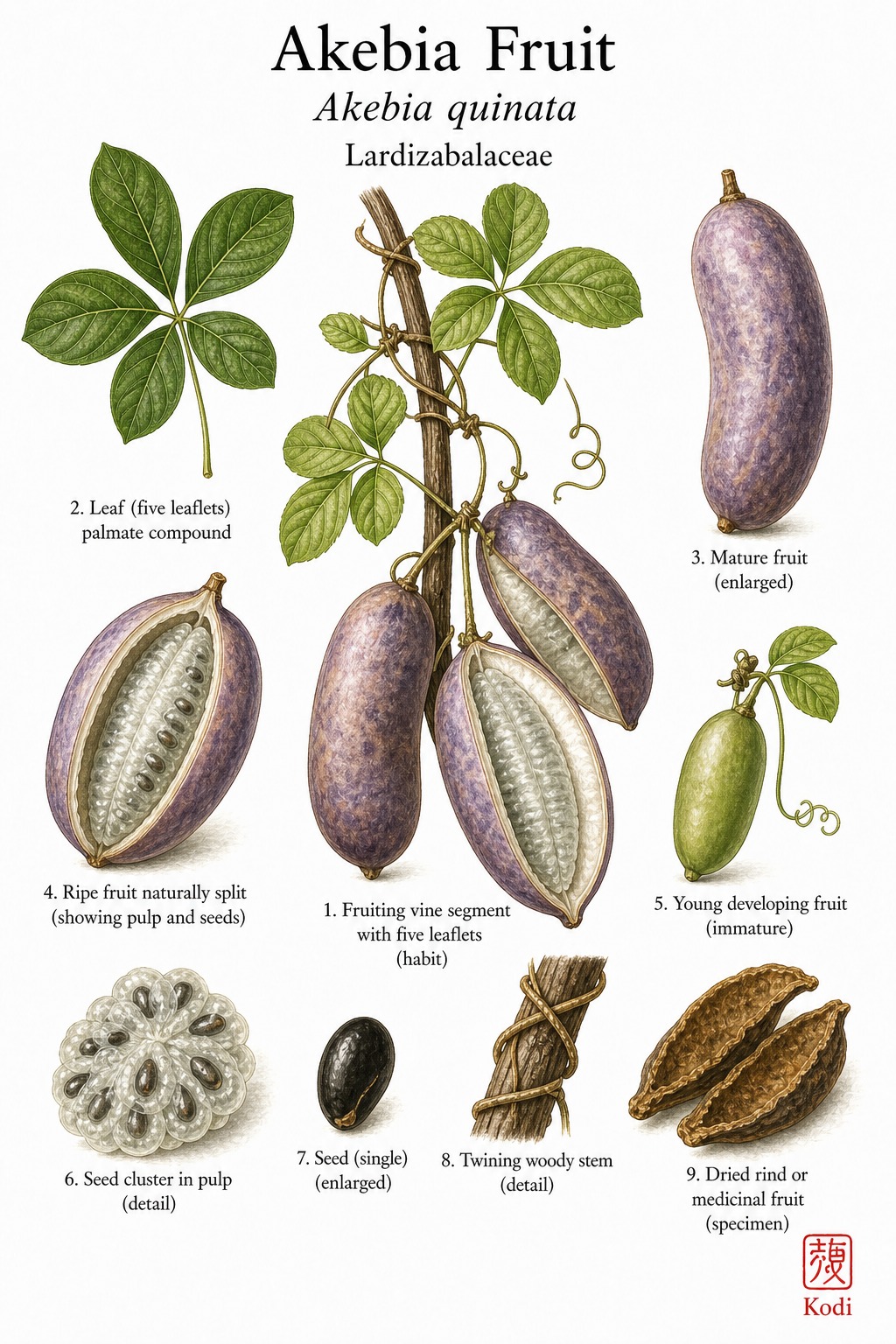
Known in TCM as Ba Yue Zha (八月札), this bitter, neutral herb enters the Liver and Stomach. Traditionally, it soothes the Liver and regulates qi - Ba Yue Zha is classically used for hypochondriac pain, rib-side distention, chest constraint, and emotional qi stagnation, most often applied for hypochondriac pain, liver qi stagnation, and abdominal pain. Modern research has identified Triterpenoid among its active constituents.
Part used: Fruit
Also Known As
Latin: Fructus Akebiae | Pinyin: Ba Yue Zha | Chinese: 八月札
TCM Properties
- Taste
- bitter
- Temperature
- neutral
- Channels
- Liver, Stomach
Traditional Use
Primary Actions
- Soothes the Liver and regulates qi - Ba Yue Zha is classically used for hypochondriac pain, rib-side distention, chest constraint, and emotional qi stagnation.
- Invigorates blood and alleviates pain - it is chosen when qi stagnation has created fixed or recurrent abdominal, hernial, or menstrual pain.
- Disperses nodules and relieves constraint - traditional applications extend to breast or abdominal masses where stagnation dominates the presentation.
- Promotes urination - some lineages use it for damp-heat or stone-type urinary difficulty, especially in larger supervised doses.
Secondary Actions
- Ba Yue Zha is sometimes discussed together with Yu Zhi Zi, and historical sources can blur the fruit and seed identities, so botanical sourcing matters.
- This is a qi-regulating pain herb more than a general tonic, which is why it fits best when distention, emotional constraint, or stagnation-pattern pain is clear.
Classic Formulas
- Qi-regulating formulas pair Ba Yue Zha with Xiang Fu or Chai Hu for rib-side pain, emotional constraint, and menstrual stagnation.
- Lower-abdominal and hernia pain prescriptions combine it with Ju He, Yan Hu Suo, or Wu Yao when cold-stagnation and qi constraint are intertwined.
- Stone and urinary-difficulty folk lineages may combine larger doses of Ba Yue Zha with Yi Yi Ren or other damp-draining herbs under supervision.
Classical References
- TCMWiki describes Ba Yue Zha as slightly bitter and neutral, entering the Liver and Stomach to soothe the Liver, regulate qi, invigorate blood, relieve pain, calm restlessness, and induce urination.
- Me and Qi likewise frames it as a qi-regulating herb used when pain and distention arise from Liver constraint rather than from simple deficiency.
Modern Research
Active Compounds
- Triterpenoid saponins - major Akebia constituents frequently linked to pharmacologic activity
- Oleanane-type triterpenes - an important structural class in Akebia phytochemistry
- Flavonoids and phenolic compounds - supportive antioxidant constituents in fruit profiling studies
- Unsaturated fatty acids and sterols - broader nutritional and metabolomic components studied in the fruit
Studied Effects
- A 2021 review summarized Akebia quinata and Akebia trifoliata phytochemistry, ethnopharmacology, and biological studies, providing the main overview for modern Ba Yue Zha research (PMID 34352331).
- A 2025 metabolomic comparison of Akebia species examined bioactive compounds in the pulp of several Akebia taxa, showing continued interest in fruit-level differentiation (PMID 40475824).
- A 2021 genome-analysis study explored triterpene synthesis and unsaturated fatty-acid accumulation in Akebia trifoliata subsp. australis, helping explain ongoing chemistry-focused interest in this genus (PMID 33518712).
PubMed References
- Akebia quinata and Akebia trifoliata - a review of phytochemical composition, ethnopharmacological approaches and biological studies. (2021)
- Metabolomic profiling of Akebia species: Comparative analysis of bioactive compounds in the pulp of A. trifoliata, A. trifoliata ssp. australis, and A. quinata. (2025)
- Insights into triterpene synthesis and unsaturated fatty-acid accumulation provided by chromosomal-level genome analysis of Akebia trifoliata subsp. australis. (2021)
Safety & Interactions
Contraindications
- Pregnancy without practitioner supervision
- Diarrhea due to Spleen deficiency
- Long-term use when no qi stagnation or pain pattern is present
Cautions
- Because Ba Yue Zha moves qi and blood, medicinal-dose use during pregnancy is generally avoided unless specifically prescribed.
- Higher-dose folk use for stones or masses should not be treated as casual self-care.
- MSK page not found - drug interaction data not available from Memorial Sloan Kettering integrative medicine database
Conditions
- Hypochondriac Pain Traditional ★★★★☆ JSON
- Liver Qi Stagnation Traditional ★★★★☆ JSON
- Abdominal Pain Traditional ★★★☆☆ JSON
- Dysmenorrhea Traditional ★★★☆☆ JSON
- Urolithiasis Traditional ★★☆☆☆ JSON
Frequently Asked Questions
What is Akebia Fruit used for?
Akebia Fruit is traditionally used to Soothes the Liver and regulates qi - Ba Yue Zha is classically used for hypochondriac pain, rib-side distention, chest constraint, and emotional qi stagnation., Invigorates blood and alleviates pain - it is chosen when qi stagnation has created fixed or recurrent abdominal, hernial, or menstrual pain., Disperses nodules and relieves constraint - traditional applications extend to breast or abdominal masses where stagnation dominates the presentation., Promotes urination - some lineages use it for damp-heat or stone-type urinary difficulty, especially in larger supervised doses.. Research has investigated its effects on: A 2021 review summarized Akebia quinata and Akebia trifoliata phytochemistry, ethnopharmacology, and biological studies, providing the main overview for modern Ba Yue Zha research (PMID 34352331).; A 2025 metabolomic comparison of Akebia species examined bioactive compounds in the pulp of several Akebia taxa, showing continued interest in fruit-level differentiation (PMID 40475824)..
What are other names for Akebia Fruit?
Akebia Fruit is also known as Akebia. In TCM: 八月札 (Ba Yue Zha); Fructus Akebiae.
Is Akebia Fruit safe during pregnancy?
Akebia Fruit is not recommended during pregnancy. Because Ba Yue Zha moves qi and blood, medicinal-dose use during pregnancy is generally avoided unless specifically prescribed.
What are the contraindications for Akebia Fruit?
Akebia Fruit should not be used in: Pregnancy without practitioner supervision; Diarrhea due to Spleen deficiency; Long-term use when no qi stagnation or pain pattern is present. Consult a qualified healthcare provider before use.