Evodia Fruit
- Chinese
- 吴茱萸
- Pinyin
- Wu Yu
- Latin
- Fructus Evodiae
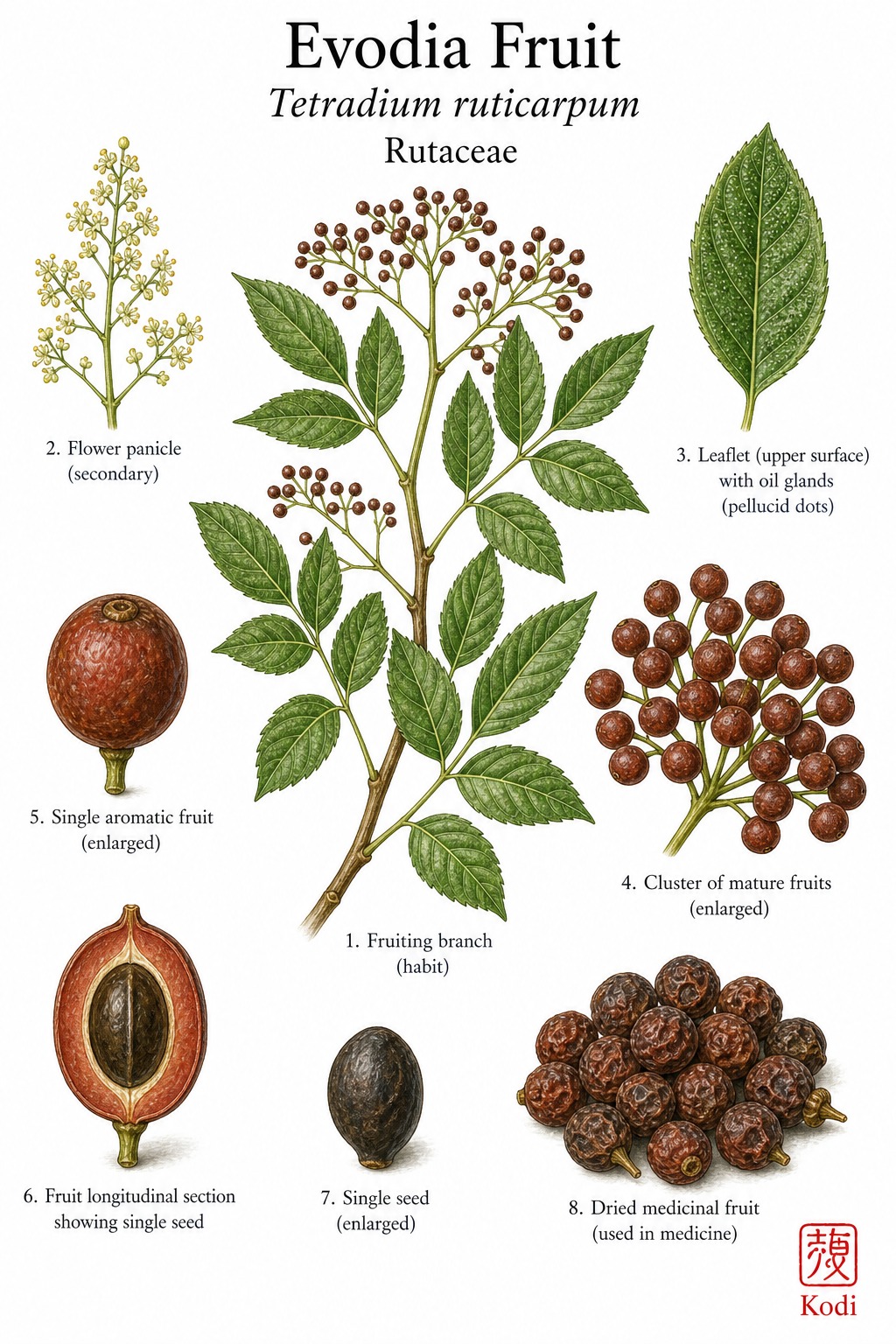
Known in TCM as Wu Yu (吴茱萸), this bitter and pungent, hot herb enters the Liver, Spleen, Stomach, and Kidney. Traditionally, it warms the middle and stops vomiting - Wu Yu is used for nausea, retching, cold-type epigastric pain, and rebellious Stomach qi when cold is the core problem, most often applied for nausea, abdominal pain, and acid reflux. Modern research has identified Evodiamine among its active constituents.
Part used: Fruit
Also Known As
Latin: Fructus Evodiae | Pinyin: Wu Yu | Chinese: 吴茱萸
TCM Properties
- Taste
- bitter, pungent
- Temperature
- hot
- Channels
- Liver, Spleen, Stomach, Kidney
Traditional Use
Primary Actions
- Warms the middle and stops vomiting - Wu Yu is used for nausea, retching, cold-type epigastric pain, and rebellious Stomach qi when cold is the core problem.
- Disperses Liver cold and alleviates pain - it is a classic herb for vertex headache, hernial pain, cold abdominal pain, and menstrual pain rooted in cold stagnation.
- Directs rebellious qi downward - formulas use it for acid regurgitation, sour swallowing, and cold-constrained Liver-Stomach disharmony.
- Warms the Spleen and Kidney and stops dawn diarrhea - it appears when deficiency cold causes early-morning loose stool with cramping and exhaustion.
Secondary Actions
- This record keeps the shorter import alias Wu Yu, but the standard pharmacopoeial herb identity is Wu Zhu Yu, the well-known hot fruit of Tetradium ruticarpum and related species.
- Because it is strongly warming and drying, successful use depends heavily on correct cold-pattern identification rather than casual use for any nausea or headache.
Classic Formulas
- Wu Zhu Yu Tang - classic formula for cold-deficiency headache, vomiting, and epigastric discomfort with rebellious qi.
- Zuo Jin Wan - famous Liver-Stomach formula pairing Huang Lian with a small dose of Wu Zhu Yu for acid regurgitation and heat-cold complexity.
- Si Shen Wan - dawn-diarrhea formula using Wu Zhu Yu to warm the middle and help secure chronic leakage.
Classical References
- Me and Qi describes Wu Zhu Yu as a hot, bitter-pungent herb entering the Liver, Spleen, Stomach, and Kidney to stop vomiting, warm the interior, and relieve cold pain.
- Traditional materia medica consistently warns that its powerful hot nature makes it inappropriate for heat patterns, yin deficiency, or reckless self-use.
Modern Research
Active Compounds
- Evodiamine - one of the best-known quinazolinocarboline alkaloids in Evodia research
- Rutaecarpine - major alkaloid discussed in vascular, inflammatory, and gastrointestinal studies
- Dehydroevodiamine - a related alkaloid often included in mechanistic research
- Limonin and related bitter constituents - broader compounds contributing to fruit chemistry
Studied Effects
- A 2023 review focused on the major indole alkaloids of Evodia rutaecarpa and their potential relevance to gastrointestinal disease research, reflecting the herb's long traditional digestive focus (PMID 37741256).
- A 2011 review summarized anti-inflammatory and anti-infectious effects of Wu Zhu Yu and its major constituents, helping explain modern interest in the herb's bioactive alkaloids (PMID 21320305).
- A 2021 study reported that rutaecarpine ameliorated pressure-overload cardiac hypertrophy in an experimental model, illustrating the expanding pharmacology literature beyond classical digestive indications (PMID 33510809).
PubMed References
- Major Indole Alkaloids in Evodia Rutaecarpa: The Latest Insights and Review of Their Impact on Gastrointestinal Diseases. (2023)
- Anti-inflammatory and anti-infectious effects of Evodia rutaecarpa (Wuzhuyu) and its major bioactive components. (2011)
- Rutaecarpine Ameliorates Pressure Overload Cardiac Hypertrophy by Suppression of Calcineurin and Angiotensin II. (2021)
Safety & Interactions
Contraindications
- Yin deficiency with heat, blazing fire, or hot painful disorders
- Pregnancy
- Vomiting or acid regurgitation from Stomach heat rather than interior cold
Cautions
- Wu Zhu Yu is strongly hot and drying, and excessive dosing can aggravate nausea, mouth irritation, or heat symptoms.
- Alkaloid-rich extracts and supplements are not equivalent to standard processed decoction slices.
- MSK page not found - drug interaction data not available from Memorial Sloan Kettering integrative medicine database
Conditions
- Nausea Traditional ★★★★☆ JSON
- Abdominal Pain Traditional ★★★★☆ JSON
- Acid Reflux Traditional ★★★★☆ JSON
- Headache Traditional ★★★☆☆ JSON
- Diarrhea Traditional ★★★☆☆ JSON
Frequently Asked Questions
What is Evodia Fruit used for?
Evodia Fruit is traditionally used to Warms the middle and stops vomiting - Wu Yu is used for nausea, retching, cold-type epigastric pain, and rebellious Stomach qi when cold is the core problem., Disperses Liver cold and alleviates pain - it is a classic herb for vertex headache, hernial pain, cold abdominal pain, and menstrual pain rooted in cold stagnation., Directs rebellious qi downward - formulas use it for acid regurgitation, sour swallowing, and cold-constrained Liver-Stomach disharmony., Warms the Spleen and Kidney and stops dawn diarrhea - it appears when deficiency cold causes early-morning loose stool with cramping and exhaustion.. Research has investigated its effects on: A 2023 review focused on the major indole alkaloids of Evodia rutaecarpa and their potential relevance to gastrointestinal disease research, reflecting the herb's long traditional digestive focus (PMID 37741256).; A 2011 review summarized anti-inflammatory and anti-infectious effects of Wu Zhu Yu and its major constituents, helping explain modern interest in the herb's bioactive alkaloids (PMID 21320305)..
What are other names for Evodia Fruit?
Evodia Fruit is also known as Evodia. In TCM: 吴茱萸 (Wu Yu); Fructus Evodiae.
Is Evodia Fruit safe during pregnancy?
Evodia Fruit is not recommended during pregnancy.
What are the contraindications for Evodia Fruit?
Evodia Fruit should not be used in: Yin deficiency with heat, blazing fire, or hot painful disorders; Pregnancy; Vomiting or acid regurgitation from Stomach heat rather than interior cold. Consult a qualified healthcare provider before use.