Chinese Wolfberry Fruit
- Chinese
- 枸杞子
- Pinyin
- Gou Qi Zi
- Latin
- Fructus Lycii
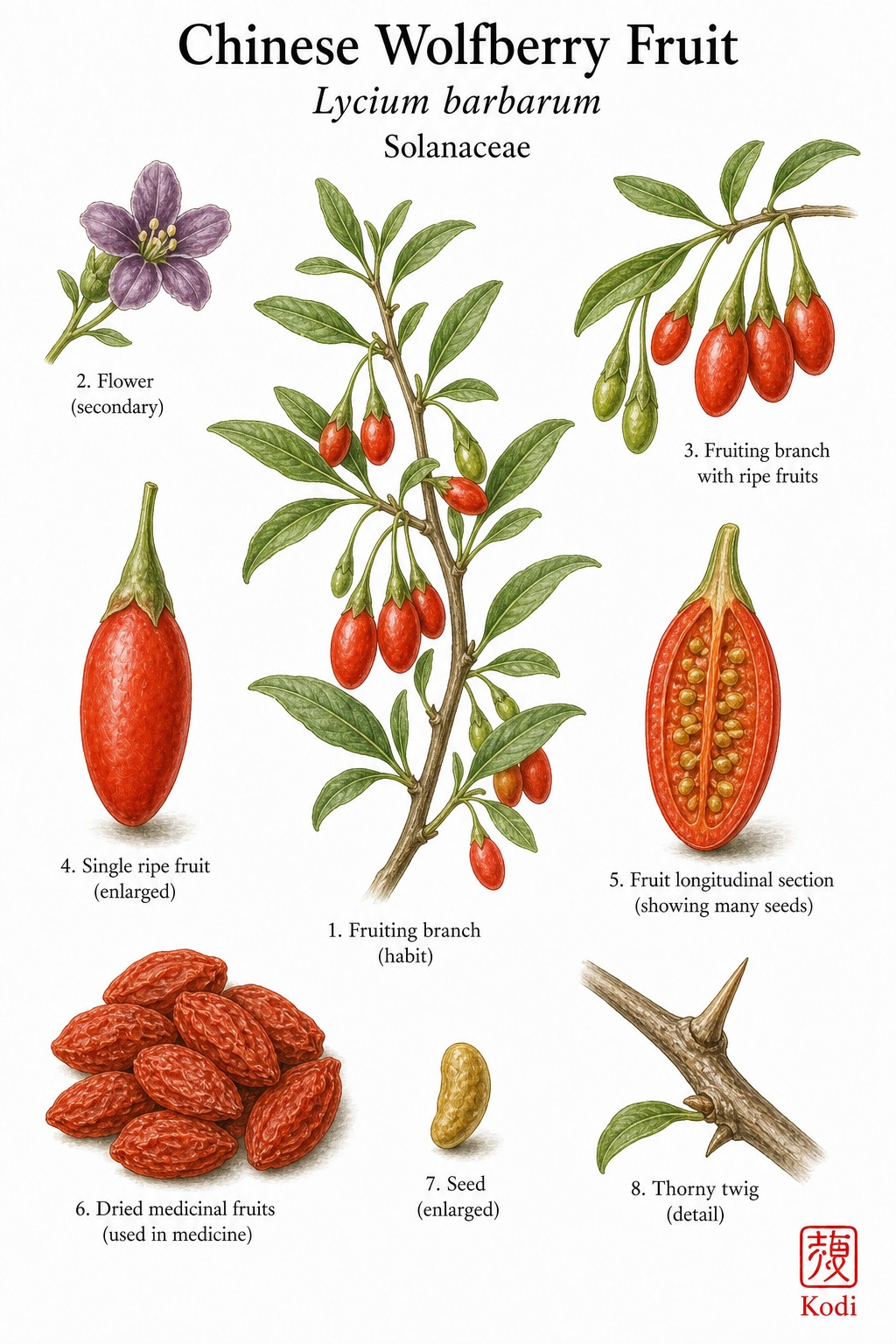
Known in TCM as Gou Qi Zi (枸杞子), this sweet, neutral herb enters the Liver, Kidney, and Lung. Traditionally, it nourishes the Liver and Kidney - Gou Qi Zi is a classic deficiency tonic for sore low back and knees, dizziness, weakness, and gradual depletion of essence and blood, most often applied for blurred vision, kidney deficiency, and dry cough. Modern research has identified Lycium among its active constituents.
Part used: Fruit
Also Known As
Latin: Fructus Lycii | Pinyin: Gou Qi Zi | Chinese: 枸杞子
TCM Properties
- Taste
- sweet
- Temperature
- neutral
- Channels
- Liver, Kidney, Lung
Traditional Use
Primary Actions
- Nourishes the Liver and Kidney - Gou Qi Zi is a classic deficiency tonic for sore low back and knees, dizziness, weakness, and gradual depletion of essence and blood.
- Benefits the eyes - it is widely used for blurred vision, dry eyes, floaters, and age-related visual weakness when Liver blood or Kidney yin are insufficient.
- Nourishes blood and essence - the berry appears in long-course formulas for constitutional weakness, infertility support, and recovery from chronic illness.
- Moistens the Lung - it is often chosen for dry cough with scanty sputum when dryness and underlying yin deficiency coexist.
Secondary Actions
- Gou Qi Zi is one of the clearest food-medicine bridge herbs in Chinese practice, making it common in soups, porridges, teas, and tonic formulas rather than only in heavy medicinal prescriptions.
- Its action is gentler and less cloying than richer essence tonics, so it is frequently used for longer restorative courses or combined with stronger Kidney and blood tonics.
Classic Formulas
- Qi Ju Di Huang Wan - classic eye-support formula pairing Gou Qi Zi with Ju Hua on a Liu Wei Di Huang Wan base for Liver-Kidney deficiency affecting vision.
- Wu Zi Yan Zong Wan - reproductive and essence-tonic formula in which Gou Qi Zi helps nourish Kidney essence and support fertility.
- Zuo Gui Wan and related yin-essence formulas use Gou Qi Zi to deepen Liver-Kidney nourishment without overcooling the patient.
Classical References
- Materia medica tradition consistently describes Gou Qi Zi as sweet and neutral, entering the Liver and Kidney to nourish essence, enrich blood, and benefit the eyes.
- Me and Qi and related teaching references also emphasize its useful Lung-moistening role when dry cough appears together with chronic deficiency.
Modern Research
Active Compounds
- Lycium barbarum polysaccharides - the best-known immunologic and metabolic research fraction in goji berry
- Zeaxanthin dipalmitate - hallmark carotenoid linked to modern macular and eye-health interest
- Betaine - a notable osmoprotective and metabolic constituent
- Flavonoids and phenolic acids - broader antioxidant compounds contributing to the berry's functional-food profile
Studied Effects
- A 2025 comprehensive review summarized goji berry chemistry, bioactive compounds, health-promoting activities, and functional-food applications, highlighting strong preclinical but still developing clinical evidence (PMID 41092619).
- A 2023 review focused on nutrition, phytochemical structure, biological features, and food-industry prospects, reinforcing Gou Qi Zi's position as a food-herb bridge rather than a narrowly pharmaceutical agent (PMID 35593666).
- A 2022 review examined Lycium barbarum polysaccharides in relation to immunity, metabolic syndrome, and gut-microbiota modulation, showing why the berry remains prominent in metabolic-health research (PMID 37430929).
PubMed References
- Lycium barbarum (goji berry): A comprehensive review of chemical composition, bioactive compounds, health-promoting activities, and applications in functional foods and beyond. (2025)
- Lycium barbarum (Goji) as functional food: a review of its nutrition, phytochemical structure, biological features, and food industry prospects. (2023)
- Effects of Lycium barbarum Polysaccharides on Immunity and Metabolic Syndrome Associated with the Modulation of Gut Microbiota: A Review. (2022)
Safety & Interactions
Contraindications
- Loose stools or marked digestive weakness from Spleen deficiency
- Acute exterior excess patterns when rich tonics are not yet appropriate
Cautions
- MSK reports a case of bleeding with elevated INR after goji berry wine was used alongside warfarin.
- Allergic reactions have been reported, especially in people with food or pollen allergies and possible lipid-transfer-protein cross-reactivity.
- Concentrated powders, juices, and extracts should not be assumed equivalent to ordinary culinary or decoction use.
Drug Interactions
- Warfarin - case reports describe elevated INR and bleeding risk with concurrent use
Conditions
- Blurred Vision Traditional ★★★★☆ JSON
- Kidney Deficiency Traditional ★★★★☆ JSON
- Dry Cough Traditional ★★★☆☆ JSON
- Blood Deficiency Traditional ★★★☆☆ JSON
- Dizziness Traditional ★★★☆☆ JSON
Frequently Asked Questions
What is Chinese Wolfberry Fruit used for?
Chinese Wolfberry Fruit is traditionally used to Nourishes the Liver and Kidney - Gou Qi Zi is a classic deficiency tonic for sore low back and knees, dizziness, weakness, and gradual depletion of essence and blood., Benefits the eyes - it is widely used for blurred vision, dry eyes, floaters, and age-related visual weakness when Liver blood or Kidney yin are insufficient., Nourishes blood and essence - the berry appears in long-course formulas for constitutional weakness, infertility support, and recovery from chronic illness., Moistens the Lung - it is often chosen for dry cough with scanty sputum when dryness and underlying yin deficiency coexist.. Research has investigated its effects on: A 2025 comprehensive review summarized goji berry chemistry, bioactive compounds, health-promoting activities, and functional-food applications, highlighting strong preclinical but still developing clinical evidence (PMID 41092619).; A 2023 review focused on nutrition, phytochemical structure, biological features, and food-industry prospects, reinforcing Gou Qi Zi's position as a food-herb bridge rather than a narrowly pharmaceutical agent (PMID 35593666)..
What are other names for Chinese Wolfberry Fruit?
Chinese Wolfberry Fruit is also known as Lycium. In TCM: 枸杞子 (Gou Qi Zi); Fructus Lycii.
Is Chinese Wolfberry Fruit safe during pregnancy?
The safety of Chinese Wolfberry Fruit during pregnancy has not been established. Consult a qualified healthcare provider before use.
What are the contraindications for Chinese Wolfberry Fruit?
Chinese Wolfberry Fruit should not be used in: Loose stools or marked digestive weakness from Spleen deficiency; Acute exterior excess patterns when rich tonics are not yet appropriate. Consult a qualified healthcare provider before use.
Does Chinese Wolfberry Fruit interact with any medications?
Chinese Wolfberry Fruit may interact with: Warfarin - case reports describe elevated INR and bleeding risk with concurrent use. Always inform your healthcare provider of any herbal supplements you are taking.