Northern Schisandra Fruit
- Chinese
- 北五味子
- Pinyin
- Bei Wu Wei
- Latin
- Fructus Schisandrae
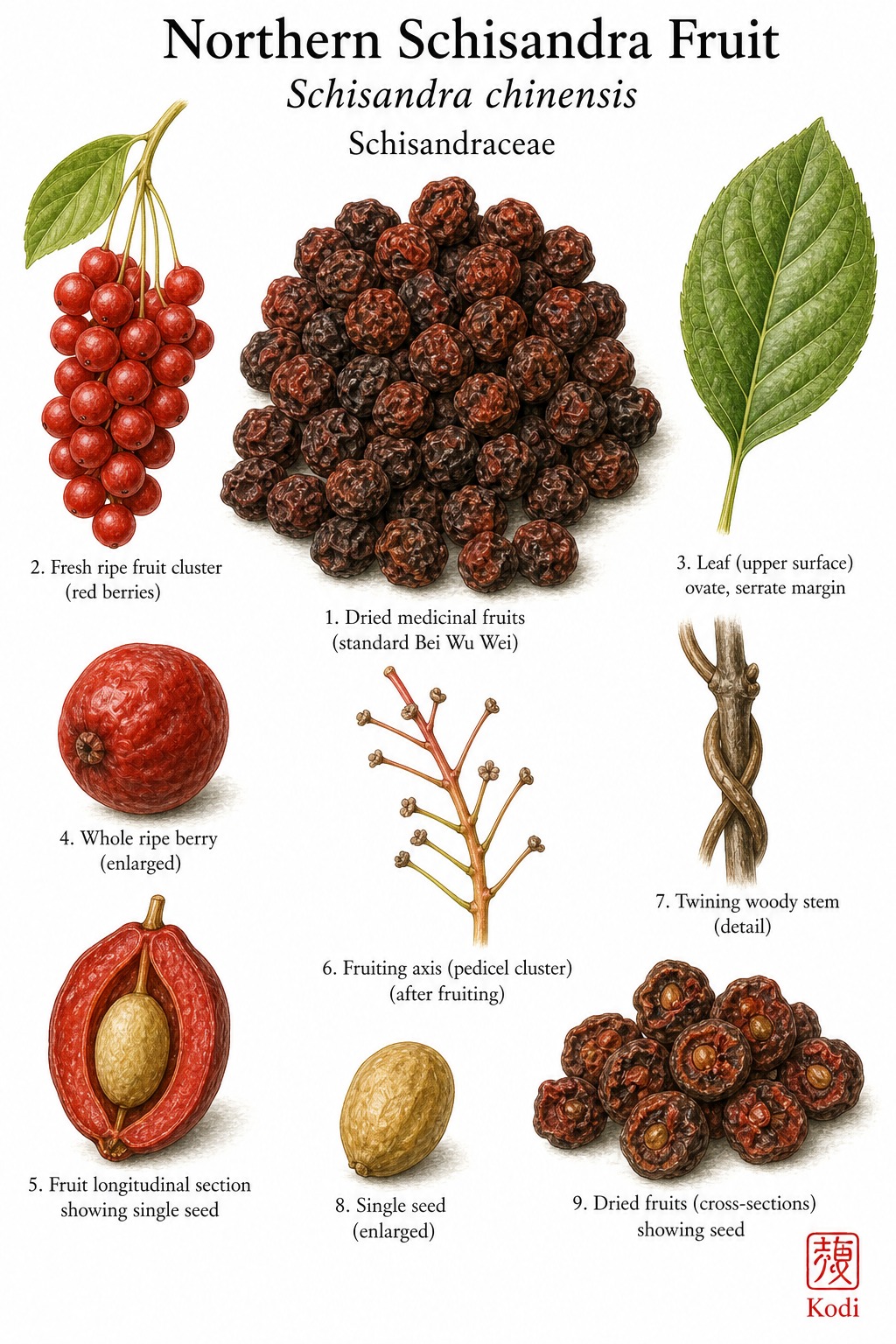
Known in TCM as Bei Wu Wei (北五味子), this sour and sweet and bitter and pungent and salty, warm herb enters the Lung, Heart, and Kidney. Traditionally, it restrains the Lung and stops chronic cough or wheezing - Bei Wu Wei Zi is used when leakage of Lung qi causes prolonged cough, wheezing, or weak grasp of breath, most often applied for cough, wheezing, and spontaneous sweating. Modern research has identified Schisandrin among its active constituents.
Part used: Fruit
Also Known As
Latin: Fructus Schisandrae | Pinyin: Bei Wu Wei | Chinese: 北五味子
TCM Properties
- Taste
- sour, sweet, bitter, pungent, salty
- Temperature
- warm
- Channels
- Lung, Heart, Kidney
Traditional Use
Primary Actions
- Restrains the Lung and stops chronic cough or wheezing - Bei Wu Wei Zi is used when leakage of Lung qi causes prolonged cough, wheezing, or weak grasp of breath.
- Generates fluids and checks leakage - it is used for spontaneous sweating, night sweats, thirst, dry mouth, and fluid loss after chronic illness or summer-heat damage.
- Binds the intestines and secures essence - chronic diarrhea and essence leakage patterns are classic indications when deficiency underlies leakage.
- Calms the Heart and tonifies the Kidney - it also appears in formulas for palpitations, insomnia, and Heart-Kidney disharmony.
Secondary Actions
- This record specifically refers to the northern species Schisandra chinensis, the preferred tonic-standard medicinal berry in the pharmacopoeial distinction between northern and southern Wu Wei Zi.
- Northern and southern Schisandra are related but not chemically identical, and the northern species is typically favored for richer lignan content and tonic use.
Classic Formulas
- Sheng Mai San - classic three-herb formula using Bei Wu Wei Zi to restrain leakage of qi and fluids while supporting the Heart and Lung.
- Xiao Qing Long Tang - uses Wu Wei Zi to prevent over-dispersion while cough, wheezing, and cold-phlegm are treated.
- Si Shen Wan and similar deficiency-leakage lineages use Wu Wei Zi to bind the intestines and secure chronic diarrhea.
Classical References
- Traditional Fructus Schisandrae materia medica notes that Schisandra chinensis is the northern source, Bei Wu Wei Zi, and is preferred over the southern species for standard medicinal use.
- Classical descriptions emphasize the five flavors, warm nature, and entry into the Lung, Heart, and Kidney to astringe, generate fluids, calm the spirit, and secure essence.
Modern Research
Active Compounds
- Schisandrin - one of the hallmark lignans of Schisandra chinensis
- Schisandrol A - major lignan associated with neuroprotective and hepatoprotective research
- Gomisin C and gomisin G - interaction-relevant lignans with CYP and transporter significance
- Schisantherin A - anti-inflammatory lignan frequently discussed in Schisandra pharmacology
Studied Effects
- A 2019 review summarized the health and nutrition potential of Schisandra chinensis, including antioxidant, hepatoprotective, and adaptogenic research directions (PMID 30720717).
- A 2024 review focused on schisandrin and described sedative, antioxidant, immunomodulatory, and liver-related pharmacologic features while noting bioavailability limitations (PMID 37658213).
- A review of Schisandra fructus and its active ingredients highlighted promising neurological-disease applications in preclinical research (PMID 29986408).
PubMed References
- Potential of Schisandra chinensis (Turcz.) Baill. in Human Health and Nutrition: A Review of Current Knowledge and Therapeutic Perspectives. (2019)
- A comprehensive review on Schisandrin and its pharmacological features. (2024)
- Schisandra chinensis Fructus and Its Active Ingredients as Promising Resources for the Treatment of Neurological Diseases. (2018)
Safety & Interactions
Contraindications
- Active exterior pathogen when venting is still required
- Acute excess Lung heat or acute damp-heat diarrhea
- Marked phlegm-fluid retention that should be dispersed rather than constrained
Cautions
- MSK notes that Schisandra may alter metabolism or transport of some drugs through CYP1A2, CYP3A4, CYP3A5, and P-glycoprotein effects.
- Northern and southern Schisandra are not fully interchangeable because their lignan profiles differ.
- Schisandra can reduce certain liver-enzyme lab values, which matters when interpreting follow-up testing.
Drug Interactions
- CYP1A2, CYP3A4, and CYP3A5 substrates - lignans may inhibit or otherwise alter metabolism of susceptible drugs
- P-glycoprotein substrates - Schisandra may affect transport and increase side-effect risk
- Tacrolimus - coadministration can raise tacrolimus exposure
Conditions
Frequently Asked Questions
What is Northern Schisandra Fruit used for?
Northern Schisandra Fruit is traditionally used to Restrains the Lung and stops chronic cough or wheezing - Bei Wu Wei Zi is used when leakage of Lung qi causes prolonged cough, wheezing, or weak grasp of breath., Generates fluids and checks leakage - it is used for spontaneous sweating, night sweats, thirst, dry mouth, and fluid loss after chronic illness or summer-heat damage., Binds the intestines and secures essence - chronic diarrhea and essence leakage patterns are classic indications when deficiency underlies leakage., Calms the Heart and tonifies the Kidney - it also appears in formulas for palpitations, insomnia, and Heart-Kidney disharmony.. Research has investigated its effects on: A 2019 review summarized the health and nutrition potential of Schisandra chinensis, including antioxidant, hepatoprotective, and adaptogenic research directions (PMID 30720717).; A 2024 review focused on schisandrin and described sedative, antioxidant, immunomodulatory, and liver-related pharmacologic features while noting bioavailability limitations (PMID 37658213)..
What are other names for Northern Schisandra Fruit?
Northern Schisandra Fruit is also known as Schisandra. In TCM: 北五味子 (Bei Wu Wei); Fructus Schisandrae.
Is Northern Schisandra Fruit safe during pregnancy?
The safety of Northern Schisandra Fruit during pregnancy has not been established. Consult a qualified healthcare provider before use.
What are the contraindications for Northern Schisandra Fruit?
Northern Schisandra Fruit should not be used in: Active exterior pathogen when venting is still required; Acute excess Lung heat or acute damp-heat diarrhea; Marked phlegm-fluid retention that should be dispersed rather than constrained. Consult a qualified healthcare provider before use.
Does Northern Schisandra Fruit interact with any medications?
Northern Schisandra Fruit may interact with: CYP1A2, CYP3A4, and CYP3A5 substrates - lignans may inhibit or otherwise alter metabolism of susceptible drugs; P-glycoprotein substrates - Schisandra may affect transport and increase side-effect risk; Tacrolimus - coadministration can raise tacrolimus exposure. Always inform your healthcare provider of any herbal supplements you are taking.