Cherokee Rose Fruit
- Chinese
- 金樱子
- Pinyin
- Jin Ying Zi
- Latin
- Fructus Rosae Laevigatae
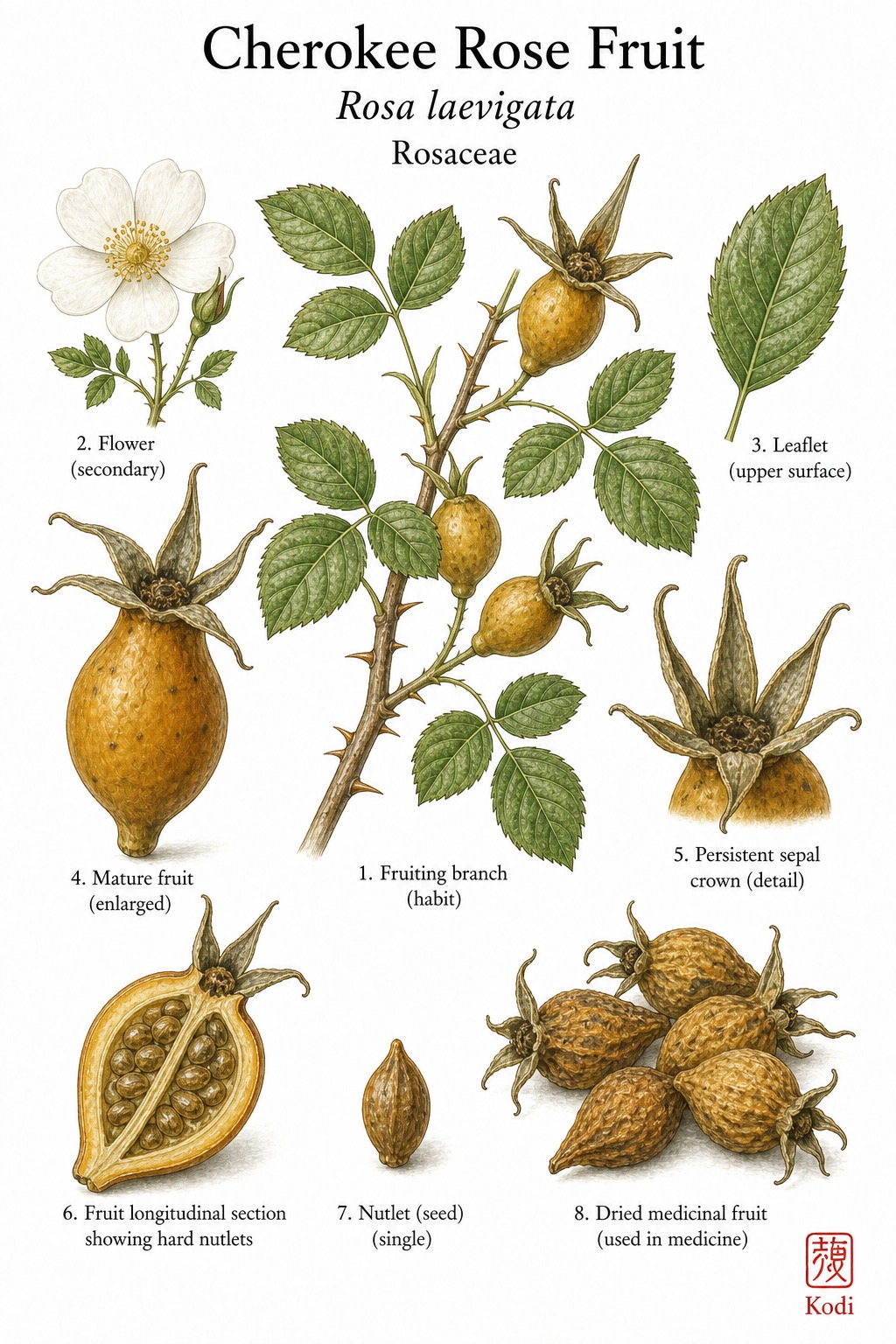
Known in TCM as Jin Ying Zi (金樱子), this sour and astringent, neutral herb enters the Kidney, Bladder, and Large Intestine. Traditionally, it secures essence and reduces urinary leakage - Jin Ying Zi is used for spermatorrhea, frequent urination, incontinence, and other deficiency-type leakage disorders, most often applied for frequent urination, leucorrhea, and diarrhea. Modern research has identified Polysaccharides among its active constituents.
Part used: Fruit
Also Known As
Latin: Fructus Rosae Laevigatae | Pinyin: Jin Ying Zi | Chinese: 金樱子
TCM Properties
- Taste
- sour, astringent
- Temperature
- neutral
- Channels
- Kidney, Bladder, Large Intestine
Traditional Use
Primary Actions
- Secures essence and reduces urinary leakage - Jin Ying Zi is used for spermatorrhea, frequent urination, incontinence, and other deficiency-type leakage disorders.
- Stops leukorrhea - it is a classic astringent fruit for chronic vaginal discharge when Kidney deficiency fails to contain fluids.
- Astrings the intestines and checks chronic diarrhea - traditional use fits long-standing loose stool from deficiency rather than acute infectious diarrhea.
Secondary Actions
- Jin Ying Zi is best for chronic leakage from deficiency and is not the right choice when unresolved damp-heat or pathogen needs to be cleared first.
- It is often paired with other securing herbs such as Qian Shi, Shan Zhu Yu, or Lian Xu rather than used as a stand-alone binder.
Classic Formulas
- Essence-securing pairings with Qian Shi and Lian Xu - traditional lineages use Jin Ying Zi for spermatorrhea, urinary frequency, and leukorrhea.
- Chronic diarrhea lineages pair Jin Ying Zi with He Zi, Rou Dou Kou, or Shan Yao when deficiency leakage affects the intestines.
Classical References
- TCM materia medica sources describe Jin Ying Zi as sour, astringent, and neutral, entering the Kidney, Bladder, and Large Intestine to secure essence, stop discharge, and astringe the intestines.
- Lei Gong Pao Zhi Lun is cited as an early textual source for the medicinal fruit.
Modern Research
Active Compounds
- Polysaccharides - major fruit constituents under active immunologic and metabolic study
- Triterpenoid acids - one of the core bioactive fractions in Rosa laevigata fruit research
- Polyphenols and flavonoids - antioxidant constituents contributing to broader functional-food interest
- Vitamin C and organic acids - nutritive compounds often highlighted in food-science reviews
Studied Effects
- A 2022 comprehensive review summarized physicochemical and biological properties of Rosa laevigata fruit, including antioxidant and functional-food relevance (PMID 34339923).
- A 2021 study found a neutral polysaccharide from Rosa laevigata fruits showed immunomodulatory and antitumor activity in cell and zebrafish models (PMID 33966844).
- A 2024 study reported in vitro anti-inflammatory activity of polysaccharides isolated from the fruits of Rosa laevigata, supporting ongoing interest in the fruit's macromolecular fractions (PMID 38396810).
PubMed References
- Physicochemical, biological properties, and flavour profile of Rosa roxburghii Tratt, Pyracantha fortuneana, and Rosa laevigata Michx fruits: A comprehensive review. (2022)
- Structural analysis and biological effects of a neutral polysaccharide from the fruits of Rosa laevigata. (2021)
- Structural Characterization and In Vitro Anti-Inflammatory Activity of Polysaccharides Isolated from the Fruits of Rosa laevigata. (2024)
Safety & Interactions
Contraindications
- Acute damp-heat dysentery or acute excess leakage that still requires clearing rather than binding
Cautions
- Because Jin Ying Zi is strongly astringent, it can trap pathogens if used too early in unresolved infectious or inflammatory conditions.
- The fruit is better suited to chronic deficiency leakage than to short-term symptomatic suppression.
- MSK page not found - drug interaction data not available from Memorial Sloan Kettering integrative medicine database
Conditions
- Frequent Urination Traditional ★★★★☆ JSON
- Leucorrhea Traditional ★★★★☆ JSON
- Diarrhea Traditional ★★★☆☆ JSON
- Impotence Traditional ★★☆☆☆ JSON
Frequently Asked Questions
What is Cherokee Rose Fruit used for?
Cherokee Rose Fruit is traditionally used to Secures essence and reduces urinary leakage - Jin Ying Zi is used for spermatorrhea, frequent urination, incontinence, and other deficiency-type leakage disorders., Stops leukorrhea - it is a classic astringent fruit for chronic vaginal discharge when Kidney deficiency fails to contain fluids., Astrings the intestines and checks chronic diarrhea - traditional use fits long-standing loose stool from deficiency rather than acute infectious diarrhea.. Research has investigated its effects on: A 2022 comprehensive review summarized physicochemical and biological properties of Rosa laevigata fruit, including antioxidant and functional-food relevance (PMID 34339923).; A 2021 study found a neutral polysaccharide from Rosa laevigata fruits showed immunomodulatory and antitumor activity in cell and zebrafish models (PMID 33966844)..
What are other names for Cherokee Rose Fruit?
Cherokee Rose Fruit is also known as Rosa. In TCM: 金樱子 (Jin Ying Zi); Fructus Rosae Laevigatae.
Is Cherokee Rose Fruit safe during pregnancy?
The safety of Cherokee Rose Fruit during pregnancy has not been established. Consult a qualified healthcare provider before use.
What are the contraindications for Cherokee Rose Fruit?
Cherokee Rose Fruit should not be used in: Acute damp-heat dysentery or acute excess leakage that still requires clearing rather than binding. Consult a qualified healthcare provider before use.