Raw Gardenia Fruit
- Chinese
- 生山栀
- Pinyin
- Sheng Shan Zhi
- Latin
- Fructus Gardeniae
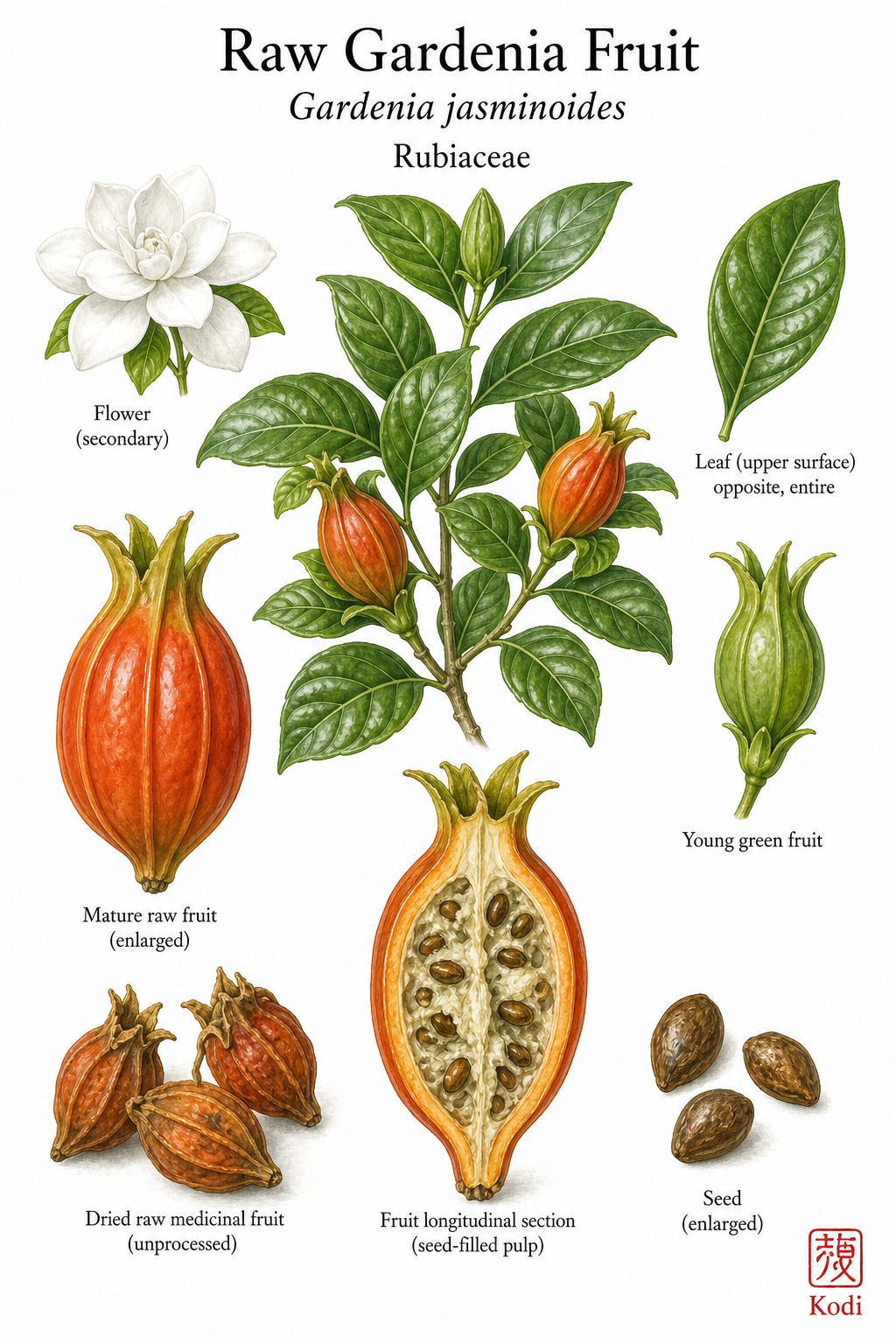
Known in TCM as Sheng Shan Zhi (生山栀), this bitter, cold herb enters the Heart, Liver, Stomach, and Lung. Traditionally, it drains fire and eliminates irritability - the raw form is used for febrile restlessness, agitation, chest constraint, and heat disturbing the Heart, most often applied for fever, jaundice, and urinary tract infection. Modern research has identified Geniposide among its active constituents.
Part used: Fruit
Also Known As
Latin: Fructus Gardeniae | Pinyin: Sheng Shan Zhi | Chinese: 生山栀
TCM Properties
- Taste
- bitter
- Temperature
- cold
- Channels
- Heart, Liver, Stomach, Lung
Traditional Use
Primary Actions
- Drains fire and eliminates irritability - the raw form is used for febrile restlessness, agitation, chest constraint, and heat disturbing the Heart.
- Clears damp-heat - traditional indications include jaundice, dark painful urination, and heat lodged in the Liver-Gallbladder or lower burner.
- Cools blood and stops bleeding - raw Gardenia fruit is used when heat drives bleeding such as epistaxis, hematuria, or blood-heat rash.
- Reduces swelling and trauma heat externally - poultice use extends to sprains, bruises, and hot painful swelling.
Secondary Actions
- Sheng Shan Zhi refers to the raw, uncharred Gardenia fruit form, in contrast with Jiao Shan Zhi, which is processed more specifically for bleeding applications.
- The raw form is colder and more strongly fire-draining than charred preparations.
Classic Formulas
- Zhi Zi Chi Tang - classic heat-constrained irritability formula using raw Gardenia fruit with Dan Dou Chi.
- Yin Chen Hao Tang - damp-heat jaundice formula in which Gardenia fruit helps clear heat through the urine.
- Huang Lian Jie Du Tang - intense fire-toxin formula using Zhi Zi to drain heat from multiple burners.
Classical References
- Traditional materia medica sources describe Shan Zhi and Zhi Zi as bitter and cold, entering the Heart, Liver, Stomach, and Lung to purge fire, cool blood, and clear damp-heat.
- Processing notes distinguish the raw form from stir-baked or charred forms, with the raw fruit carrying the strongest fire-draining action.
Modern Research
Active Compounds
- Geniposide - the signature iridoid glycoside of Gardenia fruit
- Gardenoside and related iridoids - important quality-control and pharmacology-linked constituents
- Crocins and gardenia pigments - carotenoid-derived compounds relevant to color and antioxidant research
- Polysaccharides and flavonoids - broader fractions discussed in food-medicine reviews
Studied Effects
- A 2025 critical review summarized Gardenia fruit nutrients, phytochemicals, processing methods, and health-promoting effects, highlighting anti-inflammatory, antioxidant, and broader functional-food interest (PMID 37882781).
- A 2017 chemistry and bioactivity review detailed iridoids, carotenoids, and other constituents while summarizing anti-inflammatory, hepatoprotective, and neuroactive research directions (PMID 28911543).
- Modern work on Gardenia polysaccharides continues to expand, but most evidence remains preclinical and should not be confused with validated disease treatment in humans (PMID 40582668).
PubMed References
- Gardenia (Gardenia jasminoides Ellis) fruit: a critical review of its functional nutrients, processing methods, health-promoting effects, comprehensive application and future tendencies. (2025)
- Chemistry and bioactivity of Gardenia jasminoides. (2017)
- Preparation technologies, structural characteristics, pharmacological activities and applications of Gardenia jasminoides Ellis polysaccharides: A review. (2025)
Safety & Interactions
Contraindications
- Loose stool or weak digestion without true heat
- Cold deficiency patterns that would be worsened by a bitter-cold fruit
Cautions
- Raw Gardenia fruit is colder and more draining than charred forms, so processing identity matters clinically.
- Strong use can aggravate abdominal discomfort or diarrhea in patients with weak middle-burner function.
- MSK page not found - drug interaction data not available from Memorial Sloan Kettering integrative medicine database
Conditions
Frequently Asked Questions
What is Raw Gardenia Fruit used for?
Raw Gardenia Fruit is traditionally used to Drains fire and eliminates irritability - the raw form is used for febrile restlessness, agitation, chest constraint, and heat disturbing the Heart., Clears damp-heat - traditional indications include jaundice, dark painful urination, and heat lodged in the Liver-Gallbladder or lower burner., Cools blood and stops bleeding - raw Gardenia fruit is used when heat drives bleeding such as epistaxis, hematuria, or blood-heat rash., Reduces swelling and trauma heat externally - poultice use extends to sprains, bruises, and hot painful swelling.. Research has investigated its effects on: A 2025 critical review summarized Gardenia fruit nutrients, phytochemicals, processing methods, and health-promoting effects, highlighting anti-inflammatory, antioxidant, and broader functional-food interest (PMID 37882781).; A 2017 chemistry and bioactivity review detailed iridoids, carotenoids, and other constituents while summarizing anti-inflammatory, hepatoprotective, and neuroactive research directions (PMID 28911543)..
What are other names for Raw Gardenia Fruit?
Raw Gardenia Fruit is also known as Gardenia. In TCM: 生山栀 (Sheng Shan Zhi); Fructus Gardeniae.
Is Raw Gardenia Fruit safe during pregnancy?
The safety of Raw Gardenia Fruit during pregnancy has not been established. Consult a qualified healthcare provider before use.
What are the contraindications for Raw Gardenia Fruit?
Raw Gardenia Fruit should not be used in: Loose stool or weak digestion without true heat; Cold deficiency patterns that would be worsened by a bitter-cold fruit. Consult a qualified healthcare provider before use.